GENOMICONrss

rss

The Crowd-Sourcing of Intelligent-Design

energy

Ecotricity’s wind-powered sports car

A while back I went on about Jeremy Clarkson’s review of a Tesla… which he was generally impressed with, but took fright at the price.

It appears that The Ecotricity guy has built one… and the development costs have been less than the cost of a single unit of the Telsa.


It is faster out of the blocks than a V12 Ferrari and can do 0-60mph in four seconds. It will go faster than 140mph and can be fully charged over lunch. But the most remarkable thing about the first British electric supercar is that it is not being built by one of the world’s great car companies with a limitless research budget, but has been knocked up in a few months by some middle-aged engineers in a Norfolk garage from off-the-shelf parts mostly available on the web – Guardian

To be fair, they’ve borrowed a fair bit of development costs by basically nicking the design of a Lotus Exige… still, an electric car that doesn’t look like a tea-pot.

I think we’re going to be seeing more of this sort of thing… largish companies that belong in the 21st century rather than the 20th setting up innovation labs where groups of very smart people are allowed to “play”.

Stirling Sunflowers : Solar Electric Things

If you go to any high place on the planet that isn’t a desert of some sort, and look out at the view, chances are you’ll see a lot of green… still. As far as the eye can see, it will be mostly green.

That green is a million billion illion willion squillion leaves, and each one is almost certainly a little flat thing that’s been specially evolved and angled to aim at the sun, and quite a lot of them follow the sun across the sky. This is not an accident, and it’s not Mother Nature trying to tell us something… although…

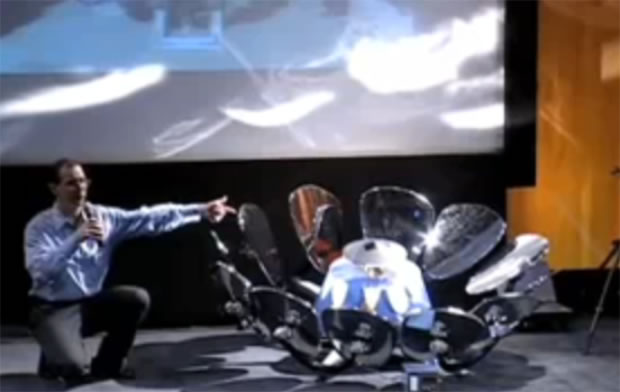
This turned up on the TED rss a couple of days ago:

It’s Bill Gross going on about a couple of things for which I have a tangential fascination – genetic algorithms and Stirling Engines … and solar energy obviously. Everyone loves solar energy. Except amature nuke shill morons who are probably suffering from some sort of authority-worship/obedience complex. I blame the parents.

Unfortunately it’s from 2003, and the only things I can find that point to which direction this thing went in, are boring looking arrays of mirrors and fresnel lenses… though I daresay they’re still better than I could do. They’ve gone for the money. They’ve gone for centralisation.

Still, if it works…

I do like the initial design though – and the philosophy… something decentralised and cheap enough for anyone.

Other than that of course… this thing just looks… right.

sunflower

It is it’s own built in marketing. Sometimes something just looks so cool, you’ve got to get one whether it works 100% or not.

The Wifiification of Everything

That’s what I want. Everything wifiified.

I want gadgets that can sit on my network when my laptop is away, keeping an eye on things.

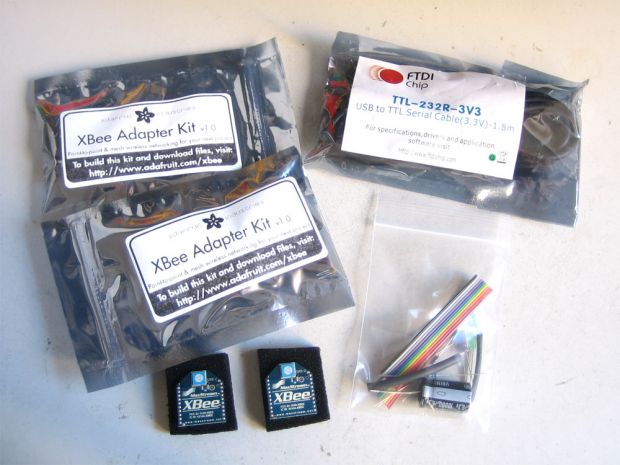
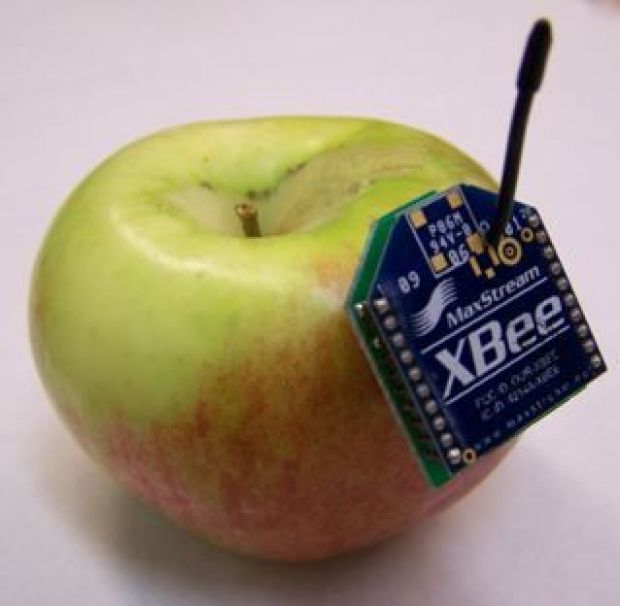
For a while I’ve been tinkering (in my mind, always in my mind) with Arduino-hooked-up XBees… these:

xbee
(from www.faludi.com)

Which are as cheap as chips (expensive chips) and LadyAda goes on about them in tutorials etc over here.

Trouble is though (if I’ve got this right) they only talk to each other, so setting one up as a network device involves some other bit of kit that I don’t know about – which is probably dead simple, but I still don’t know about it.

Then I saw these…

eyefi (from Eye-Fi)

Which are appear to be about $100 – which is way too expensive, but which appear to be smaller… and which maybe behave as a network device… so it’s closer.

Why? Don’t know. But if everything is going to have a computer in it, then it needs to talk to something… and it can’t be my laptop, because it isn’t there 1/2 the time… for example, it would be quite cool to have one of these little cards in every single wall-point / light fitting to micro-manage electricity usage. Seriously – it would be so much easier to manage your myriad stand-bys, chargers, thermostats etc etc off from a single piece of web-enabled software than by going around trying to do it by hand.

In addition to that, if it was a bit of web-enabled software, then there are probably all sorts of crowd-sourcing ramifications etc. I’m sure that simply by knowing where the electricity is going, would go a long way towards stopping it going there.

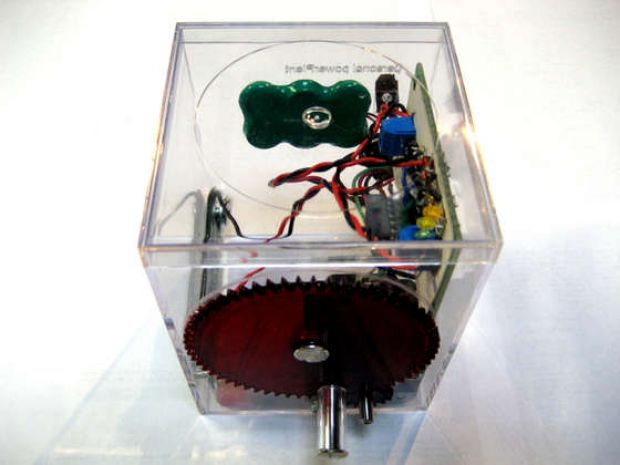
Personal Power Plant

I think this is a really neat idea:

powersupply1

from instructables.com

It’s a little power supply with rechargeable batteries, a solar panel, and a crank-handle for recharging.

I think I’ll have a go at making that – although I’ve had a bit of a tinker with solar cells recently, and they’re distressingly weak. I think there’s a lot more mileage to be gained from making devices more efficient than making solar cells more powerful. It always bugs me when people point to charts of our energy usage and make claims about “what we will need tomorrow”. We should just fucking use less. It’s not that hard. I think a major part of the problem is that people simply have no idea at any given time how much they’re using… or any way of putting that knowledge into context even if they did know. Which they don’t.

That’s why I think Graphical energy monitors are such a good idea, they’re just way too expensive at the moment. They should be free. They should be compulsory – I mean according to the centameter lot they knock a 1/4 off your power bill. What would that do to the doom-sayer’s graphs? It would fuck them up, that’s what. They’d have to get proper jobs.

Anyway, back to the Personal Power Plant thing, I think the way to go with this thing is make it a sort of open-source plug-in platform… so if you want you can plug a windmill into it, or some sort of thermo-thing… because although it may be snowing everywhere else in the world right now, where I am it’s so hot that the tar is melting out of the roads and flowing down the gutters. There’s a hell of a lot of energy blowing about the place for free all the time. We just aren’t bothering to collect it.

DIY Algae Farm

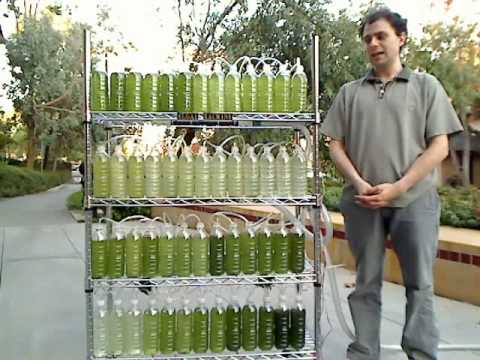
This is the future:


from

Absolutely – I know this beyond a shadow of a doubt because I myself have laid awake at night trying to figure out how to turn empty water bottles into algae farms. I imagined they would go sideways though… like these:

Of course when I was younger I could actually tell the future… kindof… which is to say, I managed to convince myself I could learn a lot about people’s inner psyches from looking at the backs of their hands, and their shoes.

Now I’m not so sure… but I must confess, that the fact that the plastic water bottle guy in the first vid also seems to be wearing shoes made out of plastic water bottles as well… well, that does set off alarm bells.

Still, whatever. Sometimes you know things are right, just from the way they look.

I love this stuff. It’s a green alchemical gold-rush. So much accidental greatness is going to come out of this, I can just smell it.

SSSD – Seriously Stupid Systems Design : Nuke Power

So the nuke shill-industry comes clanking into town again, like the moth-eaten circus of liars it is, advertising even more fantastic feats of economic gravity-defiance than they did the time before (to which our ministers nod, and sagely agree), and there are at least 5 good reasons why nukes are a terminally stupid idea, not the least of which are that despite all the claims for safety, the actual facts (you remember “facts”, folks) tell a slightly different story.

Recent Uk Nuke Fuckups

Recent Recent French Nuke Fuckups

Recent German Nuke Fuckups

In fact here is a whole blog cataloguing the cockups and lies from the nuke industry that the mainstream press fail to report

Idiots on the internet have been persuaded that because nuke is less carbon-crap than coal, that it’s somehow clean.

Still, never mind about that, check out this from Amory Lovins:

Which brings me to the reason relevant to this blog as to why Nuke is a bad idea.

It’s seriously stupid systems-design. In five years time when renewable technology improves (as it is already doing, continuously), with a decentralised modular system, you can just swap in another unit. You can experiment. You can throw it to the market to innovate. You can throw it to the memosphere to innovate, and believe me, it will. In fact it already is.

With Nukes, you’re stuck with an expensive, dangerous, wasteful monolythic system for 50 years. How many generations after that your children will be paying for your waste, is unknown. Nuke waste in the UK currently costs the taxpayer a billion GBP a year, every year, indefinately.

The non-nuclear-proliferation of sane-energy is going to happen whether the old-guard like it or not. People are already doing it. You can’t stop the memosphere. The memosphere will route-around, undercut and render obsolete, everything that stands in its way. What has happened to the music industry is going to happen to every single industry that doesn’t crowd-source intelligence.

The question is, whether you’re going to piss hundreds of billions up the wall building an expensive, secretive, dangerous, polluting, legacy-system controlled by greedy, lying old men in your back yard as well.

So instead of (cough) “investing” hundreds of billions in nuke, why not invest it in these:

Algae based biofuels.


Reverse genome-sequencing… synthetic life creating biofuels from a C02 feedstock.

Graphical Energy Montitors


from http://www.nvision.se/Projects/energy-map

Not so much a replicating idea, as an idea that has world-changing potential… but which as far as I’m aware isn’t being executed in a way which will allow the thing to go viral. This is something that badly needs to be open-sourced.

What it is, is a gadget that clamps onto your electricity mains coming into the house, and which provides an easy, centralised graphical-display as to how much electricity is being used in a house/building at any given time… preferably with some sort of pavlovian thing (eg: red=too much!) so people instinctively try to keep usage within the green. I’m pretty sure that the main reason people use a lot of electricity is similar to the reason so many people get into debt… at any given point, they’ve got no idea what their current state is. Simply by being conscious of the current state pre-disposes people to being in control of it.

www.wattzon.com has a similar take to carbon-footprints (and thinks a Nobel-Prize is due to whoever figures it out)… and has extra kudos for not supporting IE6.

It’s an idea I’ve been sitting on for about 10 years… A neighbour of mine who was an electrical engineer got as far as assembling the bits… but my notions of interface were a bit limited… and were sunk as soon as we did some measurements of what different household appliances etc actually use…

… heating water swamps everything. Things like lights, TVs on standby, chargers etc were rendered irrelevant by the thermostat coming on and off.

This an area where crowd-sourcing design would have helped… because since then, a couple of gadgets have come out of the woodwork which use this idea, but tackle interface in different ways.


http://www.centameter.com.au/


http://www.ambientdevices.com/products/energyjoule.html


http://www.diykyoto.com/uk

(more here)

And they’re all too expensive and I don’t think the interface is quite right yet. It would be cool if you could morph them with something like this :


and have something which allows you to compare your scores with other people over the web. Maybe even control your appliances via the web, but that’s getting into much more of a hardware overhead. You’d need to make electric plugs that a) controlable via the web and b) measure the electricity going through them, and wifi it back to a central unit.

Still, why not?

An ode to Cognitive Surplus.

A celebration of the inventive backwaters of the human spirit... a celebration of people who would appear to have far too much time on their hands...


A celebration of laterality.


If you come they will build it.


By knowledge shall the spheres be filled.


Golden Mean Calipers