The first one being that robots can now be trusted (pretty much) to operate on people without being supervised, although as far as I’m aware it’s only been tested on Turkey so far, not the country, the big chickenny things – which is ok because chickens are basically just walking plants aren’t they.
Which is apparently successful 93% of thhe time, which is good – but what about the other 7% where it accidentally slips and cuts your todger off eh? What about that? I suppose it could quickly sew it back on again and pretend nothing had happened… that’s what I would do. It would get away with it 73% of the time.
The other one is a sort of television that you can see from every angle.
Which as far as I can see is only useful for one thing, and that’s putting your own disembodied head into, forever. You could get thousands of them – line an entire room with them… you could sit in the middle on a simple wooden chair while the thousands of replicas of your own head told you how great you were for hours on end in somnambulant, monotonal voices.
It’s not a sex thing. It would be character-building.
So the teleportation isn’t really teleportation – but it’s right out there on the fringe – so far beyond what I can imagine that I fall back to some 19th century atemporal hash and think “Skynet is going to be Chinese?”.
… followed closely I suppose by whoever has the most money – that other-world, the people-behind-the-walls. In the black towers, or in super-yauchts on the Med. Apparently Canada’s security bill for hosting the G8 talks next month runs to a billion dollars. The guard-economy never had it so good – but it is a type of gilded house-arrest. Always on-edge.
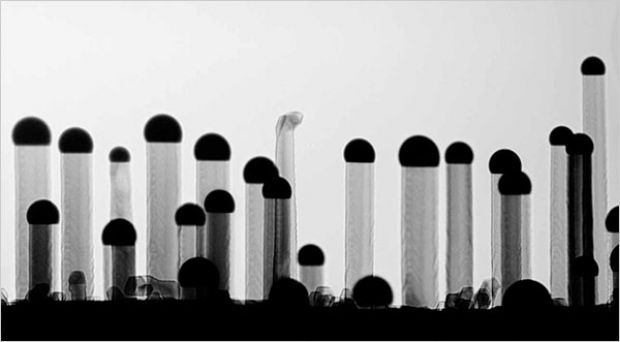
What’s that? Don’t know. Looks like mushrooms, om nom nom etc.
Apparently Moore’s Law is due to hit a wall… is already hitting a wall.
Many computer scientists have been warning for years that this time would come, that Moore’s Law would cease to be valid because of increasing technical difficulties and the expense of overcoming them. Last week at Stanford University, during a panel on the future of scaling (of which the shrinking of transistors is one example), several panelists said the end was near.
“We’re done scaling. We’ve been playing tricks since 90 nanometers,” said Brad McCredie, an I.B.M. fellow and one of the company’s leading chip designers, in a reference to the increasingly arcane techniques the industry has been using to make circuits smaller. – New York Times
So those mushroomy things are silicon nano-wires. What are they? Small wires. Magic.
(PhysOrg.com) — A primitive quantum computer that uses single particles of light (photons) whizzing through a silicon chip has performed its first mathematical calculation. This is the first time a calculation has been performed on a photonic chip and it is major step forward in the quest to realise a super-powerful quantum computer..
That’s primitive?
That’s not primitive. Eating baked-beans straight from the can with you fingers is primitive. Charging about in a thunderstorm, naked, yelling, covered in mud and attacking cars with a machete is primitive.
Being able to do quantum computing by manipulating single photons is fairly advanced I would’ve thought. I have absolutely no idea what these people are talking about – their words are just frightening sounding noises… incantations and conjurations. They’re abracabracising.
And I’m a computer programmer.
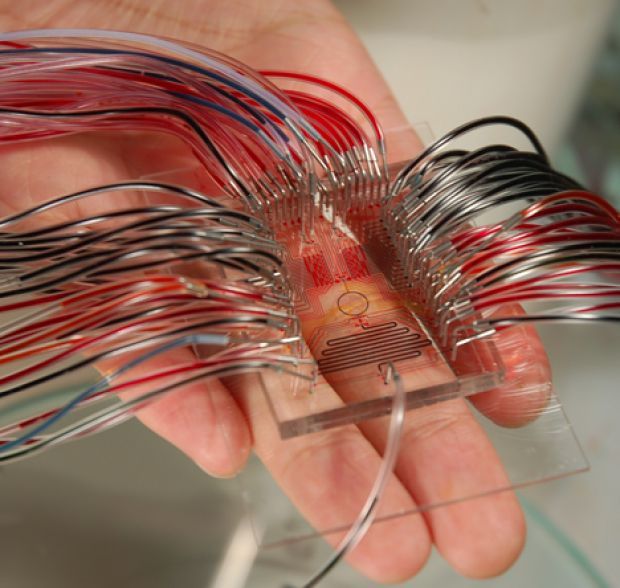
At a slightly less mind-bending scale comes this little marvel from the University of Michigan (It’s always universities doing these things. They’re up to something these people. They’re definitely up to something)
It’s a pneumatic microprocessor… (or more accurately, macroprocessor) which may (or may not) be quite useful in the emerging field of lab-on-a-chipdom… coupling with the marvelous device that turned up a couple of weeks ago
Which looks like some sort of beautiful deep-see worm from The Abyss, or a fascimile of one of those weird Chinese dogs that mad old ladies have made out of space-age medical equipment.
There’s been a lot of talk on the DIYbio list about Sharpie-Microfluidics (“Sharpie” being American for “pen”, or maybe “one of those felt-tipped pens with the pointy ends”, but to me it sounds Australian, and there’s nothing wrong with that. The Australians have a take on the English language that is disarmmingly direct, and I love it dearly
And I digress – apparently you can draw the microfluidic shape you want directly onto glass and it behaves just like a mega-bucks version.
Maybe there should be a word for the conversion of high-science to low (or at least, more democratically-dispensed) science. De-sublimation. It’s like turning gold into lead, but in a good way.
A couple of things turned up recently… one was this:
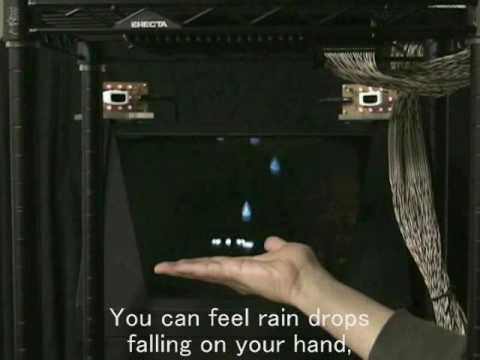
Touchable holography – which I saw on Technology Review at about 2am last night… and thought “far fucking out, that’s mind blowing, I’ll write about that tomorrow”… then at 8am the next day saw it on Reddit and thought “Meh. Old hat”.
I wonder how high the resolution is? There’s about a million potential uses for this if it’s got really fine resolution, and given that porn was a driver for both video recorder and internet commerce (of various sorts) it’s a fair bet that teledildonics could well take a quantum-leap. Not that I’m interested in that sort of thing of course. I don’t even have a telly.
Anyway… the other thing was this:
Which ought to get the DIY Fusion community a-buzzin – yes, there is a DIY-Fusion community, and they do kindof seem to know what they’re doing though to my own poor, confused, drug-raddled brain-cells, the only difference between them and the Perpetual-Motion-Machine community is that they aren’t attempting to break the laws of thermodynamics.
But then this is high-science to me. High-sorcery. Although I kindof understand the fundamentals, the mechanics I shrink in horror (and awe) from… but one man’s meat is another man’s gravy, and other people seem to be picking it up with relative ease… I mean the open source fusor research consortium‘s site does mention the reactor above… but it’s been usurped by a 17 year old kid making a Star in a Jar, as he calls it.
I’ve been harbouring notions of high-science and low-science… the high-science bit being the frozen-light, and genomics and nuclear fusion… and even touchable holograms and whatnot, while low science is more immediately useful, and is more to do with successfully growing your own tomatoes or being able to find your keys.
But maybe that’s wrong. Maybe it’s all easy… or more accurately, maybe someone who’s a Gandalf in one field is a total Bilbo in another… and really, there are enough Gandalfs within any given population not to wind up with what I was imagining earlier…. a super-race of people dressed in shiny silver clothes, gliding about in white light, doing mysterious things with gadgets that look like luminous salt-shakers etc.
Which would be good – because the big problem I have with fusion reactors, isn’t that they’ve been in the permanently shifting, rainbow’s-end of the future for as long as I can remember, but that if they cost a gazzilion astro-dollars to make, then all this power is (once again) going to be concentrated in a few hands – and that’s one of the reasons the 20th century was such a fuckup.
I’m kindof worried about a meritocratic/technocratic class-system evolving. They’re not good for us.
There’s this cliche that buzzes around the place (breathlessly repeated) “advanced technology is indistinguishable from magic”, and I must admit I find it quite irritating… partly because it seems to be a way of saying “we can make perpetual motion machines if we really put our minds to it” and partly because I can’t imagine any technology that I would consider to be anything other than technology.
But I think I’ve met my match. Lene Hau can stop light.
<snip>she brought light to a complete halt in a cloud of ultracold atoms. Next, she restarted the stalled light without changing any of its characteristics, and sent it on its way.</snip>
and
<snip>In the experiment, a light pulse was slowed to bicycle speed by beaming it into a cold cloud of atoms. The light made a “fingerprint” of itself in the atoms before the experimenters turned it off. Then Hau and her assistants guided that fingerprint into a second clump of cold atoms. And get this – the clumps were not touching and no light passed between them.</snip>
The techniques sound simple; the simple description of what is actually taking place does my head in.