GENOMICONrss

rss

The Crowd-Sourcing of Intelligent-Design

rapid fabbing

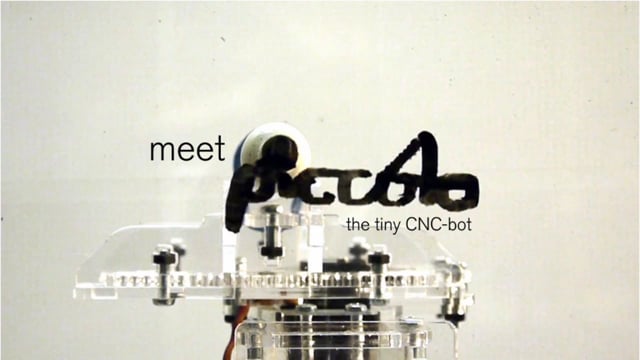
Piccolo – Micro CNC

This is the coolest thing I have ever seen

Piccolo the tiny CNC-bot from diatom studio on Vimeo.

Via Ponoko, who have totally changed my life. I’m now changing careers – opening a fab-lab in Wellington NZ… and if they’ll have us, we can be one of their suppliers – we have the 3D Milling kit that the US lot have, but isn’t available to Ponoko customers from the NZ branch.

It was Ponoko who started me off with the Golden Mean Calipers (which is where 1/2 my income comes from now) (because who does “one thing” any more?)… and now it’s become a bit of a personal mission of mine to do for other people what Ponoko has done for me… which is to create micro-businesses, so people can be independent.

Epoch-Spanning-Scissors

Scissors made by proper scissor-craftspeople for one half, and CNC prototyped on the other.

Both works of art in their own way… the crafts-person’s ones being superior… but kindof commonplace now I think. We’re kindof used to scissors looking that way… to the extent we don’t really see “finely crafted” any more. It takes 5 years of training to learn to make proper scissors.

More photos in their flicker department

They combine a disruptive technology with a hundreds-of-year-old process of incremental refinement into the one piece. Disruptive technologies always win of course… anything that de-skills people always wins. Bows and Arrows and Crossbows never went away completely… but they became backwaters… to the extent that when Wellington wanted to assemble a corps of longbowmen to use against Napoleon, he couldn’t because it takes a lifetime of practice, and nobody could draw the bows any more. Except the odd weirdo.

I’m quite interested in this concept->completion vs incremental-improvement divide. I’ve been making golden mean calipers…

…for about a year now, and am still learning how to do it. Every week or so I stumble across a new technique that massively improves the product/process. When I first started making these I had to really emphasise the fact that they were hand-made… because they looked it. Not any more… they’re pretty much identical now. There are a couple of things that I would like to improve… but… well, time will tell.

This is me making calipers about a year later – holding the punch in a way that allows me to cut out an entire sub-process. I only found out how to do that a week ago.

I come from a programming background where this sort of thing doesn’t really happen – you’re permanently on a learning-curve so steep it’s overhanging… and if something is “repeatable”, you automate it… so it’s rare to get that constant-tiny-increment-improvement that you get with… craft. Bruce Sterling recently went on about “Passion and Virtuosity”… and I think programming is antithetical to virtuosity. You never really get to practice things to the point where it becomes… music. Programmers sometimes go on about “code being art”, but that’s bullshit. It’s not, and not only is it not, it’s actually antithetical to a key component of what makes high-art, high. And I’ve been programming since the 1970s.

So it’s been quite strange seeing the incremental improvement in making golden mean calipers… and while part of the point of this post is (I think) about the virtues of actually doing stuff by hand, with your hands, over and over again… I will confess that one of the key innovations was to stop trying to make the rivets myself, but to get someone else to make them – with a machine.

So… can/will CNC manufacturing cut this out of the loop? (because it reduces the loop to tinkering in a CAD app)?

Rapid Fabbing essentially turns hardware problems into software problems… that’s what reprap is. It’s a process of codifying incremental improvements, so they all live in the brain of the machine that is created… passing on the knowledge of self-building from parents to children.

Well that’s the theory anyway. From the look of them there’s still a ways to go before “the unpracticed” can assemble a machine identical to one put together by the adepts that are creating the designs… but that is what the reprap process is designed to do.

Still… scissors:

Laser-cut Solar Cooker

solar cooker

For the absolutely mental price of 500 eu.


from : via

They have other cookers for about 1/2 this price… and about 1/2 of that price seems to come from the shiney bits.

I’m coming to find that there’s this price-level (particularly for camera gear) – where although the price seems like an outrage – that is about how much it takes to make your own. I bet the cost of water-jet cutting (If that’s how they do it) 20 shiney triangles with interlocking bits isn’t a hell of a lot less than the price being charged here.

It’s not just “the cost of not doing business in China”, it’s the cost of not mass-producing… and maybe the cost of no competition. Or maybe it’s what the market will stand.

Dunno – I went to the trouble of working on my process/materials/sources etc with my golden mean calipers – and was able to drop the price by 20% – and it made no difference to the level of sales whatsoever.

So this thing… that looks like it’s been rapid-fabbed will probably cost to make in your own rapid-fabbery what it costs to buy from someone who’s done all the trialling and erroring, and made thousands of them.

Or to put it another way – I think that the “threat” that some people think rapid-fabbing poses to “products” probably isn’t that much of a threat – or at least is only a threat where we’re being ripped off (eg: paying a premium for a “brand”). Or to put it another way, a side-effect of wide-spread proliferation of rapid-fabbing will be to “rationalise” product costs – but it will in no way put manufacturers out of business. Or to put it another way, the threat to manufacturers of physical products isn’t piracy, but mass-production.

And IP law of course.

Did you know that although pharma companies claim they need to lock everything up with IP law (which costs lives)…

… 80% of R&D into pharma is publicly funded and…

… of the 20% corporations do spend, 50% of that goes on trying to circumvent IP of other companies.

Ghosts of Revolutions Waiting to Happen

There once was a neologism (what do you call old neologisms?) “See-Throughs”… being big office buildings that have failed to fill with the sorts of creatures that inhabit such terraria. You can see from one side to the other… no desks or filing cabinets or spider plants etc.

I’ve been noticing a number of Web 2.0 equivalents of late… or Web 3.0 maybe… the long (is it long yet?) anticipated “Internet of Things”, for which I’m seeing a lot of gushing enthusiasm but precious little in the way of a Killer App. Well, not for we jaded, prozac-stuffing westerners anyway.

So.

Exhibit 1) www.moq7.com

clothespeg1

Someone’s invented a better clothes-peg generating a buzz of enthusiasm from those who monitor such things, as to how this thing would be tooled?

What interested me though was the site it came from… www.moq7.com, professing to be a discount pre-seller of next-generation products… the idea being that you submit a bit of money into escrow, and if a threshold is past where it’s actually worth making the thing, they will.

Which is a great idea – a friend of mine has been proposing this as a music-industry model for years. I think it’s a goer… only it ain’t going.

Not sure how long this site has been up – since 2008 presumably… I can remember there being a bit of a buzz over it a while back over the launch of a money-clip made out of money… and while I’m all in favour of art for art’s sake, lets have an Emperor’s New Clothes moment here shall we? Selling magnets taped to bank notes? Come on. That’s taking the piss. Honestly, what problem is being solved here? What value is being created?

Maybe I should put some of my stuff up on it.. see what happens… but to be fair, although I’ve been playing with Ponoko for quite a while now, apart with the possible exception of Golden Mean Calipers, I haven’t made anything that I’d actually call useful.

So maybe that’s the answer to the recent query (from someone I can no longer find), “What’s the biggest barrier to mass customisation?”. It’s simply that we can’t think of anything to make. We solved most of our manufacturing problems ages ago… and yea, being able to design then print a working whistle (albeit one that looks like it’s been chiseled out of wax) might be an impressive proof-of-concept, we (as a species) solved the whistle problem a long, long time ago… this is also “evidence of concept” that we’re not exactly setting the world on fire here with Stuff That People Actually Need.


Exhibit 2) www.cloudfab.com

Which looks like comparison shopping for digital-fabbing plants… which I think may be in the same arena as what Ponoko are aiming to do – by making their software available to anyone with a laser-cutting shop. Outsourcing manufacture to the cloud as it were. Makes sense – if you’re dealing with physical stuff, then simply “knowing what’s available, and where to get it” seems to be 9/10ths of the law. It makes double sense if like the Makerbot lot, you’re getting your customers to make Makerbot parts for you.

There’s quite a nice roundup of the various technologies available here, though not a lot on location/who’s going to do the work etc.


Exhibit 3) www.shopster.com/… which looks like a site where you can sell other people’s products… or have yours sold by other people. I might have a go at this one actually because I find it a lot easier to make things than to sell them… the only catch-ette being, I’m a software guy which means I’m location-agnostic. If I start making physical things then I’m tied to a specific address. Unless I get someone else to do it of course. That would be ok. Make themselves useful etc.

So anyway… this could be a goer as well, but the “featured” sellers department leaves me feeling a certain un-put-my-finger-on-able unease. It reminds me of the electrical-gear shops in Tottenham Court Road in London where everything seems to be for sale and although all the shops are different, they have this distinct vibe of being run by a massive cartel of excited and shifty Indian pirates. One of the “featured shops” (for example) has a sideline in Gadget Models. Another one sells spy-gear.

Which kindof clashes with the Web 2.0 at-the-front vibe, but there you go.


Exhibit 4) Open Structures

open_structures1

This looks quite cool actually – or has potential at least. It looks like an attempt to create a cross between Lego and Ikea… standardised parts and connectors that people can use to build whatever they like, so long as it’s made entirely out of right-angles. The site has only been up for a month or so, and the first post in their blog is still in Latin (bless)… and I think it should stay that way. It’s like a “hello world” moment, and a backhanded testament to Cicero who originally wrote the thing… “lorem ipsum” being a musing on ethics… all very heavy and meaningful etc… now famous for precisely the opposite reason – it’s meaningless.

Anyway, Open Structures has a bit where you can upload your own components and share them etc… a small handful there already, most of them not for sale, but there you go.

I think this might be a way forward – out of the situation we have at the moment where there’s mass-customisation potential, but people aren’t really using it that much. Building blocks are good. If everything was made out of building blocks we wouldn’t have landfill sites filled with old “consumer-durables”… or “consumer-utterly-undefuckingstructables” as they will come to be known, 500,000 years from now when they still haven’t biodegraded.

So anyway… random thoughts, apropos of very little again… but circling around feelings of doubt about the “crowd-sourced-manufacturing-revolution” that is all the rage at the moment… because the BIG problem with it, is that we (jaded, prozac-stuffing westerners) have kindof satisfied our “product-acquiring” needs.

So the anticipated shift from “buying stuff” to “spending even more $$$ than it would to buy stuff, making it ourselves” isn’t exactly setting the world on fire. Really, home-fabbing is another way of acquiring stuff… and the acquisition of stuff, although it may be our raison d’être as prescribed by mainstream (ie: marketing) culture, ain’t really doing it for us is it.

An interesting take on desktop CNC

I quite like the idea of a cnc machine that’s smaller than the thing it’s making… at least partly because it can then be scaled downwards size-wise.

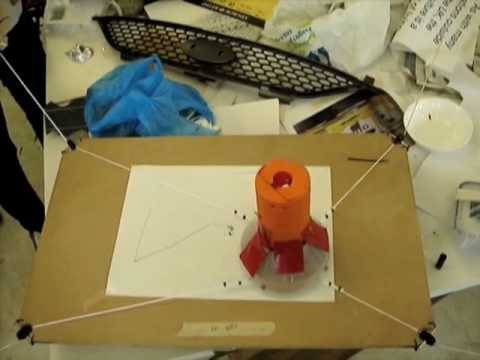
Here’s a variant that uses strings instead of rails


from ponoko

Which makes the maths a whole lot scarier, and I have a feeling that there may be fairly serious issues with precision… but it’s an interesting idea nonetheless.

It might be interesting to try a variation where the motors (which when on the corners will need to be synched, which could be tricky) aren’t at the corners, but are actually in the machine itself, which just uses the corners as a reference point. You wouldn’t need as many of them then.

A bit like the CNC router robot from last year… which impressed everyone then kindof disappeared… which was a pity. I was expecting to see a whole wave of them after that.

I mean that thing is really cool.

Fairly Impressive 3D Printing

This just turned up from Cory Doctorow on the Twitters

3d1

And I know absolutely nothing about it, other than the comment underneath, which says

“The color was done by the same printer, at the same time. According to Hugh, the printer alternates between volumetric passes and color passes, using two different heads.

and

They come from a Canadian museum, presumably the ROM. The 3D printer was developed with Canada Research Council money. That’s all I know!”

If this is the case then they’ve just knocked out a fairly massive chunk of post-printing work. Z-Corp do colour printing but the colours don’t look as deep as this. Another step forward I’d say – if it is what I think it is.

I think the multi-head thing is fairly crucial. For 3D fabbing to really work, the machines need to be able to handle a variety of tools.

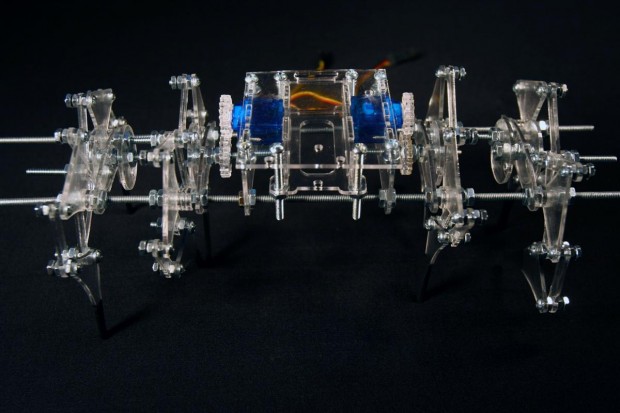
Laser-cut Jansen Arduino Walky Thing

Probably difficult to believe, but I do deliberately try not to be too robot-orientated.

This however I can’t resist because it combines so many of my favourite threads – Theo Jansen Machines, Arduinos, Rapid-Fabbing AND the designs etc are open-source, and up on Thingverse, inviting people to adapt/evolve.

(via)

Instructions / Materials / photos etc here

jansenwalker

The bits are for sale or you can make them yourself etc… this seems to be an emerging trend with open-source hardware. Varying levels of kitset completion, priced accordingly… so if you don’t want to solder, you buy a slightly more expensive, slightly more complete one. In this case the only choices are, 1) do it all yourself, 2) buy the parts and assemble yourself.

jansenwalker2

But is it useful for anything?

Indirectly maybe – we’re learning how to do open-source hardware.

What we need I think is some sort of template – some macro-format that allows a standardised way of presenting/storing designs/part-lists/instructions/photos/videos/change-logs etc etc. We can probably apply what we’ve learned from software – but hardware is different.

Open-Sourced 3D Printer Consumables

This is what we like.

“A University of Washington engineering professor has come up with a new goop for his 3D printer that costs 1/30 – 1/50 of the authorized goop, using a mix of clay, sugar and nutritional supplements, then open sourced their formula. Basically, these guys are the inkjet cartridge refillers of the 3D era

I went on about this before
, but got distracted by the historical angle so missed the price/open-source angle.

Something that we seriously need to avoid is a situation where (as is the case with 2D printers), the printer is basically just a conduit for selling chronically over-priced and proprietary consumables.

This particular development, as well as knocking the bottom of of proprietary pricing and being open-sourced, has the added advantage that being made out of sugar and maltose, you can eat your mistakes… though there is a bit of ceramic in there as well, so nutritionally it’s the same as also eating the plates.

10,000 yr old technologies revisited

I haven’t been well.

I’ve been lapsing in and out of lucidity and (more often than not) drifting off with the sound of the Oekonux Conference because I’m a maveric etc, and somewhere someone said “They’re all 200 year old technologies”. I think it may have been Smári McCarthy.

Yeahknow (I thought). I’m sure that this wasn’t what he meant, but something that appears to be happening in this explosion of crowd-sourced innovation is that EVERY (almost) forgotten technology is being pulled out of the attic and given a dust-off. And for some reason, I find this really interesting.

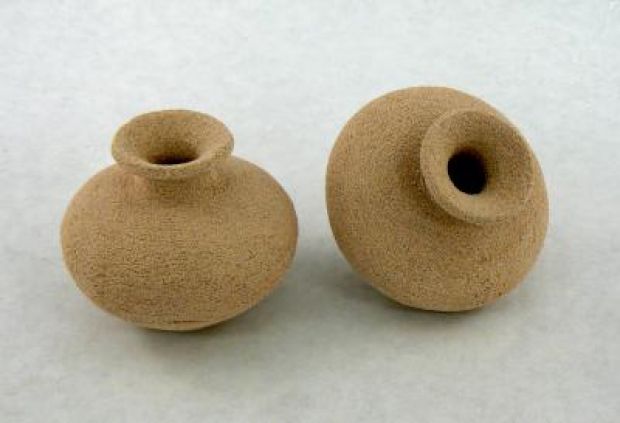
Anyway: 3D Pottery printing:

pot

from : via

Which I love, because we were making pots at least 10,000 years ago. We invented pots before we invented the wheel… and there’s not a lot of technologies you can say that for… ignoring the plethora of sharpened sticks and rocks. Mind you, some of those were works of art in their own right as well, and as far as I’m aware, an obsidian scalpel is still a lot sharper than a steel one.

For some reason the 3D printed pot thing reminds me of the Bible-Writing-Robot thing. It’s almost an affirmation of something. Not sure what, but it feels good. I think pottery was one of the fundamentally civilising technologies. It’s like going home.

Another ball and an extra set of fingers?

3D printing of bones – or more accurately, bone-scaffolds, upon which real bone can grow… not quite lizard like limb replacement, but certainly a step in that direction.

dinosaur2

“EXACT replicas of a man’s thumb bones have been made for the first time using a 3D printer. The breakthrough paves the way for surgeons to replace damaged or diseased bones with identical copies built from the patients’ own cells.

“In theory, you could do any bone,” says Christian Weinand of the Insel Hospital in Berne, Switzerland, head of the team that copied his thumb bones. “Now I can put spares in my pocket if I want,” he says.”

from New Scientist : via nextbigfuture.com

Next,

An ode to Cognitive Surplus.

A celebration of the inventive backwaters of the human spirit... a celebration of people who would appear to have far too much time on their hands...


A celebration of laterality.


If you come they will build it.


By knowledge shall the spheres be filled.


Golden Mean Calipers