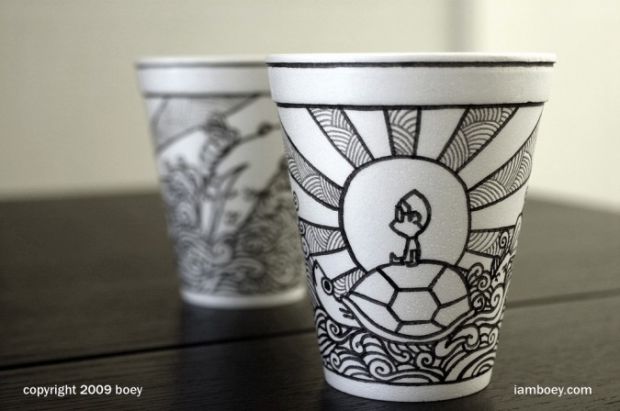
Of course the HUGE advantage with using plastic cups and whatnot is that they take about a million years to biodegrade… so they’ll still be here, long after the pyramids have returned to sand. Look upon my works, ye Mighty, and despair
In fact, I think it’s more than cool… I think it’s the future, of a kind.
If web-designers designed cars…
…and we do know a bit about design do we web-designers. We live in a vicariously-Darwinian, fast-breeder hot-house. Evolution is really sped up in the crucible of the market. We share. We recombine. We move on.
Video-recorder controls aren’t designed by web-designers; iPhone interfaces are – and it’s not to say that the real genius of design isn’t happening somewhere else, or that we’re not still cocking it up a lot but… there are sets of principles that we design to, like:
1) separate style from content/function
2) manual-free simplicity
3) de-couple systems so different parts can be swapped in an out easily
4) design for resilience, flexibility, robustness, speed, scalability, under-the-hood clarity
5) platforms rather than control-systems
etc etc.
Traditional product design doesn’t do these – in fact it often does the opposite, and profits from doing the opposite – creating fake scarcities, and micro-monopolies. There is (for example) a special part of hell where designers of laptops are strangled forever with the non-standardised power cables. Every 5 years (or whatever it is) the average Westerner spends about a year’s worth of wages buying a ton of steel and glass, that is used to carry around a single person… who doesn’t (in spite of their best efforts to the contrary) weigh a ton.
But that’s shite, it’s dying and it deserves to. The symbol (and often reality) of 20th century freedom and independence has turned into a millstone, and it belongs in a museum (and in a genre of K-for-cool movies like Two Lane Blacktop and Vanishing Point) That spirit is gone. A car is now a series of monthly payments.
So anyway, if web-designers designed cars, the chassis, engine, body, control-systems, electronics etc etc would all be discrete and swappable sub-systems. You could reskin your car, rather than having to buy a new one every 5 years… only you probably WOULD buy a new one every 5 years anyway, because as I say, we operate in a fast-breeder evolutionary hot-house. We don’t do what the car-industry does – which is produce basically the same car, but with minor (diminishing-return-on-R&D) enhancements… since the 70s.
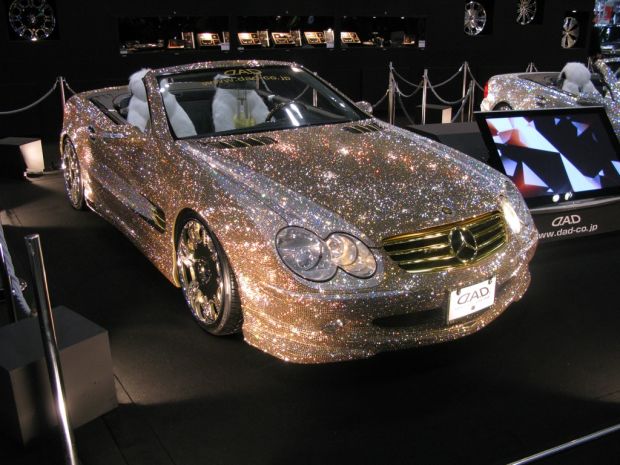
I mean take a look at this:
Now that, My Learned Colleagues, is a poster-child for an industry that has run out of ideas. The preposterousness of monument-building always peaks just before the fall of an empire. I think it’s over. I think they’re finished.
The Zambikes and Zambulances on the other hand, are just beginning – and I think they’re the mammals that will survive where the dinosaurs can’t… and I think this because they’re the beginnings of a design that is modular, decoupled… the Early Vehicular HTML under the hood etc etc. When open-source cars start kicking in big-time (and they will) this is how they will start. They won’t come from the big car manufacturers
If you turn that around the other way, put a little engine on it, give it the aerodynamics of a plane, then you’ve got a home-made Aptera.
A long shot you reckon? Remember, legally, an Aptera is a type of bike… and that’s another reason why innovation is probably going to happen around 3-wheelers, rather than 4. Less Industrial-Giant-Friendly regulation.
Admittedly, an Aptera is an answer to a particularly Western set of needs… but that’s ok, because if you’re starting with a design where the sub-systems are decoupled, then you can adapt it to do whatever suits the local conditions.
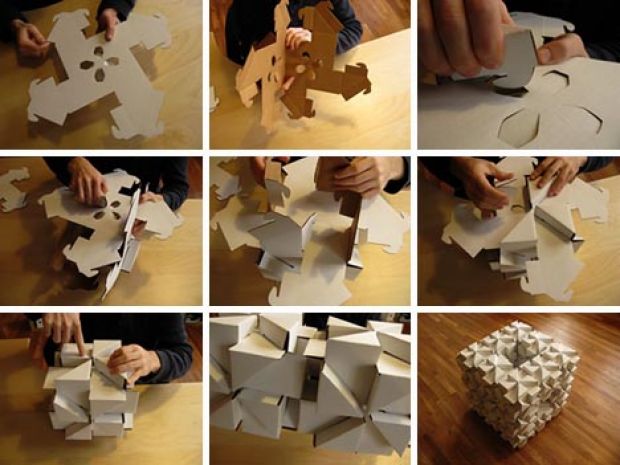
From Bloxes, who sell these neat, fit-together-box things made out of recycled cardboard although…
… it would be so much better if they just sold/gave away the templates so people could use their own locally-sourced rubbish. I mean there’s a lot of it about isn’t there.
He’s made an appropriate technology that can be put together anywhere on the planet… he’s done the whole open-source thing – the “design” is there for anyone to use for free, and he even shows people how to make them themselves (in fact there’s a video of him making one in 3 minutes on his site), but his business is selling the actual physical product (and satellite items). He’s retired, has a massive youtube channel which he uses for chatting and customer support… offers advice on hiking and safety etc… his video channel has videos of his cat…
I really like the way there’s no delineation between life and work and play… it’s all the same thing. In addition to this, the process is the product. The whole life-cycle is there for anyone to see. No secrets. No SEO. No $30,000 site makeovers and Web-2.0 consultancy.
I’d buy one of these just because I like the guy. This is good advertising. There’s no deception or clever marketing techniques – it’s just someone being himself, doing something that he’s good at and likes doing.
So there you go. Here’s a wood-burning variant, with a little electric fan
A Wall Garden that you could (although it’s not done here) make into a kind of Rube Goldberg machine so the water from each gutter drains into the next. I’m not sure what the advantage of that would be – maybe it could be hooked up with some sort of aquaponic system.
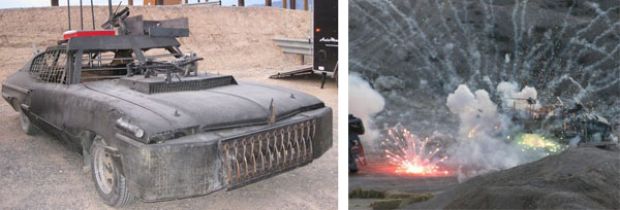
“From the producers that brought you MYTHBUSTERS comes an explosive new series, WEAPONIZERS (3 x 60 min) premiering on Discovery Channel US, May 11, 2009 at 9pm.
This new program combines creativity, military-like strategy and engineering as two teams of master builders — dubbed “Weaponizers” — turn ordinary vehicles into remote-controlled machines of destruction. With the pace and intensity of a video game, the vehicles are completed with live-ammunition machine guns and other seemingly ordinary objects that are transformed into powerful weapons. Building on the teams’ expertise — hot rod restoration, pyrotechnics, special effects, crash engineering and military weaponry — the opponents harness their ingenuity in a competition face off where the goal is to achieve victory by creating an indestructible vehicle.
In each episode, the teams convert regular rides such as a shuttle bus, an ice cream van and muscle cars into vicious vehicles. Using science, special effects, engineering, metal fabrication and a bit of fantasy, they construct and test their vehicles to ensure that they pack the biggest punch and are fully remote-controlled. Once all testing is complete, each team descends into respective underground control bunkers to command their vehicles for the two-round competition.
In round one, the teams undertake a challenge-based phase where the vehicles race to destroy or defend exploding targets such as medieval castles or Mad Max style fuel depots. Then in round two, the “Weaponizers” are thrown into a Carmageddon Round — the rules are… there are no rules. It’s a gloves off test of what expertise these teams can draw on to achieve victory, which in WEAPONIZERS’ terms means there is only one vehicle left standing!”
–
The blurring of the line between toys and weapons continues apace, and I think it’s a public service in some ways – saving the lives of would-be suicide-bombers by teaching them how to make cars remotely controllable and as strong as hell.
It had to happen though – sooner or later there had to be a “no rules” version of robot-wars.
Neologism of the day : Junkstrapping – which is like bootstrapping, but using junk rather than off-the-shelf components.
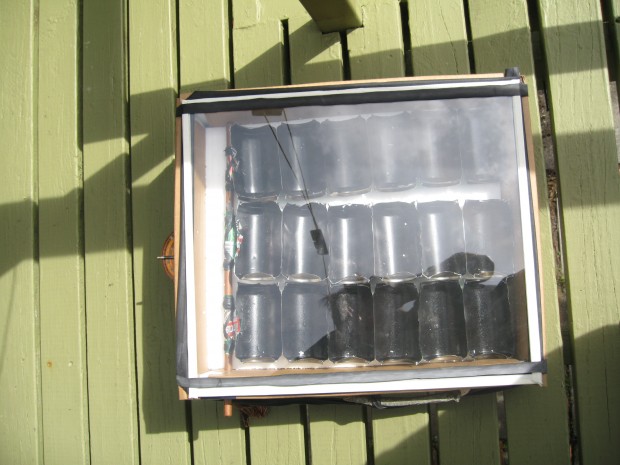
And here it is:
The design philosophy is something like:
- made out of bits you can find pretty much anywhere for free-ish.
- no permanent attachments – no glue, staples, nails etc so you can experiment/swap bits
- avoid big bits of stuff – because they can be hard to find.
- flexible design so it can be built round the hardest to find bit – the glass.
So there it is. It’s
- 3 layers of cardboard box cardboard,
- a couple of bits of polystyrene
- a window pane
- a load of beercans cut in half and crimped together
- a bit of copper tube at the top
- all connected together with bicycle inner tube.
All of which I scrounged from local businesses – the most beneficial aspect of which is that you get to talk to and befriend local business peeps… apart from the beer cans which I was forced to buy and drink myself. I also put tape around the edge of the glass because its sharp etc.
So there you go. I’m going to go through a bit of an experimental phase… I think double glazing it would be a good idea, and it will need to be water-proofed. I’d like to get away without using polystyrene if I can as well.
But there it is… a reasonably overcastish sort of day, but bright enough to cast a shadow…
… and the bit of pipe sticking out the side is too hot to touch.
I’ll make an instructable or something once I’ve gone through a few more iterations. I’ll need to get some more beer cans as well probably.
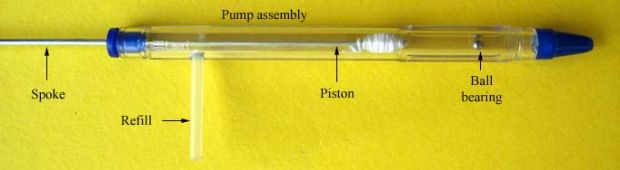
It’s like instructables - but a lot simpler, with a lot of general scientific building blocks/principles turned into toys etc.
This stuff has so much more imaginative potential than the mountains of injection-moulded crap that turns up in Toysrus. It would be cool to have a similar site which has building blocks of really useful technologies – like using plastic bottles to sterilise water etc. Kindof like a Lifehacker style knowledge-sharing site for the billions of people on this planet who don’t have access to clean water etc.