On Cephalisation
Is that how you spell it? It’s how I spell it.
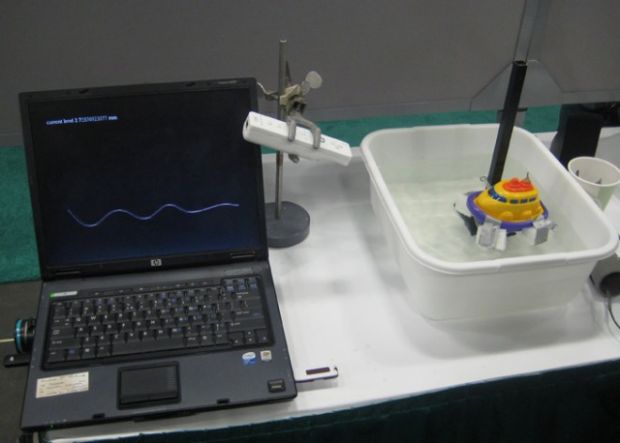
There’s a thing here from Wired about using hacked Wiimotes as scientific senors.
![]()
on account of their being relatively cheap and being able to do a bunch of stuff, as it were. I’m quite keen on the idea of an iPhone basically being a detachable head… it has a load of sensors, a brain, can communicate as well as merely sense etc – and apparently the thing that is facilitating this robotics revolution that’s about to break, is the arrival of cheap sensors (previous revolutions were brought about by cheap CPUs and cheap lasers).
So it kindof makes sense to me to have a kind of “sensor pack”. Rather than having separate electronic components, and the expertise required to combine them with resistors and wires and drivers and such… just have a single thing with a whole array of sensors that can plug into any computer using USB or bluetooth or whatever. Detachable heads again.
I guess all you’d really need is to get a detachable web-cam with a microphone and add wii-like motion-sensors to it as well. It would be quite good to have some sort of chemical sensor as well though. To act as a smoke-alarm maybe…. or monitor air-quality. To monitor microbial composition etc – there was a thing on TED a while back where someone talked about using cellphones for global environmental monitoring. Not sure if anything’s happened though. I should really go back over all the stuff I’ve written about in the last year, get in touch with everyone concerned and ask “and then what happened?”
Anyway – detachable sensor-packs. They’re coming. Probably.
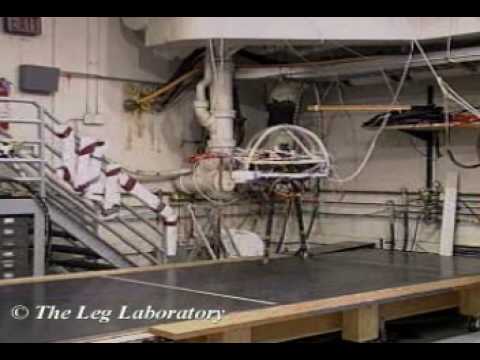
LegLab. Home of the Sissybots
Youtube recommended this video for me:
I think the stages of robotic adoption will be:
1) WTF? How could that possibly be useful?
2) LOL A sissy bot… still, at least it doesn’t look like a flea that’s dying for a piss
3) WOW it looks like a dog or something
4) OMG, We’re fucked.
Even walking is a type of communication. The robots in the vids are using Robert What’sisname from Ted (a talk on engineering designs inspired by nature) where all the smarts are built into the architecture of the legs… rather than trying to micro-manage the programming, you just make them springy sticks.
It is a kindof mincy way of walking though. Especially for a dog.
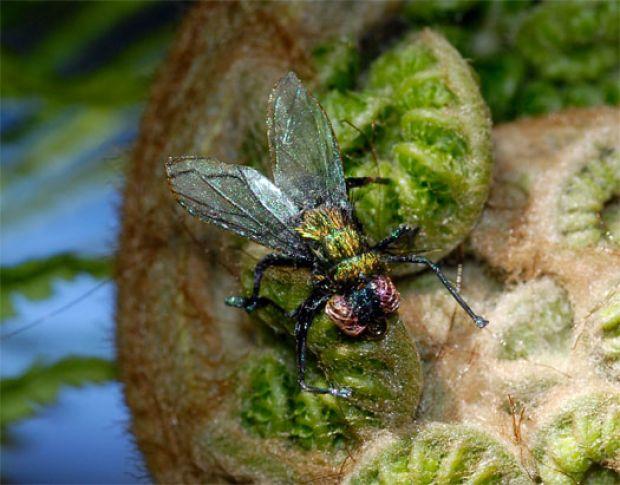
Superfly, Fishing Guy
![]()
![]()
![]()
![]()
Though it looks to me like the “catching of fish” bit has become of secondary concern to the artistry of fly-making.
There’s a whole gallery of different one’s here... amazing.
They seem to turn up in movies quite a lot. 9? 10? – that’s more movies than I’ve been in.
(via notesfromhalfland where lots of amazing tiny things are made)
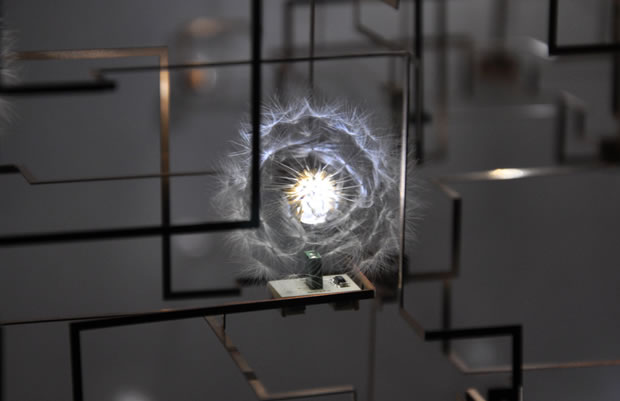
Dandelion Lights
From the V&A in London, via www.spotd.it
![]()
![]()
There are quite a lot of fairly mad looking lighting-type things at the above link. Which I’ll repeat here to save you scrolling back up. The V&A is a fairly mad place in a lot of ways – I can’t believe the Victorians (or whoever it was) actually made a plaster-caste of Trajan’ Column. Holy Crap! You know how big that thing is?
![]()
Boids : Cellular Automata Gadgets
These are cool
![]()
![]()
Because anything to do with Cellular Automata is cool.
These are one-off light sensitive lights… the change according to their environment… and if you put them together, they change according to each other.
![]()
![]()
And that is the thing with little automous feedback systems when they get together… the inevitably talk to each other, and inevitably create higher-levels of complexity – and that is why fractals look the way they do, and why you get those repeating triangular patterns on textile cones
From Leiteq, in The Netherlands
Anthropomimetic Machines
New word : things that mimic humans : Anthropomimetic
This is neat – in a slightly spooky sort of way.
(from)
A different take on robot muscles… which I still think are a bit of a missing link, and this although interesting, doesn’t quite fill the gap either.
The polymorph stuff looks interesting. I wonder where you can get some?
Oh. Everywhere. £4.75 for 250g on ebay. Actually, now I come to think of it, this stuff has been around for a while – I can remember it being on some sort of UK infomercial about 5 years ago.
From the Garden of Earthly Delights #2
Further to the utterly fantastic video here.
People seem to be having a fair crack at making the things.
(from)
A robotic flower from Akira Nakayasu of Kyushu University, Japan and Himawari… on display at Robosquare in Fukuoka (they’ve got a Robosquare? Why haven’t I got a robosquare?)
It follows your hand and its LEDs copy the movements – which is pretty cool, partly at least because Copying and Attention-seeking are two of the behaviours hard-wired into the Human Bios – it’s how we learn.
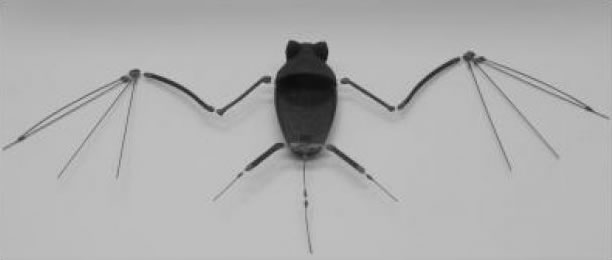
Missing Links Waiting to happen : Robo-Bats
![]()
(from)
I believe virtually everything I read, and I think that is what makes me more of a selective human than someone who doesn’t believe anything… but until I’ve seen a video of this thing flying…
The point though is though, that it’s using memory-metal for the muscles – pass a current through it and it moves. I can remember reading about this stuff in OMNI magazine in the 70s… and thought the future had finally arrived (actually, it was only just being invented), but nothing much seems to have happened with it since. I think that finding robot muscles other than magnetic-induction type motors is fairly fundamental in moving things forward into proper sci-fi land though.
I’m not entirely convinced about this fluttery business. I think the reasons moths and bats and whatnot have wings rather than propellers is more a case of evolution designing around a physical weakness in multi-cell systems than one being more efficient than the other… I mean, which looks more stable to you, this:
(from)
or this
?
Ok – about the same, but the flapping to me looks like a it’s basically two propellers doing two back and forth semi-circles rather than a full rotation… and I suspect very strongly that the reason it’s filmed in slo-mo is that at normal speeds, they only managed to get seconds of stable flight at a time. There are a lot of flutterbots on youtube, and they look as erratic as hell.
I suspect that stability basically comes down to smarts… as you’ll know if you’ve ever watched wasps raiding bee-hives… bees bumble about and crash all over the place* while wasps can zoom straight through really narrow gaps – and they’re basically the same hardware.
Still… tiny muscles are to robots what light-gates are to computers. Maybe.
–
* Christ on a bike, how much time must people have on their hands to dub a scream over a bee crash?
Return of the Bristlebot
I’ve got this theory that every stupid idea is a great idea waiting to happen – all it takes is a different perspective.
So it is with bristlebots - I’ve touched on this before with the thing where the bristlebot turned into a possible engine for a space elevator.
Well another one’s turned up. Making a tiny bristlebot to deliver drugs to tumours.
It’s about 1mm wide by 1cm long and is powered with an external vibrating magnetic field. Apparently there’s plans to mount a camera on it, which is something I went on about before, and everyone thought I was mad etc. Microbial Safari.
Of course this particular robot is a direct nick from nature – foxtails which (in NZ at least) are the bane of dog owner’s lives because they get stuck between their toes, and like these robots, can only go in one direction – deeper.
Nasty little shits they are. Quite intriguing to play with though – they’re actually covered in micro-barbs to accentuate the affect. Kindof like one-way velcro.
Next,