GENOMICONrss

rss

The Crowd-Sourcing of Intelligent-Design

energy

Windows, Solar-Power and George Monbiot

windowtax

I feel a bit sorry for George in a way – I think he used to know Susan back in the day… although I don’t neccessarly feel sorry for him for that, although…

No I feel sorry for him because he’s a nice bloke, and he’s a fuckwit magnet. His column in the guardian is invariably followed by braying heaps of bile-spewing, right-wing cunts… and when I see him actually trying to answer some of these people I suffer a sensation akin to seeing one of your mates playing in a rubbish dump.

Anyway, he recently went on about how people feeding solar-home-generated electricity back into the grid is basically just a giant shift of money from the poor to the middle-classed. The rubbish dump murmured in vague (if not slightly confused) approval, because the rubbish-dump wants nuclear-power… or coal… or anything that’s basically top-down controlled, and polluting.

(If you’re reading this George, here’s why Nuclear is a seriously stupid idea.)

But back to the feed-in tariffs being a transfer of money from the poor to the middle-classed… he may be right. Personally I think being able to supply energy for sale to the grid is an incredibly important thing to be able to do… but I didn’t realise it came with such massive subsidies – so theoretically you could buy electricity from the grid at 7p and sell it for 44p.

It might be worth checking with the Germans to see if crims actually did this… and maybe the Germans aren’t as… assiduously criminal as the British (because they are, oh yes, they are)… but that just seems to be a bit out of wack to me. The subsidy I mean.

However.

I think purely looking at it in terms of superficial economics is… not taking in the whole picture.

The photo at the top is something that you see all over England – permanently bricked up windows… because back in the 17th Century (in the age of Rickets), some bright spark had the bright idea of taxing the number of windows in everyone’s houses.

The great unwashed responded by bricking up their windows. The tax created a bricking-up-windows pressure.

Now, the government creating a platform where people get paid for their net energy is creating various pressures.

1) The pressure to be more efficient – so your net is higher. President Carter came on TV wearing a jumper in the hope that everyone would be more frugal with energy savings, and everyone laughed at him. They won’t laugh at this.

It would be fairer (and have a similar effect) if the subsidy went on insulation – but “saving” money is a very different psychological proposition to “making” money.

2) It creates a pressure for smart-metering. If you want to increase your net energy production, you need to know what your overheads are.

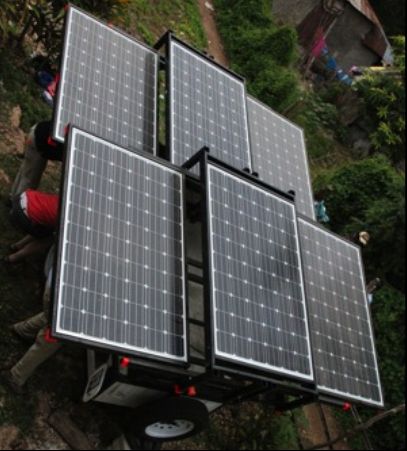
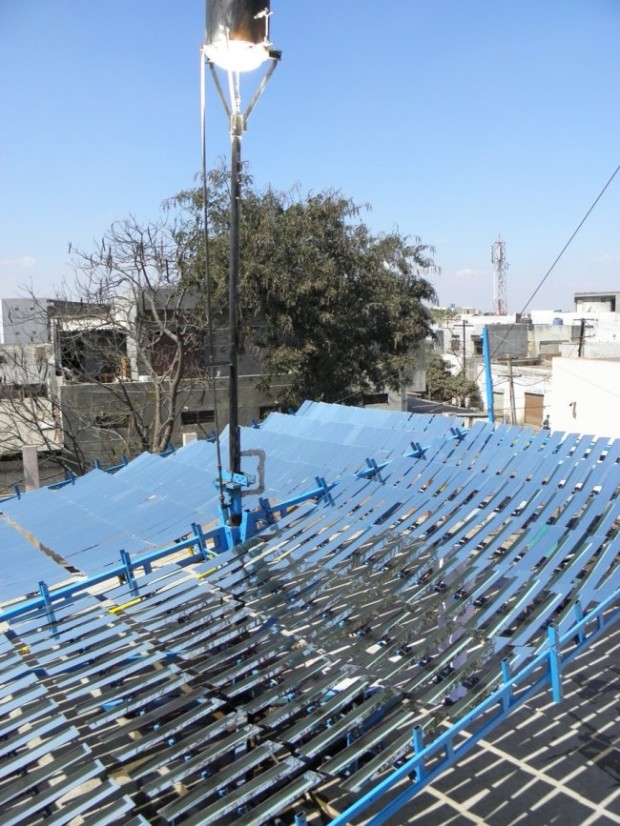
3) I’ll tell you what they are – they’re all to do with heating water. I think solar water heaters might actually be a better way of lowering your energy costs than solar-electricity – I visited a guy who was selling them (for 3K $NZ a go) and on a cloudy day, at mid-day, the tubes were too hot to touch. I know they won’t work in winter, but… it’s still a fairly mega subsidy, coming out of the sky to you for free.

But failing that, lagging your pipes becomes an investment with immediate returns, rather than something you might get around to one day.

4) It creates a pressure to produce other micro-generation devices – not just solar. Solar is piss-weak really – although the prices are coming down massively (see Konarka et al), you’re not going to be using them do your cooking any time soon. But… converting an excercycle? A little wood-gas generator?

I can see bad as well as good coming of this to be honest – as I say, The British are assiduously criminal (I know. I’m British. I used to work for a slum-lord)… but it does create a pressure to produce other micro-generation devices – a pressure away from top-down control of energy (which has created so much in the way of war and suffering) to something localised. I think this part is vital to be honest.

So… I’m a poor person. By UK standards – and I’ve lived in about 20 different houses in the UK… and I’m not sure that any of this would have applied to me because I either rented or squatted (or lived in a van) but… I guess I would have had the sky-space to do solar in about 1/3 of these properties?

Something like the little Whispergen CHP Sterling Engine generators from New Zelaand would be a better bet – although that might create an anti-tree pressure. You certainly wouldn’t be seeing skip-loads of scrap wood any more.

So although I’m not so sure about the subsidy side of things – I think being able to sell energy back to the grid creates drivers for efficiency, decentralisation, and exploration of non-solar devices. And I think it’s a good thing. There’s more to it than meets the eye I think.

As opposed to Nuclear, (which George seems to be advocating) which is just clangingly fucking wrong in every conceivable way. £8 a tonne? Don’t make me fucking laugh. If you’re British, your taxes (yes you) are still paying for the Nuclear Waste created by this generation:

Next time you see a photo of the Pyramids, you can proudly say to yourself… “Yes, my legacy will last longer than this. 3000 years from now, my radioactive waste will still be radioactive. Will they still be paying taxes then? Who can say… but one thing we know… they’ll still be looking after our (govt subsidised) pollution”

Androidal Home Automation

Android being the Open-Source iPhone alternative. You don’t have the App(le)-Police telling you what you can’t do.

So here it is. Switching a light on an off. Hello World.


(fae)

So amazingly advanced and dismayingly primitive at the same time.

There’s an overview/article of the various protocols here – which is worth a look. Seriously – it may look a bit clunky at the mo, but a combination of this and smart-power monitoring is going to be massive. There’s gold in them that hills, I tell ee.

Where Wings take Dream

Two new snippets from the war-game industry.

solarplane

Air Force Eyes Purple Bacteria to Power Drones… which are according to an article over here, the only game in town when it comes to killing AQ suspects.

Apparently what they do is pay people to plant beacons outside the houses of AQ suspects (or anyone else the payees happen not to like) and in go the rockets… the beacons looking like this:

beacon1

Which is fairly low-tech by the looks, and I’m guessing the “intelligence” created thereby is every bit as bad as the intelligence that got us into these wars in the first place. It’s a self-perpetuating, self-serving machine.

That machine at the top isn’t one of the drones btw. It’s a nice photo though, so there it is.

The purple bacteria look like a type of solar organic battery, which while not as efficient as silicon, costs a about a quarter as much.

“So far, the Air Force has spent $450,000 on the project, and expect to power an UAV with the mock bacterial dye within three to five years. But the cells could be used in other projects before that. The military is considering a bacteria-inspired solar “power shade” that would fit over Army tents to keep the electricity flowing inside.”

Wind powered scarf-maker

This is cool – a wind-powered knitting machine.

knitting

from Merel Karhof (video here). It actually looks quite fast.

I feel slightly unsettled that I can tell just from the building not only that it’s London, but that it’s somewhere in West London. Not the sort of place you’d imagine would have a wind-powered knitting machine, but there you go.

The idea is that it merrily spins away making scarves, and every so often you harvest a bit of it. Reminds me of the self-knitting lampshade that I went on about earlier:

lampshade

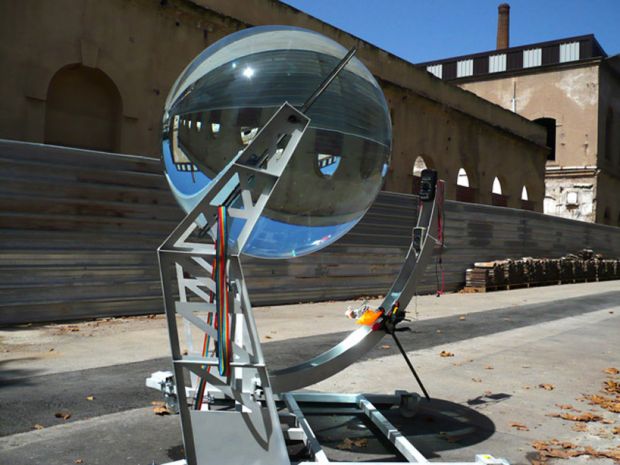
On Spherical Robots

And the notion, that no matter how crazy an idea is, someone, somewhere will have a perspective on it that makes it incredibly useful.

So. Spherical robots – and I must admit, there’s a bit of a fixation for them out there in the world-of-unreality-fighting-towards-the-surface… and I don’t know why, because there’s a major problem with robots that don’t have arms: they can’t solder. Hopeless. Still, there does seem to be this fixation – I think basically because we like the shape – there’s something about a sphere that just seems “right”, or complete, even though it’s not, because it can’t solder or tie shoelaces etc. Still never mind.

I think these ones are rather glam:

sphere1


(from)

Spybots – Amphibious spybots – not disimilar in intent to Rover off The Prisoner – which was basically a massive floppy balloon that chased people and then caused them to black out.

Or those tiny exploding balls off Aeon Flux

But never mind about that – back to the inflatable ones (and anything inflatable is basically a good idea waiting to happen)… Balloon Windmills!

sphere2
(from)

What could possibly go wrong? Brilliant.

And as far as I can gather from the little video – it’s basically a spherical robot run backwards

On the Power of Crowd-Sourcing.

Or Why You Will Never Make In On Your Own.

lighbulb1

So anyway, I’ve been sitting on this idea of electricity-monitoring for about 10 years now, and thought I had it all figured out…

… and a conversation turned up on the open-manufacturing list recently which led to the Internet 0 thing, which is now 5 years old and appears not to have set the world on fire, or at least not yet.

And I always thought that the killer-app for electricity-monitoring would be being able to control your house from the web. This would be the bribe that would get it through the door – and I missed completely the REAL killer-app, which is that with wified home-automation, you don’t need to have wired-in light-switches – which radically reduces the amount of building effort/cost/expertise etc. The driver isn’t novelty-seeking consumerism, it’s the building trade.

Ten years of thinking about this, and I missed what someone with a different perspective saw immediately. This is why crowd-sourced imagination is a killer-app at a higher level. It doesn’t matter if you’re Einstein or Newton or Da-Vinci… you simply cannot compete with imagination coming from a multiplicity of different perspectives.

How does the saying go? 1 point of perspective is worth 80 points of IQ?

Crowd-sourcing doesn’t work for everything, but it’s very good for perspective… and therefore very good for imagination.

Home Energy Monitors / Automation

This is really starting to pick up steam now – Lady Ada has an open-source version

tweetstart_LRG

there’s a group in London that has regular meetings and a lovely logo

homecamp

the products are going mainstream
montor121

monitor2

google are getting in on the act, Tim O’Reilly is getting in on the act.

And so on – I’m still not sure they’re getting it entirely right – although Google and Amee aren’t getting it wrong – they’re just hardware independent, and this is a hardware problem.

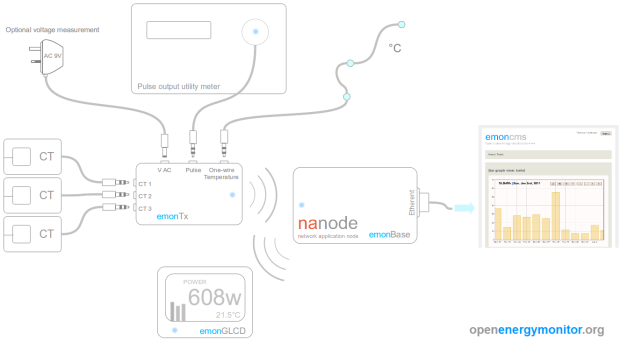
So what I think it needs is something that looks a bit like this:

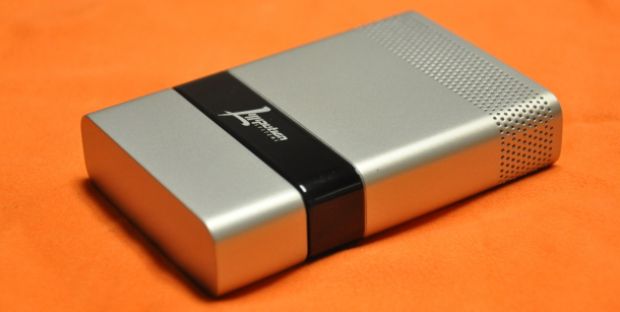
centametr

Remote control is the bribe to get people to use this – it’s the killer app, and monitoring (which is where the real benefit lies) sneaks in on the back of it.

So:

- there needs to be wall plugs like killawatts, that monitor usage and can switch on/off remotely
- there needs to be clamp meters that can measure the whole house, or appliances where remote control is difficult or unnecessary
- The signal needs to be being logged all the time, without a computer – straight to a modem.
- the web software needs to be able to be hardware-agnostic.
- the visual feedback needs to operate at a really simple, emotive level
- it needs to be useful without having a meter on every socket
- it needs to be able to pull power from the lines its measuring – ie: no batteries
- and it needs to be cheap.
- the “devices” or “rooms” etc need to be taggable – this is where the social benefits kick in – so we can see if a certain product group (or even product) is being a drain on resources.

It’s nearly there, but it’s not quite there.

This one is interesting (TED) because it uses the power lines themselves to transmit data – rather than resorting to XBEEs

Daylight Bulbs from Plastic Bottles

Another one for the Appropedia


(from : and the conversation in the comments contains a fair bit of knowledge as well)

Which is something that has caught on, and proliferated throughout the entire neighbourhood. What we need to do (now that 1/2 the human race have cellphones) is to hone the teaching-aids… video, text, diagrams etc etc such that information like this can be spread rapidly, globally.

While it may not be practical to overlap this with the Sodis water disinfection thing, it’s not a million miles away.

Speaking of which, here are some neat designs for bottles specifically for sodisifying.

sodis2

sodis1
(from)

Which in some ways misses the point, but raises points of its own… maybe the way around dumping/recycling the billions of plastic containers that we throw away each years is to make them useful in their own right.

As an even more tangential aside, I bought a bottle of water here in NZ the other day – the container of which boasted it was made of cellulose… looked and felt (and tasted) just like a normal plastic water bottle. I left the empty container on the seat of my car in the sun – when I came back it had shrunk to the size of a lightbulb.

So that’ll be things going full circle. Kindof

Cool Wind Generator Design

$700 AUS… now that’s getting somewhere. It looks as though it uses the whole roof as a way of funnelling the wind. Looks simple enough to reverse engineer as well – really there’s no reason why these things should cost more than plastic rubbish bins….

… apart from the need for:

A battery bank
Regulators / Inverters
Wires, wires, wires.

I quite like the idea that someone had a while back… which was only an idea – for a wind system that you could just plug into any wall point – and it would supply power back to the rest of the house. I guess it’s not impossible with adequate levels of trickery at the junction-box end of things.

It’s so easy to get hung up on the mechanical bits… it’s actually retrofitting the existing system that costs.

Ecotricity’s wind-powered sports car

A while back I went on about Jeremy Clarkson’s review of a Tesla… which he was generally impressed with, but took fright at the price.

It appears that The Ecotricity guy has built one… and the development costs have been less than the cost of a single unit of the Telsa.


It is faster out of the blocks than a V12 Ferrari and can do 0-60mph in four seconds. It will go faster than 140mph and can be fully charged over lunch. But the most remarkable thing about the first British electric supercar is that it is not being built by one of the world’s great car companies with a limitless research budget, but has been knocked up in a few months by some middle-aged engineers in a Norfolk garage from off-the-shelf parts mostly available on the web – Guardian

To be fair, they’ve borrowed a fair bit of development costs by basically nicking the design of a Lotus Exige… still, an electric car that doesn’t look like a tea-pot.

I think we’re going to be seeing more of this sort of thing… largish companies that belong in the 21st century rather than the 20th setting up innovation labs where groups of very smart people are allowed to “play”.

Next,

An ode to Cognitive Surplus.

A celebration of the inventive backwaters of the human spirit... a celebration of people who would appear to have far too much time on their hands...


A celebration of laterality.


If you come they will build it.


By knowledge shall the spheres be filled.


Weirdsky Industries