GENOMICONrss

rss

The Crowd-Sourcing of Intelligent-Design

emergent economics

Butterflies, Wheels, Worms: and the Turnings Thereof

It’s all about books.

Ok, first you have to watch this.

WTF? It’s 47 minutes long?

Ok – you don’t have to watch it, but it would be better if you did.

It’s one of those tarted-up dramatized documentary things that someone’s pirated and put up on google. It’s about the Venetian Inquisition back in the 1500s. There are two horrible bits – to do with burning and boiling – you can skip past those – but please do donate some money to Amnesty International, because in the name of religion and politics, this stuff is still happening today.

It’s about books.

The First Gutenberg Shift in fact – the church had a monopoly on the flow of information – and in particular the flow of information from people to God. This gave them an Empire, and license to create laws, and enforce them. Brutally. They had every thing sewn up, from top to bottom.

Then people learned how to make books (skipping-the-bishops) and the church responded with The Inquisition, and an interpretation of scripture that granted them (again) license to behave as cruelly as blind faith and the the medieval imagination will allow. All under the strict oversight of the law. Their law.

The reason I’m going on about this is (as well you know) that exactly the same forces are at work today. Digitisation has allowed people to do for themselves what they once had to pay corporations to do. “To Replicate and Distribute” – this is the value that corporations once provided… and it allowed them to hegemonise our culture, but now we no longer need them.

So now the Copyright Cartels (big publishers, owners of “IP”, et al) are attempting to change laws to maintain their empires.

True to prototype, they’re using the law as a terror-weapon against people who try to route around their distribution systems – this is why the original students (students again) sued for file sharing, were hit for something like 18 trillion dollars each. This is as close as a modern lawyer can get to burning someone alive.

In addition to this, they’re using the tried and true tactic of conflating this new freedom with “indefensible” crimes. So you will hear about child-abuse and terrorism – it used to be heresy and witchcraft. (and somewhere out there, circling in the dark is a nagging irony that these new “indefensible crimes” of child-abuse and terrorism, have this uncanny habit of turning up in shadows of the old monster, religion… but let’s leave that for now)

Still, The Corporation today is not as powerful as the church of yesterday, and this pattern of prosecution/persecution has now fallen back into something a little less theatrical and a little more pecuniary – people are sued at a level where they’re frightened of going to court, so settle for a justice-free fine.

Corporations after all are not generally staffed by monsters – it’s the system that’s the monster, the people are just people.

Anyway, it’s about maintaining empire in the face of a sweeping environmental change.

So the first Gutenberg shift was about books. Watch the video.

And now:

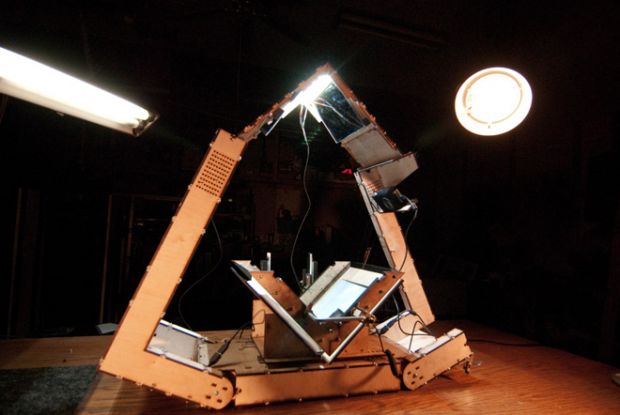
scan12
(from)

Although this probably isn’t going to shake the new empires of control to their cores, it does represent a nice symbolic circularity. There are now communities of people experimenting with the digitization of books.

And it only started 6 months ago – in June 2009.

This is Web 3.0… aka, The Next Sweeping Change. It’s memospheres of hardware. If you think it’s anything else you’re dreaming.

This technology has been around for a while of course – there’s a 4 year old ad here for an ATIZ for $35.000 (LOL)… and the 1000 frames a second Japanese variant. It’s only a matter of time before someone makes one out of lego. (actually, they already have)

I do find it massively ironic that some of the companies making this technology actually try to patent it (similar to the irony of the video at the top of the page having been pirated, in a 500 year old echo of the subject matter)… but – it’s a little more interesting when people do it themselves. It creates a kind of tech evolutionary fast-breeder.

People doing things for themselves (eg: The Whole Earth Catalogue Generation, Punk, Rave etc) is like a cultural flooding of the Nile. What went before is swept away and a new fertility is distributed – to anyone willing to pick up a shovel, or a guitar, or a typewriter, or an Arduino.

DIY Book Scanner Introduction and Motivation from Daniel Reetz on Vimeo.

I find the justifications given by the book-scanners interesting as well. They all seem to have this “morality” which is all about rescuing books that are out of print, or unavailable. It’s all about the long tail. It’s all about bringing literature to the blind, the disenfranchised. It’s all about fearfully avoiding stepping on the toes of the “owners” of mainstream information.

Well I say to hell with them.

The real reason for uploading information is to get the whole of human knowledge into the universal-mind, and make it universally available. That is the end that we’re driving for… that is the New Protestantism that hasn’t yet coalesced around a single unifying morality – that hasn’t learned its own name yet.

The “rights” of massive corporations in the big-picture are about as morally important as the “rights” of the Medieval Church to sell indulgences. They can spin it any way they want… they can back it up with force… but in the end, they don’t matter. The actual, physical environment in which they (and we) exist is now different, and it will never go back to how it was before… and really, why would we even want that?

It was the responsibility of previous generations to commit all human knowledge to writing… for future generations, so knowledge would not be lost. It is the responsibility of our generation(s) to digitize human culture. Not just our own, but all previous generations as well – so it is universally and freely available. “Money” will have to adapt – we’re don’t exist to serve money, it exists to serve us.

We have a moral obligation to artists, and art, not to economic systems.

So that’s my thought for the day.

Crowd-Sourced Fightmobile

See… if a load of… “enthusiasts” get together to design a car, the last thing they come up with is a teapot. What they produce instead is something specifically designed to fight other cars… and they call it The Rally Fighter.

fightmobile1(via)

Local Motors, who crowd-source (to an extent) the designs of their output have put together something… and for about $2 million dollars (which is peanuts apparently) made a machine that people will actually want… although by “people” they mean the American Off-Road Rally Market… who can afford $50,000.

I’ve gone on about Local Motors before… once raving uncontrollably about what a great idea it is, once raving uncontrollably about what a terrible idea it is.

These days… undecided… but it’s probably a good thing, because I’m gradually coming to the very definite conclusion that the biggest problem that humanity has is top-down control… and while 2 million/50,000 still looks pretty expensive to me, it does mean that you don’t need to be a corporation the size of GM to do it… and it’s companies like GM and their deliberate sabotage of renewables that have created a large number of the problems we face today – whether they be wars in oily countries, or a sky gone so oily that the ice-caps are melting

Someone pointed out recently that the only types of electric vehicles that seem to get designed are teapots, or supercars. I wonder… if cars are evolving into two different sexes? Not that women necessarily only like teapot cars mind… but… I have noticed that they quite like cars that look like bugs or little (big) animals.

Anyway. The car above is definitely a bloke car… a 15 year-old bloke car – which is to say, it’s designed to impress other boys, rather than women.

Phoooaaar

Side_view_BenFinal

Flatland Revisited #3

A truly impressive bit of stop-animation from the NZ Book Council entitled “Where Books Come To Life”, although I daresay a fair number of books died in the making-of.

Actually, speaking of which, I was reading this thing from Clay Shirky last night that seemed to be saying “well if you like bookshops so much, why don’t you club together and buy one?” – which is a bit like saying “well if you like it so much, why don’t you marry it?”

But isn’t really like that at all. He’s quite interested in Mutualisation is Clay – only he spells it with a ‘z’. Groups of people getting together and buying infrastructure off their own bat – rather than being permanently under the aegis of some sort of top-down control.

I saw on the twitters the other day that someone was going to their kid’s school (or somewhere) to protest about various lacks of spending or whatever. I used to live in the country when I was a kid – waaaaay out in the country. 50 miles up a gravel road from the nearest shop. My Mum and Dad were school teachers at a school that looked after local farmers kids – almost all of which were Maori as it happens.

Anyway – there wasn’t really anyone to protest to, so my Mum and Dad and the locals all got together and built a massive swimming pool for the school. It was the 60s. You could do things yourself back then.

God-damn that’s a digression. Still. There it is. I bet the swimming pool is still there. It’s often easier to get people to donate time than money – especially if it’s a chance to meet other people.

P2P Banking

Well as you may have gathered by now, I’m gunning for the banks. In 2006 I took all 4 of my banks to court and extracted about £7.5k in fees that they had unlawfully taken from me over the years. But that’s not enough – I want to see them completely destroyed. Out of business.

Which isn’t to say that banking isn’t absolutely vital to the running of things – it is. In a way that’s part of the problem: you can’t survive in a Western society without one… and they act as a cartel, and suck blood out of our societies. They’ve been operating a type of derivative colonialism against developing nations for decades.

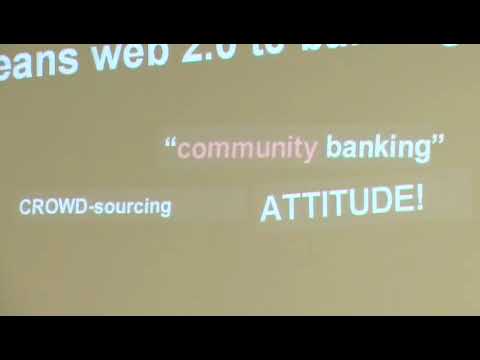
Anyway… sometime soon, the thing that happened to the entertainment industries is probably in some form going to happen to banks… and this is really interesting:

It ticks a lot of boxes… especially the bit at the end where he says “this brings us to a situation comparable to a small village…//… because when you’re are in a small village and you screw up, everybody knows – and this is very important… why? because you think about it, before you screw up”.

I think this concept is crucial, in all sorts of areas. It’s the way out of market-orientated management of everything from schools to hospitals to… well, everything that’s run by the government, but which is not natively well-suited to being a business.

Kiva took a bit of a broadside recently for being somewhat less than transparent about who exactly people were lending to. And someone pointed out that what this creates is not cynicism for Kiva so much as the next Kiva.

I think the interesting thing about Kiva is not that the fundamental drivers were being misrepresented, but how strong the fundamental drivers were… ie: people will help people… and the closer you get to the ‘story’ that the other person tells, the more you’re likely to help. This wasn’t about feeding random people dying in some country you couldn’t point to on a map… this was… well… a proxy for a one to one connection. What Kiva supplied in terms of “story” is incredibly thin and one-dimensional compared to what we’re capable of.

And I think this will be really big… and the social-village is a crucial part of it. That is how we self-police… we internalise the shame – the loss of reputational capital… of being caught cheating.

And I think this is how we bring down the banks. A mixture of this, and localised currencies. “Too big to fail” they said, as they stole our taxes… and then failed to break them up, so they were no longer too big to fail. Well… the solution to the banking problem is the same as the energy problem: We go off-grid.

Look a Yonderrrrr….

An inside out advertising crap-sandwich, with the crap on the outside and the genius in the middle.

It’s a piece of absolutely superb advertising… Nick Cave talking about his new book (and for the record, Nick Cave is not only one of the best writers I’ve ever come across, but he’s also the only human being I’ve ever seen charismatic enough to hold down a 30,000 audience at Reading Festival, in broad daylight, on his own) (and I have seen a LOT of bands – thousands, easily) – but that aside, this is a truly great piece of advertising. I will buy whatever he’s selling because by being honest and direct, and a bit self deprecating and… human, he’s engaged me.

And on either side of this is “advertising” which sounds conniving and manipulative… even though it’s absolutely state of the art, and probably cost hundreds of thousands to make. It has had writers writing it, actors acting it, all manner of effects and editing and gloss and so on… and even though I don’t even really know what it is that it’s advertising, I don’t believe it. You can’t see any substance for the polish… because there IS no substance.

I think David Byrne once said that “The better someone’s voice is, the harder it is to believe what they’re singing”

I think Thom Yorke once said that “the meaning of life is heartfelt communication between people”.

You can’t fake it any more. It’s got to be real.

ps: And Nick Cave’s right about vinyl as well – and that’s a way out for the music industry. Market a physical product as being superior and “purer” than the compressed digital version… because let’s face it Possums, it is.

(Insert Name Here) – Dollars

Ok, this is ill-conceived, not thought-through and premature. I don’t know what I’m talking about.

I saw these the other day:

designDollars

(via : from)

A London Design firm (or person) Lisa Tse has taken to printing their own money – which, admittedly, they did back in January… and if their office is where I think it is, then you probably need to be able to print money to be there.

Still… it reminds me…

I come from a small town in New Zealand in the 1970s… there is a beach covered in sticks and bits of pummice, and the kids all ride their bikes to school and there’s nothing for teenagers to do except drive up and down the main street on Friday Night listening to ACDC.

Once a year, they (we) have a thing called “The Big Dig” where all the local businesses give prizes (a free haircut, 3 free lawn-mowings, some new wind-screen wipers) – these are all printed on bits of paper and buried in their hundreds, in film canisters out at the beach. Then on the given Saturday, everyone rushes out and digs up as many of them as they can. Not all of them get found, and sometimes you find ones that weren’t found from the year before. They still work.

This is localised currency… each business issues a little bit of its own currency – promissory notes every bit as real as the printed money that is conjured out of nothing by the central bank.

Obviously, a business can only issue so many of these IOUs. In the case of The Big Dig, they’re essentially swapped for advertising – and this (I suspect) is what Lisa Tse’s dollars are doing as well. There are in-built limitations on the accumulated value of these things… you can’t be an “Upper-Cut” billionaire, because not only can you never use a billion haircuts, Upper-Cut can’t possibly deliver that many.

There are limitations, and there’s possibly a limited shelf-life, and maybe this is a good thing. The world doesn’t need billionaires. Billionaires have not made the world a better place. Systems of money that are designed so that people who are already rich just get richer and richer (at other people’s expense) without actually doing anything… without creating any value – that is deeply problematic.

Maybe currency that is a function of the value in the system – rather than a function of how much can be borrowed (from the future) is a good thing.

Every time someone in my little town buys a house from someone else, hundreds of thousands of dollars is siphoned out in interest and insurance payments, and winds up going to some distant corporation (who probably bankrolls wars and environmental abuse).

This isn’t a minor parasitic drip-feed, this is parasitism through a pipe so thick… it’s specifically tuned to the utter limit that the market can bear. It’s maximised to be slightly shy of killing the host. This is what we live with, and we think it’s normal.

And it is normal, but it shouldn’t be. We need to route around the centralised money system.

Micro-Volunteering

This is fantastic… potentially, maybe, I think.

It’s like a distributed, mechanical-turk-style application where people can spend a few idle minutes, hours (whatever) doing some small bit of voluntary work… via iPhone

It sucks because it’s via iPhone. Everything else about it is great.

There are a couple of reasons why I find this so interesting….

1) In my experience, people are really reluctant to hand over money, but will volunteer time. Lots of it. I can’t quite figure this one, but it seems to be what happens. Asking for donations (in my experience) is a total waste of time compared to “could anyone help me with”… some actual bit of work

2) I think we need to get away from debt-based currency. Back in the late middle-ages, they had grain/corn-exchanges – grain being a commodity that absolutely everyone needed and used. I don’t think such a thing exists today. I’ve come across a guy trying to design a system based around energy… joules instead of dollars – but he’s so verbose that I can’t figure out what he’s on about. And so it won’t work.

Micro-volunteering offers the distinct possibility of exchanging labour for labour… in an arena which isn’t automatically a zero-sum game. A bit like the Japanese granny-care setup that Douglas Rushkoff occasionally goes on about. This isn’t what this app is set up to do, but it has potential.

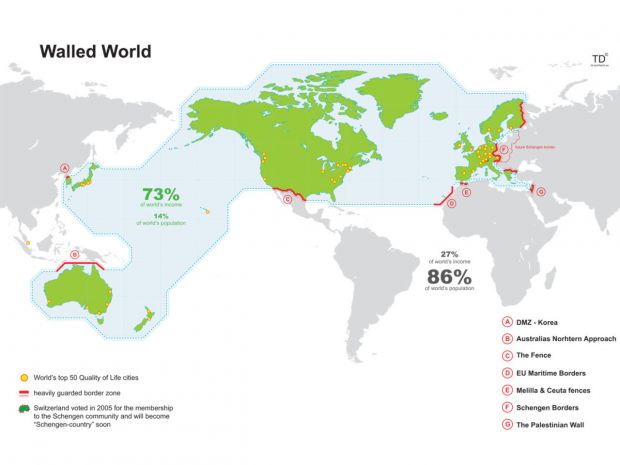
3) I think there is huge, powerful potential in one-to-one communication from the walled-world, to the outside.

walled

I think that conscious attention… the knowledge that it’s there, the act of giving it, is going to be a LOT more powerful than simply punting money at charities once a month etc. Eventually, something is going to do to the big global charities, what P2P did to the RIAA et al – and I think that is going to be a real world-changer.

Theoretically, the mechanisms for this already exist – but there’s something about working together that really pulls people together. Social apps doing nothing but chattering doesn’t have quite the same effect.

And I don’t think it’s a one way street. The West is suffering from chronic existential problems and depression. I think value is going to flow both ways. Big time.

And I think this app is an example of how it could start… just someone sitting at a bus stop helping out with a bit of translation… giving some advice, saying “hi, what’s the weather like where you are?”

4) This is also a mechanism that would support the Crowd-Sourced Eco-Monitoring that I was on about earlier. I think there are fairly huge benefits to this as well.

Nano Ganesh

Like quicksilver – smarts adapting to an erratic environment…

ganesh
(from)

For $56, farmers in India can control the pumps that irrigate their fields… which saves them walking for miles, sometimes for nothing, because the pump-driving-electricity is a bit erratic. It’s called Nano Ganesh.

I can see this as a general principle becoming very widespread – cellphones as controllers for everything. This is looking something like physical telecommuting – where instead of working (in your underpants) on information-processes that are anywhere on the planet, you’re working on physical activities… farming for example.

There’s a movie that I haven’t seen yet that seems to have a fair bit of this – in an entirely unpleasant and exploitative sort of way:

Which you can watch in Spanish etc, because the one with that gravelly hollywood-ese American voice-over is simply too stupid to live.

It’s a nightmare vision this though… it’s not labour-saving in the sense that a farmer saves herself walking for miles just to turn a pump on and off, it’s labour-saving in the sense that the cost (and therefore value) of human labour has been pushed down to the point that people have become inhabitants of matrix-like virtual-sweatshops.

And this is an inevitable artifact of the fact (and I’ll say it again) that our money system is not based on abundance of production, but is lent into existence (at interest) as a scarce resource. Our monetary system has poverty built into it.

Viral Cloud Manufacturing

This is the most interesting thing that’s turned up recently:

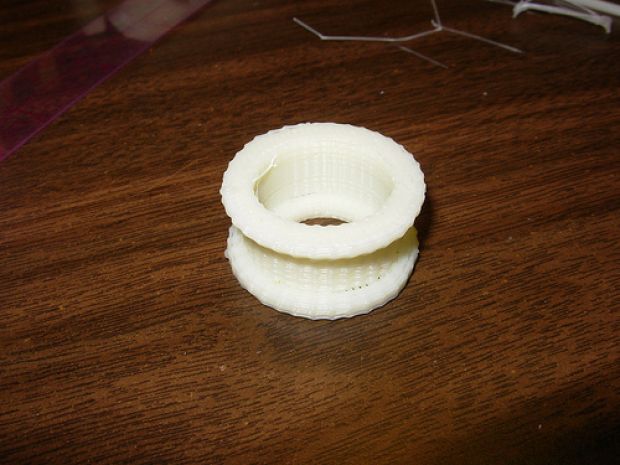
cog

Nice innit. It’s a small plastic thing. You can never have enough of those.

What it is, is… the peeps who make the little Makerbot things… little laser-cut 3D printers with a bit of the reprap tendency built into them, found themselves a bit hassled for time and are offering to pay people to make parts… with their own makerbots. They’re paying a $1 a go.

Now… I’m not sure if anyone’s done the numbers on this (they must have done, but what are they? what are they?)… on how much of a bite materials/electricity/postage makes out of the profits… or how many can be made an hour etc etc…

… but, in the Web 2.0 world, there’s a list of tickboxes for “signs that your startup will be successful”, and top of the list is “it helps people make money”.

This raises a potentially interesting scenario (if the numbers do work out) of people buying Makerbots JUST to make the parts for other Makerbots. You’d have this potentially rapid proliferation of a technology that serves no other purpose than to self-proliferate… because (god-dang it) I still haven’t seen anything that a reprap’s produced that would stand up against an injection-molded rival, that would cost a fraction of the price.

A reprap bubble in other words.

Now… what really needs to happen is for this to somehow be driven not by $$$ but as currency that looks a little bit like this:

ie: a currency based on abundance-of-production, rather than being lent into existence (at interest) as a scarce resource… that we then fight over etc.

Despite what Gordon Gecko says, This is NOT a zero-sum game. We’ve been cheated.

Anyway, I’m really interested in the idea of The Reprap model escaping from the confines of a single piece of technology, and getting into a much wider sphere… but I wasn’t expecting this. This is… Motive.

Spoonflower : Custom Printed Fabric

This is cool, though I lack the competence to actually make shirts (or whatever) myself. They should hook up with an online shirt-making place.

Assuming you wanted a shirt of course.

textile1

The “no-minimum-run” is the thing though. This gives people the breathing space to experiment.

Next,

An ode to Cognitive Surplus.

A celebration of the inventive backwaters of the human spirit... a celebration of people who would appear to have far too much time on their hands...


A celebration of laterality.


If you come they will build it.


By knowledge shall the spheres be filled.


Golden Mean Calipers