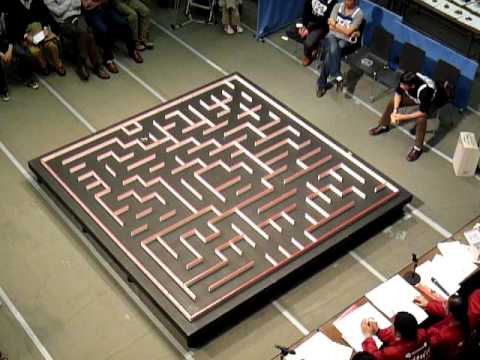
The first one is the learning round, the 2nd is the “learned” round. When it knows what to do. It goes like the clappers. I especially like the way it does a fancy little 1/2 spin when it’s finished.
I think these mouse-races are vaguely interesting – because they demonstrate something… that as usual, I can’t quite put my finger on… something to do with the difference between bits and atoms.
I’m drifting (or at least attempting to drift) from programming to micro-industry. From bits to atoms… and one of the things that is really striking is the shift in headspace required. With bits, once you learn something it’s done. “To Name Something Is To Have Done With It”. Once you learn something, you can abstract it away… “It Is Known” – which means you never have to think about it again.
Don’t work so well with atoms. You can nearly do it… with the CNC end of things – which is (in case you were wondering) to do with the purity and uniformity and “unnaturalness” of the materials that are used… but I’ve been making those golden mean calipers for 2.5 years now, and I’m still learning techniques etc. One of the revolutionary tectonic undercurrents of the current age is the drive to turn hardware problems into software problems. That is what CNC (in it’s myriad forms) does. Software is easier than hardware – in part because of the abstraction thing. Once something is learned, it is known, and can be given a name and “invoked” but never thought of again. Software has a bias towards single-iteration learning.
I think there might also be some relevance to AI – as in machine intelligence that learns as it goes – from feedback that it gets from somewhere. My new Niece is a type of AI… a couple of months old… and it’ll take years of full-time training to get her to work properly. There’s a slightly older model – a couple of years… which is a vast improvement on the new one, but which still has soooo many years before she becomes fully-functional, that it’s bewildering. It’s a process of massive multi-iteration learning. A huge programming job.
So anyway, that new mouse is learning how to do something that requires a single iteration. Normal reality is not so accommodating – and is so complicated and unreliable that it will probably take an AI to negotiate it… or a mix of hard-coding and AI (which is what we meat-bots tend to have). The the alternative is controlling then environment (the art of politics) – which is what lego is, and laser-cut perspex is and what this maze is and so on. Existing industrial robots.
Maybe that’s another huge tectonic undercurrent of the robotics revolution – creating systems with reduced needs for controlled environments. Until that becomes the norm, then the creation of controlled environments/inputs is probably going to be at least as big as the creation of the machines that will operate within them.
So much will have been written about this in the time that it takes to write this sentence it’s hardly worth bothering – to dog-paddle amid the tsunamis of hype…
… but in case you hadn’t heard, and because the purpose of this here web-address is to keep track of things, Google started talking about Wave today.
It’s one of those things that deals with such basic interactions, that the full effects of it aren’t that predictable – the real-time collaboration on the same page for example.
In a nutshell though, it makes any conversation (be it via email, blog comments, etc) into an embeddable object. The ramifications of that are huge. Conversation on the web at the moment is a mess. Everything’s everywhere – if this takes off – and I suspect it will, because the viral aspects of it are Skype-like, then it will not only create and destroy whole rafts of businesses overnight, it could well wind up changing the way we interact with each other.
If it does link your email identity to your comments-on-blogs identity… then every comment you leave on every participating service will be traceable back to you – all your comments will become a single body of work. It may well lessen the anonymous arsehole factor – which is a shame, because I rather enjoy being an arsehole sometimes, still, there you go.
Google (and in fact the entire internet) is, as far as I can gather, not a million miles-away from being a giant artificial intelligence machine. Possibly the greatest ramifications of this are in this area – if so, what does it mean? Far, far smarter linking between conversations I think. The Universal Mind may be about to have an IQ leap.
If it catches on, and I think it will. I think this will be a bit of a game-changer.
“‘Eureka machine’ puts scientists in the shade by working out laws of nature
The machine, which took only two hours to come up with Newton’s laws of motion, marks a turning point in the way science is done”
So we may have come a long way from when I was at school and we used slide-rules then.
[edit] It also seems that a genetic robo-scientist in Wales has performed the entire loop of the scientific methodology on its own… and made a discovery.
” As reported in the latest issue of the journal Science, Adam autonomously hypothesized that certain genes in the yeast Saccharomyces cerevisiae code for enzymes that catalyze some of the microorganism’s biochemical reactions. The yeast is noteworthy, as scientists use it to model more complex life systems.
Adam then devised experiments to test its prediction, ran the experiments using laboratory robotics, interpreted the results, and used those findings to revise its original hypothesis and test it out further. The researchers used their own separate experiments to confirm that Adam’s hypotheses were both novel and correct–all the while probably wondering how soon they’d become obsolete. ”