GENOMICONrss

rss

The Crowd-Sourcing of Intelligent-Design

3D printing

Software: The Glue of the Apocalypse

3d_print

CAD is hard.

The micro-manufacturing revolution isn’t going to happen unless people get A LOT of help with the cad side of things… so for a while I’ve been keeping 1/2 an eye on a sort of Lego-Layer… a layer where people can “make their own designs”, out of pre-made parts, where the heavy-lifting CAD-wise has been done.

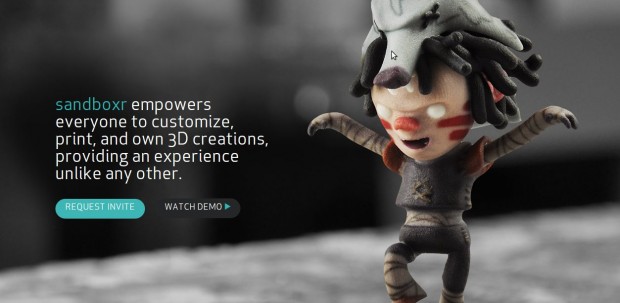
Enter Sandboxr.

Which firstly is quite a nice looking website, looks like bootstrap, but appears to be (bless) table-based, so who knows what it going on there. That aside, this is How To Do It, I think. Big and Simple.

Nice looking prints as well – which is (apparently) why they need $120k from Kickstarter. To get their own colour 3D printer.

Beyond that though, it’s quite a neat parametric system… and I think this slider-thing is going to be the way things go. I think this because I’ve written a couple of really simple versions myself, that I’ll launch, once I get a DRM key for my laser cutter (I’m having to buy LaserCutter 5.3 (which sucks) twice (which sucks)).

Still… pretty neat… trivial, but pretty neat. They’re aiming to be a showcase for designers… to flog copies of their wares… which I don’t have a problem with because they’re actually selling physical instantiations, rather than selling copies of bit-patterns (a practice which should be roundly mocked)

So it looks like the 3D Printing gun guy is attempting to set up a Pirate Bay of 3D Printing

… although to be fair, The Pirate Bay is already the Pirate Bay of 3D printing… though without the bells and whistles that Defcad claim to eventually offer.

I kindof like where this guy is coming from…
and I kindof don’t.

This bit is good:

“But with 3D printed firearms, pharmaceuticals, automobiles, drones, and medical devices, the stakes will suddenly get much higher. Because 3DP is not about reviving manufacturing jobs or competing with assembly lines on cost. It is not about disrupting manufacturing. It is about disrupting copyright, IP, and regulation. It is about printing items whose prices have been set to infinity. It is about disrupting man-made forms of artificial scarcity”

Good on him – making a stand over something that needs to be made a stand over “it’s about disrupting copyright”…

… but disrupting regulation? That is not such a good idea. If it wasn’t for regulation we’d still be dumping CFCs into the Ozone Layer. Corporations/Industry need to be regulated – every bit as much as drivers need to be dissuaded from driving drunk. The trouble with this guy is that he appears to be a libertarian, and libertarians are idiots.

He also appears to be a Little-American Libertarian which doesn’t bode well. Insular conservatives who don’t seem to realise that there’s a world outside the US. So he makes a big deal about donating 50% of the proceeds from a deliberate rounding-error to VFW… aka “Veterans of Foreign Wars”. Got bad news for you sunshine: The “Foreign” bit is where 95% of the people on this planet, and therefore The Internet live. The Internet is not American. The revolution is not American. It’s all of us… and the rest of us don’t want grown-up teenage-boys running around with guns… whether they’re stay-at-home gun-nuts, or soldiers “defending their country” by attacking other people’s.

Americans get duped into worshipping their soldiers by politicians trying to deflect criticism from insane budgets and insaner wars. Donating money to US ex-soldiers may play well to the home-crowd, but the rest of the world would really just prefer that US military would stop attacking people. I’m guessing a fair few Americans feel the same.

And then there’s the video of course. That kindof sinks the whole notion:

He watches too much television. Compare and contrast to the movie about the Pirate Bay guys… sometimes they’re smart, sometimes they’re stupid but they are who they are. They don’t sound like they’re trying to do voice-overs for History Channel programs about UFOs visiting the Ancient Egyptians. I think he’s going to come a cropper… because he’s pretending to be something he’s not… but what he’s pretending to be, so many people (so badly) want, that he’s being forced to become it… and the thing about the excoriating gaze of the internet, is that LSD-like, it will find your cracks, and blow them 40ft apart if you’re putting on an act. The Koby guy went to pieces; Julian Assange did not. To live outside the law, you must be honest.

Though to be fair, he comes across a lot better in this… but anyone who talks about “Liberty” is (these days) buying into something fake. It’s a very odd notion of freedom, which we once heard a great deal of in defence of the slave-trade. There’s something Orwellian about the way they need to say “Liberty” rather than “Freedom”. Again, “Liberty” appears to be a very conservative American idea, loaded with revisionist history… and one which the Koch brothers put a great deal of money into. It reeks of bullshit.

So I can see this ending messily – which is a pity, because the actual “thing” he’s making might be very worthwhile, and I really admire the no-quarters stand he’s making.

But give me the Pirate Bay any day.

3D Printed Records

From, via

Full circle, after a fashion.

I read somewhere that theoretically you could reproduce the sounds of Ethiopian 1000 BC village life, by interpreting the “wobbles” on clay pots, thrown on potter’s wheels.

Similar sound-quality to this I imagine… which is similar to the very first wax tumblers. This is off a $250,000 printer though – Objet Connex500… not exactly a hobbyist machine. I’m guessing it will be a year or 5 before sub $2000 can do 600dpi (42 microns xy, 16 z). As far as I’m aware, hobbyist machines are currently clocking in at about 100 microns. I’m not sure if there’s a Moore’s Law attached to printer resolution. I guess there is. 5 Years then. The “it will happen, but I don’t know when” event-horizon.

So there you go – the world’s least efficient digital to analogue converter.

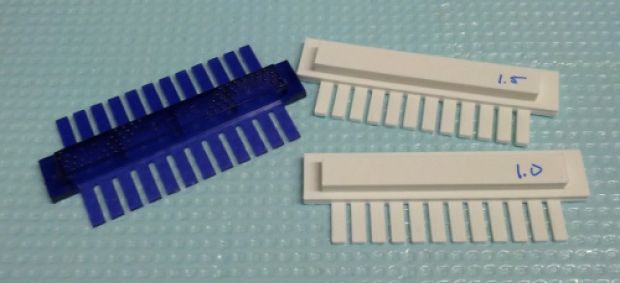
$300 worth of Lab Gear for freeish

gel_combs

f=0.01;
difference(){
  difference(){
    union(){
      cube( [ 80, 27, 3 ] );
      translate( [ 5.25, 14.3, f ] ) cube( [ 68, 9.3, 7.25 ] );
    }
    for ( i = [ 0:5 ] ) {
      translate( [ 17.1+i*11.0, -f, -f ] ) cube( [ 1.75, 12, 5 ] );
    }
  }
  union(){
    translate( [ -f,   -f, -f ] ) cube( [ 7,  12, 7] );
    translate( [ 73+f, -f, -f ] ) cube( [ 7,  12, 7] );
    translate( [ 0,    -f, 1.6] ) cube( [ 80, 12, 8] );
  }
}

from

Words are for typewriters. It’s time we stopped pretending we don’t talk to machines.

Hilo : Smartphone as Physical Platform

Firstly, this:

Which is a Kickstarter project from New Zealand… achieved with the help of a US partner – because Kickstarter is US only… or was… Kickstarter is (as of this month), UK (and I think that means EU) capable as well now. Kickstarter UK pulled down about a million dollars in its first week.

I like this mirror thing – because it’s something I’ve attempted to make myself, and it’s actually pretty difficult. I tried to make one out of a dentist’s mirror, and a computer hard-drive… neither of which worked terribly well (apparently you can make laser-cutter mirrors out of hard-drives). To a make camera-capable thing though, you need special mirrors and special lenses… and according to this video, special software as well. It’s not as easy as holding a mirror up in front of the lens.

I suspect that one of the main uses is to take photos of people without them knowing. The universal panopticon just got a little smarter. People can now take photos and videos without it looking like they’re taking photos and videos. With these you can use Augmented Reality apps without looking like a doofus. It removes the Segway Factor from AR. I think this little gadget has wheels.

I’d buy one like a shot, except that:

I don’t like this mirror thing because it’s Apple-only, and Apple are on the wrong side in the war on open computing. Apple is the Monsanto of tech. They’re actually more despicable than Microsoft – and that takes a bit of doing. If I had my way, trying to take control of the root would be a criminal offense – on a par with planting malware on a machine… which is exactly what it is. It’s baked in malware. As far as I’m concerned, Apple are a criminal organisation – and it’s not because their products are made by slaves, and they only pay 2% tax. Taking control of the root needs to be up there with “thou shalt not kill”.

But other people either don’t know or don’t care… so the vast majority of “Smartphone Accessories” on Kickstarter are iPhone only.

That little Robot (Romo? Roveo) – whatever is now back for its second round of Kickstarter funding – something that triggered me asking for my money back for the first round – because I “invested” in one of their robots, and it didn’t work. They sent a replacement, that didn’t work either. To be fair, they’ve behaved in a completely helpful and professional matter, apart from being incredibly slow to respond. I wish them well… their new offering however is iPhone only, because apparently their developers ran screaming from the room when it was suggested they do something for Android.

When I asked the Hilo guys about Android, they said “we’re releasing the schematics, so if you want to make your own version to fit your own phone, you can”. I think you’d still need the app… no word as to whether there’s an android version of that… but the idea of 3D-Printer-Capable adaptability built into the design/offering is an incredibly powerful one I think.

And that, is (now I’ve finally gotten to it) the whole point of this post.

It’d already crossed my mind that there are vast fields of possibility using rapid-fabbing technology to get iPhone accessories to fit Android phones… similar to the way that the company that created Pinterest knockoff Pinspire, has made hundreds of millions of dollars executing the formula: Find an app that is US only; make a non-geo-crippled clone; sell it original app’s owners… this could also be done for Android users wanting accessories that are only available on iPhone… and in fact, rapid fabbing might be THE only way of doing it practically. There used to be (and probably still is) an open-source library (in the shape of a giant XML file) that contained the screen specifications for every cellphone, back in the days when screens were the size of matchbooks. I can envisage something similar for hardware… a library of every phone or arduino/Pi variant… so the people who invent things like the Hilo, can provide the vitamin parts (mirrors, lenses) and create a couple of mounts for popular devices… then on their website, host a user-contributed library of CAD files for people with less common phones to print their own.

For quite a while now, I’ve been saying “the only thing that repraps produce that’s actually useful, is reprap parts”… but I’m (personally) finding that that is beginning to change… because there are things that either don’t exist, or are impossibly difficult to find. I can think of 3 of them, off the top of my head, that I could use right now… daft things like a panel-mounting for micro-usb socket. You can’t buy them. No idea why not, but you can’t. Inline sockets for fig-8 mains plugs is another one.

It may just be that the killer-app of 3D printers is creating adapters/housings for vitamin-parts, not just for repraps or phones, but for everything.

So maybe that’s what this is useful for.

PS: Bet you can’t guess what that random photo of an old 1960s fish eye lens is…

… it’s a Nikkor 8mm f1.8 1:8 Fisheye Lens Nikon F2 Mount…

aka: HAL 9000

3D Printed Lego Blending

A sandstone block built from lego, blending real objects with 3d prints from Greg Petchkovsky on Vimeo.

Absolutely brilliant. Got to be useful for something.

Rostock and Vitamin Parts

This is pretty neat

rostock1

Photos here

The reason it’s neat is that it radically simplifies previous rostock designs by using Openbeam components… who’s kickstarter thing I funded a while back, though I’m not sure if it got past the goalposts.

Openbeams are quite cool – small t-slot extruded aluminium that uses standard M6 bolts instead of expensoid custom-made parts that normal t-slots use… which from NZ is really cool because it means you don’t have to wait fucking weeks for overseas suppliers to deliver. It’s specially designed so printed circuit boards (or laser-cut acrylic) neatly fits into the slots.

It’s actually cheaper (I think) that standard square-section aluminium… but of course being in NZ means there’s huge postage whacked on top of that. This country kindof sucks in a lot of ways. It’s got the highest housing costs in the OECD as well. And the internet is fucking slow. And it’s run by dickheads.

So instead of using two rods, it uses one… made out of the same stuff as the rest of it is made out of… with the legoy effect inherent in T-Slot… and lo… a reprap.

Thing is though, it’s a reprap made almost entirely out of vitamin parts… which I guess repraps always kindof were. I mean it’s an interesting intellectual exercise making a machine that makes ALL of it’s own parts – but it’s kindof analagous to wasps vs birds… wasps build nests by chewing stuff up, and extruding it out of their mouths… in a fashion not dissimilar to extruded/additive 3D printing; Birds just say “fuck it, I’m going to use some twigs”.

They take stuff that’s off the industrial supply-chain in other words… and have designs that can route around local/temporal shortages. I think there’s more vitality in the idea of “routing around any obstacle, but using whatever’s available” than “aiming towards eliminating all dependencies”.

Back to rostocks… check out the bearing mount:

rostock2

3D Printable Fibre-Optic Stuff

This is pretty amazing

I mean really… if that really is for real, that is really, really quite something. That could put the entire reprap project forward by several generations… by entire dimensions. Depending on whether or not it’s possible to do this on a reprap.

And that’s the second thing in so many days to come out of Disney, of all places… it’s a bit like Yahoo back in the mid-2000s… when suddenly, a company that has fundamentally retarded DNA, starts hiring talent, and letting it do what it wants… before the bad DNA reimposes itself and the whole thing becomes hide-bound and sclerotic again, with all the sub-projects dying on the vine. This will happen to Apple soon enough. Apple is the last “great hope” of the copy-monopoly industries, and although it’s the richest corporation on the planet, it’s starting to fuck up already. Just watch as the “money men” drift up the hierarchy. It’ll be the new Microsoft inside 10 years.

I mean really – my 60 year old aunties have iPads… they’re the ones who bought hippie-wigs from woolworths at the end of Withnail&I, and now they’ve got iPads… and “the cool kids”? Are you kidding me? The ones that sleep outside Apple shops to be the first to buy whatever the new thing is? They’re fucking sheep. They’re a joke. The real cool kids all use Linux now. It’s not about “looking good”, it’s about not being controlled. All the shiny in the world doesn’t alter the fundamentally infantalising relationship between Apple and its flock.

fanboyfanboy2fanboy3

Baaaaa… you see all those people in blue shirts? The ones who look like they really like you? They don’t. They’re paid to clap. They’re serving-staff, paid to be your friend… so long as you keep buying shiny things with patented curved corners.

Another video of the plastic stuff

In which the guy appears to be demonstrating a plastic paper-towel tube containing some absynth. He’s a glass 1/2 full kindof a guy. Anyone in sales has to be. Anyone who demonstrates anything, and starts with the words “What If…”, immediately looses me. That’s how people in movie-trailers talk… to an audience who they apparently think is about 12.

Still… the stuff that Disney has done with it is world-changing… so long as people other than Disney are able to work with it. Free of monopoly rents…. not that monopoly rents are imposable with 3D Printing… and therein lies the rub… that is why the fascist I talked about a couple of posts ago wanted to put some sort of tracking/DRM into stepper-motors. Into the DNA.

The War On Open Computing is a fight for the purity of its DNA… and it’s not some grand philosophical notion. It’s a simple flip of a switch in the mind of the designer. Do you control it, or does someone else?

Cool fibre-optic stuff though.

3D Printing… the ebb and the flow

So it’s 1980 again – a cliche to say it now: “3D Printing is at a state now, that computers were in the 80s”… and like the 80s, there are definitive moments of ho-hum. I think I own one now… a 3D Printer I mean… or at least own part of a company that owns one… am I impressed? Not especially… but then I wrote the hype.

So where are our arses at? It seems like time for a re-cap. Take stock etc.

I was just down at a small-town technology fair in NZ, and by Christ, wasn’t that boring? Lots of big-screen TVs and people selling… what? Dunno. That had lots of posters and “Brand” etc – but I couldn’t really tell what any of them actually did. Something to do with communications I imagine. There were two 3D Printers… one from a local school-stall, one from the company that sold it to the local school. They were both printing things that were of precisely zero use to anyone, but which look quite impressive nonetheless. It must have seemed the same with computers in the 1980s – although I do remember becoming addicted to games, almost instantly.

So… 21st of July, Year of Our Lord, 2012…. this is the state of play:

1) two months ago, there was a veritable flood (ok, a flotilla) of crowd-funded 3D printers on Kickstarter… there are now two on Indiegogo… but the flotilla of printers has been replaced by a flotilla of building blocks for The Internet Of Things… sensors for smartphones; building-blocks etc… the flow of printer-information has moved elsewhere.

2) Another claim that open-source repraps are producing quality that can compete with commercial models

3D Printer Hair

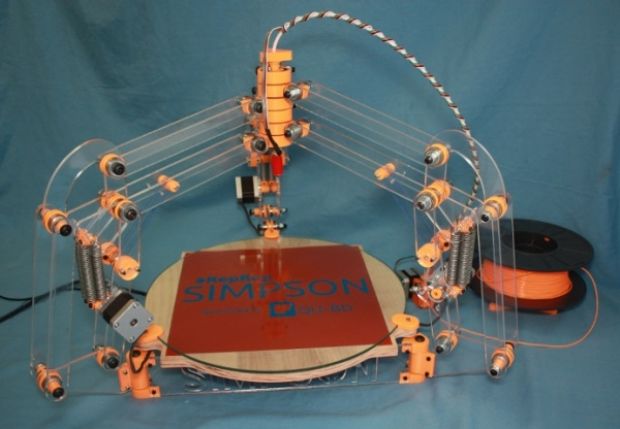
3) Rostock Delta Robot Printer

This is a variant that I’ve been cheering on for a while now… not sure why. The first one I saw was Festo’s. I have a feeling that these things could be combined with sensors… eg: that new Leap machine… so it “knows where it is” rather than doing everything blind. I have a feeling that this might allow for printer-heads with a lot more freedom of movement… ie: not trapped within a Cartesian box.

Anyway, the Rostock is open-source, and on Thingiverse. Photostream here.

rostock

4) there’s been a couple of new printer-boards emerge recently:

printer_board

One of which has waltzed home on Kickstarter.

This is not quite “plug and play”… (like a lot of the other kickstarter “internet of things” stuff is… but it’s getting there.

I think true plug-and-play with this sort of thing will need to be some sort of genetic algorithm… so a brain that uses a LEAP (or similar) to “see where it is” can figure out it’s own hand-to-eye coordination. Just leave it running overnight and when you come back, it will be able to control any set of motors with micron-levels of precision. Maybe.

See also, breakout-boards for iPods/iPhones and GoPro cameras

breakoutboard

Which are on a version of Etsy just for electronics (via: Ponoko)

5) 3D Printing blood vessels… using sugar

Which looks very 21stC… but we still haven’t earned the right to call ourselves “21stC yet”. Imagine you’re back in 1912… calling yourself “20th Century”… well, fuck me, you’re in for a fright. Hopefully in 2012, we’re not sailing into waters quite as the first 4 decades of the 21st C. Got a feeling we are though.

6) so back to the 80s. This does actually remind me of a portable computer from the 1980s

So there it is. Is this a revolution? Maybe, in a school-science-fair sort of way… but there is one hell of a lot of hype to live up to – mostly because this is a science-fiction technology – and has been since… well, the 20th Century. I think it’s fair to say that it’s gotten beyond its first baby steps though. It’s been around for decades… but there does seem to be a bit of a Cambrian explosion going on… although as yet, it’s a technology without a killer application.

If a killer-app is going to emerge… it’s going to happen (I think) by way of breaking a trade-barrier… either physical or legal. The physical is to do with places that don’t have postal-services or even roads. The legal is to do with breaking IP monopolies, trade-sanctions and weapons-controls.

That is the killer-app of bits to atoms (aka: turning information into stuff) – it allows the internet to leak into physical space – and one thing the internet is really, really good at, is routing around blockages.

So look for blockages.

A Tale of Two Printers

For a long time, there was only one:

A wondrous machine, capable of making micron level detail… from Brazil, which made it doubly cool.

Only problem was, the inventor decided to go the secret-squirrel route, killing his tree-of-innovation with patents and “IP” and proprietaryness etc… with the result that

a) everyone who saw this printer’s blog, was strung along by the scarcity of it, eager to buy, baited breath… and…

b)… it took forever and…

c) … the geekosphere fell upon it like eviscerating crows, pointing out dubiousity, and preferred open-source alternatives

So up it goes on Indiegogo, pulling in $100k (so far) but really wanting $300,000…

… and then another one turns up on Kickstarter.

There is more money in Kickstarter… and this one actually does have better specs than the other one… but the most important thing about it is that it’s open-source. This means that instead of all the innovation happening behind closed doors, executed by a small team (of one), it becomes a platform for innovation by anyone, anywhere, who’s interested.

The open variant has pulled down $140k so far (they only wanted $50k)… and still has 25 days to go. If memory serves, it achieved $100k in only two days.

I promise you, there is more money in open-platforms than closed products.

Meantime, the two main crowdfunding power-houses, kickstarter and indiegogo appear to have a new 3D printer variant turning up every week. If you search for “3d printer” you get these:

The overarching trend is a) shineyness of design and b) downwardness of price.

I’ll be really surprised if we don’t see a sub $100 kit within one year.

So how does this fit into the reprap ecosystem?… I’m not sure that this is what Adrian Bower had in mind when he talked about an ever-evolving ecosystem of machines… because hardly any of these machines are repraps… they’re repstraps – ie: they’re not made out of parts made by 3D printers – they’re made by laser-cutters and mills and so on.

I think environmental pressures (and culling) are still there… but the replication isn’t really replication at the device-level. It’s replication at the memetic level, and the machine is just a physical expression of the meme rather than being a replicator in its own right. This is still producing machines that are better and better adapted to the conditions in which they need to exist (ie: the intersection of price, speed, resolution, and material variety)… but the driver isn’t classical natural selection at the device level. It’s something else.

And I think this might mirror something that is beginning to happen in the “natural” world – in genetics. We’re seeing the beginnings of a change in how natural selection works… ie: the mutations are no longer blind, but directed… the variations are no longer the result of the mixing of the genes of two parents, but the result of external interference – “intelligent design”. It’s early days yet, but I’m guessing this will become more and more prevalent.

Lanzatech, The New Zealand waste-eating-microbes company, created the microbes by way of an evolutionary fast-breeder. (as far as I can gather) they accelerated the process of natural selection until microbes with the desired characteristics evolved. This is pretty cool… but I’m guessing that the future will be more to do with tweaking DNA directly… and you can tweak the DNA of far larger creatures. It’s already happening, courtesy of that bastion of corporate evil, Monsanto. It’s only a matter of time before we start tweaking ourselves… and who wouldn’t? The alternative is pain and death… and besides, I want to live in an Iain Banks novel.

Maybe this is “Unnatural Selection”… or maybe it’s evolution growing wings… and it is what machines have done all along anyway. I think the idea of natural-selection at a device level is a fallacy of perspective. It’s not the devices that are evolving, it’s the culture, and the culture steals whatever memetic DNA it wants, from anywhere. Everywhere… and it’s only a matter of time before human DNA becomes assimilated by The Culture.

Online Cad Systems

This is pretty cool

Cell Cycle webGL design app – a dynamic physible from Nervous System on Vimeo.

It’s an online CAD system that gives a basic framework for a fairly complex object, and then lets the relatively unskilled tweak to their own peculiar tastes… then output a file that will make it. Actual, actually make it in real actual reality – with a 3D printer.

I’m going to get into doing this when the 3D machines come from across the waves… I’ve been playing with OpenJScad recently… it’s a library that allows you to do simple CAD stuff using Javascript. A web-language in other words. Only works in Chrome for the moment… but that’s ok, because you can just download Chrome, and Internet Explorer can FUCK OFF because in another 7 years, the browser that web-devs will have to write for will look like this:

IE

only it will actually be worse than that, because there will be over 70 variants within that.

I’m not supporting Internet Explorer from now on. I just don’t care anymore. I have an audience, and none of them use fucking IE. Right now I have Chrome, Opera and Firefox all running at the same time. They’re all good for what they’re good for – the only thing IE is good for is checking to see if websites work in IE. Forget it. It’s over.

Anyway – OpenJScad is pretty good – I made this for it:

http://www.weirdsky.com/CAD/

It has the ability (built in) to create forms with dropdowns so people can make their own variants. Tis the future I tellee… for a while at least. I quite like it because it (like the web itself) is a text-based scripting language (rather than a GUI)… and being a web-dev, I find that reassuring. Unfortunately Chrome has a built-in limit to its stack-size, so if you try to make the resolution too small it will crash. But… there it is. Pretty cool.

Speaking of which though, check this out:

Nanocale 3D printing using resin and lasers.

I think the resin stuff that it uses is pretty expensive ($300 a litre?) but if you’re making nanoscale things you’re probably not going to be using very much of it.

Next,

An ode to Cognitive Surplus.

A celebration of the inventive backwaters of the human spirit... a celebration of people who would appear to have far too much time on their hands...


A celebration of laterality.


If you come they will build it.


By knowledge shall the spheres be filled.


Golden Mean Calipers