GENOMICONrss

rss

The Crowd-Sourcing of Intelligent-Design

innovating between the cracks

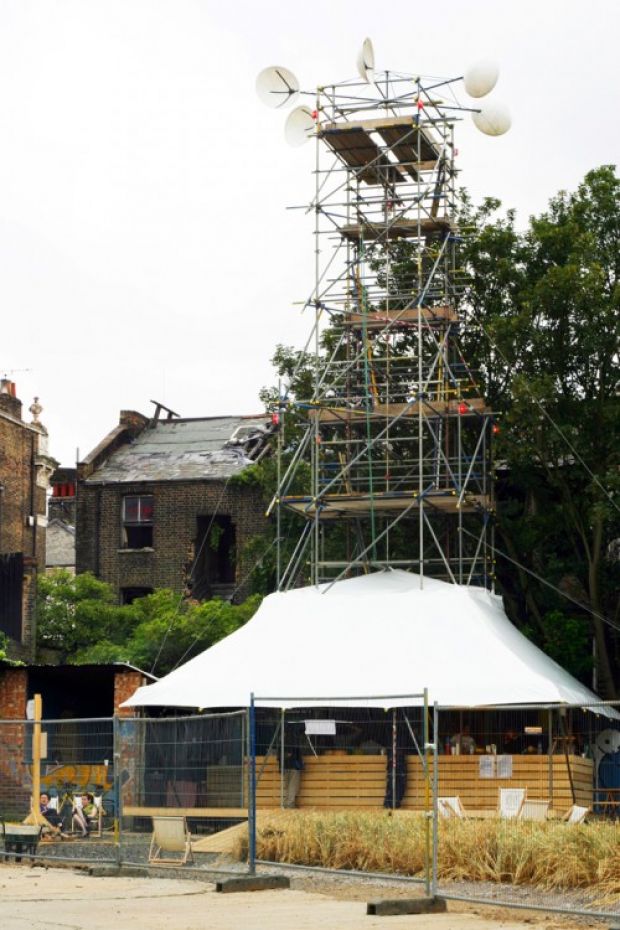
Favela Chic (wind-powered) Coffee Shop

We don need no steenking planning permission…

coffee1
(from)

Only they probably did, on account of it having something to do with The Barbican… but Dalston? Brrr… I used to live there. Hampstead Heath it aint (I used to live there as well), and this is kindof the point. You simply wouldn’t be “allowed” to do anything like this in Hampstead. It’s innovating between the cracks again. It’s where the vitality lives.

And it is (or was (as far as property goes, all bets may be off)) indicative of part of the gentrification life-cycle. Hampstead used to be bohemian… cool people lived there, so not so cool but rich people wanted to follow, now you need to be rich to live there so the vitality has moved elsewhere.

It was Camden in the 90s (yup. lived there too) – now I’m not so sure. Money has moved in – though there are parts of Camden that will be forever shit-holes. Similarly West London (yup) – it was this fault line where fairly posh backed up against crack-ville… and as far as I can gather, it’s always been this way – well, as far as the 1960s at least, which is when history basically began.

Anyway, this thing reminds me of Glastonbury a bit – one year I was running this great big sales-tent thing with 12 staff and a cook, and the other hippie-retailers had thrown up this amazing bar made out of hay-bales – it was a really cool, professional/guerrilla drinking hideout… with the sort of exciting of-the-moment vibe that a proper licensed place (with “permission” from above) could only dream of. A temporary building designed for communality and commerce… built with the knowledge that in about 4 days time it would be gone.

This sort of guerrilla-retail isn’t that uncommon actually – back in the 90s people used to squat empty shops in Oxford Street – move in mob-handed with a truck-load of knock-off goods – usually t-shirts or backpacks etc… throw the whole lot up in the wee hours before retail start-of-play, then coin it until they got moved on. The markets in London were a bit like this as well. It amazed me how organised these people became – with their own sound-systems and scaffolding and security and lighting and whatnot.

Favela Chic is actually the most alive kind of chic – this is what the raves in the late 80s were about… but the big crunch – the thing that really needs to be worked out, is the relationship with violence, because anything illegal and successful is a magnet for organised crime.

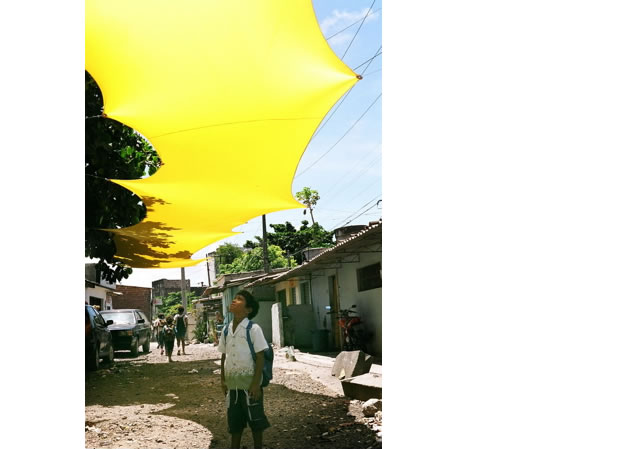
Favela Chic

favela1
(favela-brightener: kitset from : Dezeen/Cooper-Hewitt)

Exhibit #1 : The Future’s so Dark

Bruce Stirling at Reboot 11 in Copenhagen

“me shiny tech-boy jackdaw” LOL

I love this guy – he’s like an old armchair that sits in the corner and complains constantly… something I feel at liberty to say because (as I say) I love this guy and I too am an old complaining armchair sitting in the corner.

I think it’s doubly funny that he’s presenting this whole tapestry of bleak nihilism to an audience of Scandanavians, and they think it’s funny. I love these people. I wish I was there.

Anyway, Bruce is usually right and usually wrong – and I think he’s right about Favela Chic and I think he’s wrong because he makes it sound awful, and I don’t think it necessarily will be.

I’ve been trying to think about this subject for a couple of days – and it’s really too big a subject to contain in a single post, or even book… so I’ll do what I always do and throw up (favela like) a bunch of exhibits that act like windows – giving different views onto the same scene.

So here we go.

Exhibit #2 : Squatocracies

squat1from Michelle Power

There was an article in The Guardian recently about the artistic vibrancy of the Berlin Squat scene… and I can well imagine. I came out of a squat-scene myself – Camden in the 90s was when music was finally wrested from the grip of “Pay to Play” and turned into something fairly happening and exciting – innovation between the cracks again – but the cracks are wider, and there’s so much time to play with.

I’ve done some research on where people’s money goes – there are various numbers, but they tend to look something like this:
household_spending

Unless you’re already rich, you spend about 1/3 of your working life (what is that? 20 years?) as a slave to a bank or a landlord. British people don’t spend that much (or anything) on insurance or health… transport? Not if you live in Camden and can walk to everything that interests you. We basically reduced our cost of living to the price of chips and beer, and out of that a culture blossomed.

rich1

This is not a sustainable way to live, but if you’re young, it’s fucking great.

Does your landlord allow pets? In my Islington squat, we didn’t have rules-from-above, so the guy downstairs had sealed off his entire living room and had stingrays living in it. Freedom isn’t freedom until you can get out of all systems involving money.

The best years of my life were Favela Chic years. You’re free from the machine, and it’s great.

Exhibit #3 : Collapsanomics

I think collapse of Western Economics could look a little different from the collapse of the Soviet Union say. Our infrastructure and expectations are different – we do some things better, some things worse… but our infrastructure might just be better for setting up as micro-businesses (and Favelas are all about micro-businesses). Most of the people I know already are micro-businesses – as a matter of choice.

This is an interesting talk by Douglas Rushkoff – in fact this is more than an interesting talk, I think it’s kindof vital… as a starting point for understanding that this latest crash (in a series of crashes) may not be a bad thing, and may be inevitable in the very best of ways… and it may just provide us with some direction as well.

And maybe this is what the future looks like:

garage1

rather than boarded up windows and burnt out cars. This photo comes from an interesting article about The New American Post-Industrial Microenterprise.

We need to (and will) find a way of open-sourcing money. We need to get rid of the banks.

Random thought #1 : Violence

I think the biggest, and possibly most difficult thing to handle in the encroaching arena of Favela Chic is the management and control of violence. It can’t be for hire. Violence needs to be democratically controlled, or things get really ugly. People need to be paid to carry out violence on behalf of the citizenry – to a degree of capability that it acts as a deterrent, and this needs to be acknowledged as legitimate by the citizenry – I don’t think there’s a way around this… and it probably needs to be organised at a national or regional level.

It’s taken us a long time to get away from local crime/war-lords, lynch-mobs, internecine blood-feuds. The worst thing about Favela Chic is the danger of going back to these states. We need laws because human stupidity will always be with us.

Random thought #2 : Reprap technologies are only useful in the 3rd World

I’m becoming increasingly inclined to think that Repraps don’t solve a manufacturing problem, they solve a distribution problem. In the West, we have pretty good distribution (and manufacturing) so the only thing that Repraps are going to be used for with any degree of economic viability, is making other repraps… and people are already selling them off the shelf, so maybe even that’s a bit iffy.

In places where distribution isn’t that great however, being able to print out physical things could be a real game-changer.

Random thought #3 : Meeting imposed-poverty half-way by going off-grid

And to go off-grid we need land-reform: a different relationship to the space that we live on and grow stuff on – because as things stand the parasitism of banks, and landlords perpetuates a scarcity economy. As long as you pay rent or interest at current levels (average being 33%) you’re in a state of indentured servitude.

If you were a gardener would you put up with slugs eating 1/3rd of your crop? Well if you’re a normal westerner, bankers and landlords are taking a 1/3rd of your crop – for reasons that are entirely historical. A reality based upon… “closed-source code, written long ago, by people who had agendas that had nothing to do with us… and who have long since left the building” – Douglas Rushkoff.

PS: Bruce? Some people like growing tomatoes.

Between the cracks #2

One line leads to another…

Parody etc. All bets are off.

Innovating through cracks in the pavement

Swedish Microhouses:

microhouse1

microhouse2
(from : English)

Or enchanting drawings thereof, each with a (de rigeur) million dollar view.

What I find interesting about these though, is that they’re designs by “some of Sweden’s best architectural firms” specifically commissioned to fit within a 15m by 15m 3m by 5m space… and if I’ve got this right (it was faithfully reported elsewhere) this is to escape the strict regulatory framework that large buildings need to comply with.

This reminded me straight away for the reasons that this was built with 3 wheels

teapot car

If it has 3 wheels, then legally it’s a motorbike so you don’t have to be dealing with all the regulations that come with cars that would make innovation prohibitively expensive.

It seems that there’s this thing going on where innovation is happening in spite of rather than with the help of the legal frameworks that we have in place.

Which isn’t to say that all building regulations should be thrown out the window – when a force 6+ earthquake hits New Zealand (which they do periodically) cups fall of shelves. Everyone is a bit shaken. There’s talk of “the big one”. When the same sized quake hits Greece or Mexico, apartment blocks fall over and people are killed.

I’m fairly committed to the maxim “Rules for Corporations; Rights for People”, and I’ve very wary of the right-wing meme of “small government” which is basically slight of hand for weakening democratically mandated control over corporate power. (which is why corporations pour billions into the think-tank led propaganda machine to promulgate this idea).

But I think maybe there needs to be some sort of “fair use” angle on individual human innovation. Fair enough – we can’t be endangering other people, but we should be allowed to endanger ourselves.

,

An ode to Cognitive Surplus.

A celebration of the inventive backwaters of the human spirit... a celebration of people who would appear to have far too much time on their hands...


A celebration of laterality.


If you come they will build it.


By knowledge shall the spheres be filled.


Golden Mean Calipers