GENOMICONrss

rss

The Crowd-Sourcing of Intelligent-Design

diybio

Drinking straw electrophoresis

This is cool… exactly what interests me most about the collision of cognitive-surplus and crowd-sourced design.

electrophoresisfrom wikipedia

straws

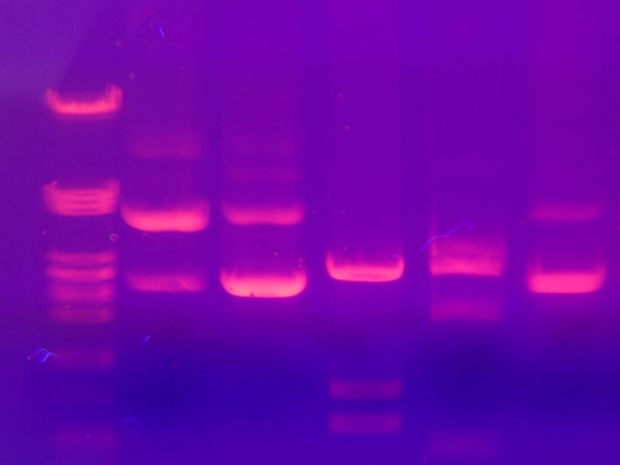
A conversation between Tito Jankowski and Meredith Patterson on the DIYbio list about how to bring the costs of electrophoresis (a way of separating organic molecules) down raised the possibility of using drinking straws to hold the samples/gel and…

… behold, it is done… and it’s done with a nine-volt battery.

As research shown in the fourth video over here showed… the majority of product innovation isn’t done in Corporate R&D labs, it’s done by users… and users suddenly have the time and the resources to basically take control. The same thing that happened to the music industry is going to happen in every single industry across the board.

The first example that uses in the video above is a Gas Chromatograph by the way.

(edit : more here)

Fruit computers

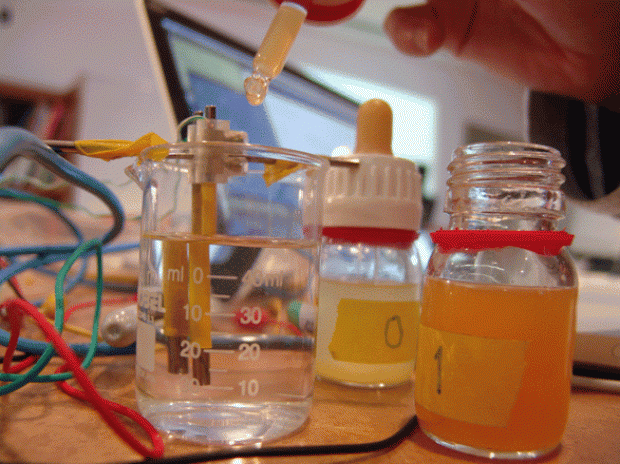
fruitcomputer1

from The Fruit Computer Laboratory

Marvellous. Reminds me partly of this edible Joule Thief:

fruitcomputer2

from oskay@flickr

And this thing that turned up recently about programmable food – a bit like the Star-Trek thing… made out of Algae (which is making something of a comeback on account of it being the fastest way of turning sunlight and CO2 into physical bio-stuff)

The New Empires of Intelligence

Ok, that was the bad news, now the reasons why I think DIYbio is probably going to become the biggest driver for just about everything, from here to the singularity.

Imagine all of these videos as one of those overlapping circle charts that people always use in powerpoint presentation. There’s an overlapping bit in the middle… and out of this I suspect will emerge, what Craig Venter in the second video describes as a new version of the Cambrian Explosion. The biggest challenge in the next 30 years, may not be climate change, it may be surviving this explosion, but that minor worry belongs (for the moment) elsewhere.

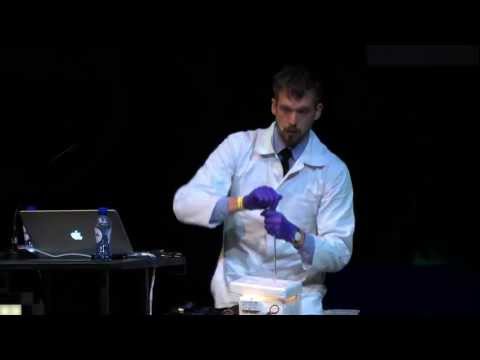
There’s a couple of hours worth of videos here, which is about 4 Gilligans, (A Gilligan being a measure of time spent doing something other than watching a sitcom. (from here (kindof)))

Ok. I’ve mentioned this one elsewhere, but it’s an easy-in, as it were. Short, simple and to the point, and I really like the design.


Now a talk by one of the people who sequenced the genome. Everyone claps at the end, and not without reason. This is why we ought to do this.


Then this one… more on possibility etc, but the imperative kicks in at about 17.00. This is why we need to do this.


Then this one on crowd-sourced innovation. This is why it has to be us that does this.


And finally a guy talking about mushrooms. It’s not actually about genetic engineering, but I like him and it does show what can be achieved with what we’ve already got.


So there you go. I’d also add, that seeing what centrally owned energy/pharma/(etc) industries did to the 20th century, it’s absolutely vital that this technology is democratised. We need this.

Here comes the flood : DIY Bio

kapiti1

I’ve recently joined the diyBio mailing list – and have spent the last couple of days feeling like my head is about to explode with all the new information I’m attempting to assimilate.

I think that this is simultaneously the most life-saving and most dangerous technology there is, and it’s becoming democratised. A friend of mine in the airforce in the 80s told me that weapons were graded in terms of kill-potential… and the ranking was Biological, Chemical, Nuclear, in that order… and the one that starts with B is becoming democratised.

On the other hand among the promises of biotech are free clean energy and immortality. You think cocaine is a big seller? It’s got nothing on energy and immortality… and these technologies, although still fairly embryonic, are coming to a kitchen sink near you. It’s incredibly inspiring and incredibly exciting. This is coinciding with what I’ve called The Crowd-Sourcing of Intelligent Design… which is basically an explosion in human creativity, with the results being fed straight into a universal mind, so everyone has access to the entire genotype of a creation… and the cross-pollination of ideas that results, creates a type of evolution that leaves sexual reproduction in the dust… and that was already mind-bendingly clever.

So.

1) you can’t control digital replication / information leakage
2) you can’t regulate people working in their kitchens
3) the democratisation of technology is a force of nature
4) the weaponisation of technology is (currently) a force of nature

IMHO.

The cat was always going to get out of the bag at some point. Here is the most likely scenario for the way this will unfold:

1) the public is primed by the media for a negative reaction
2) there is a statistically insignificant disaster
3) regulations are imposed, in fear and without regard for facts
4) freedoms are curtailed
5) the resulting regulation/criminalisation creates a black economy
6) entirely malign power-bases grow out of this economy
7) general publics are attacked by their own governments fighting these power-bases

All of which happens with the active collusion and lobbying of corporations wanting to monopolise these technologies and protect their “IP”, and religious organisations wanting to control the procreative process generally. (And this will (of course) lead conspiracy theorists to postulate that 2) was actually a corporate false-flag event, and they may be right)

All of which leads to a new self-perpetuating and self-serving “War on Bioengineering”. To be honest, I think you’ll need to be very lucky or very smart to avoid this sequence of events. Google “Lakoff” and give yourself a crash-course in deep-framing.

So there you go. First thoughts etc. This subject is too big to tackle in a single blog post, but I’ll sign off with the good and the bad and the ugly:

The Good:

The Bad:

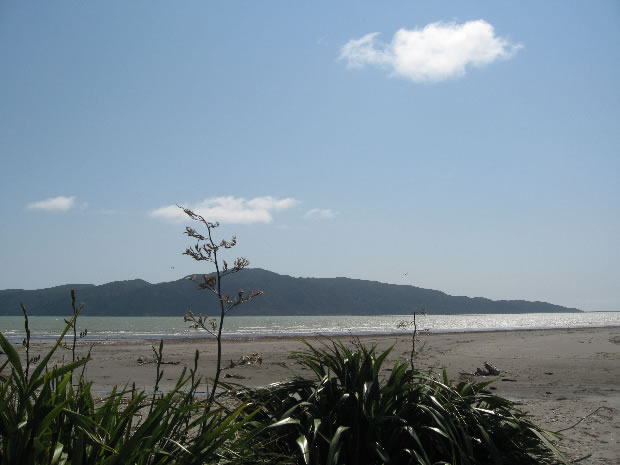
See that picture at the top of this post? That’s Kapiti Island, which lives here, in New Zealand

Google Street Maps FTW!

It’s either very small or very big, depending on what you try to do with it.

It’s a nature reserve and when you visit it, you are thoroughly (and I mean thoroughly) searched… bags, clothes etc… for rats.

Kapati used to have rats you see, introduced by humans, and they massacred the native bird population. The predator-elimination program has taken 60 years and the rats were finally eliminated 6 years ago by a team of people working in a long line gradually moving up the island, trapping and killing them. This cost around 1/2 a million dollars.

It’s a big island. Zoom in on the google map and imagine what it would take to walk/crawl from one end to the other killing every single rat… not missing a single one. It’s not however as big as New Zealand itself, which is a macrocosm of Kapati, and which is far too big to control in this way. We’ve lost it. Rabbits, rats, ferrets, possums, dear, cats, mice are here, and there’s not a lot we can do about it. They have created utter havoc for native species… my dad says he has seen hills with so many rabbits on them that the whole surface looked like it was rippling.

If anyone thinks (and I know some of you already do) that a good way to fight a new species is with another new species… we’ve already tried that here with ferrets against rabbts – and it was a disaster. Fighting an exponential curve with another exponential curve is like crossing the beams in Ghost-busters. You don’t know what will happen, but chances are it will be bad.

The Ugly:

virginia lake

This is Virginia lake in my home town.

Last year there were ducks paddling about, people strolling etc one day; the next there were people with white bio-hazard suits out in boats rescuing the swans. Virginia lake experienced an algal bloom that was so dense that it looked like the ducks were paddling through Pea-Soup, and the whole thing started releasing poisonous gases (eg: Ammonia) in such amounts that the whole area had to be cordoned off. It was a mess, and it absolutely stank… and it all happened incredibly fast.

Humans tend to relate to reality in linear terms. Nature isn’t linear. I don’t think people quite get that.

Here’s what they did (click on it to see it in detail)

Virginia Lake Sign

Cost=$637,000. It worked… yesterday the water was clear to a level of about 2 metres, but it’s a process of management rather than eradication.

Now the bad and the ugly above are fairly unusual in that they happened in naturally quarantined areas. This will not be the case if someone flushes a load of contaminated agar down the sink in Woking UK. You think that this won’t happen? Get a load of this. A noxious weed choking the Mediterranean. I saw a documentary on this a couple of years back where someone made a plot of the spread of the weed, then extrapolated backwards to find the source… and it was directly beneath The Oceanographic Museum in Monaco, where Jacques Cousteau was director.

If it can happen to Jacques Cousteau then it can happen to you.

So the point of all of this, is that it’s a hell of a lot easier to create a problem than it is to solve it. The dogs that check every single person coming into New Zealand to make sure they’re not carrying fruit or meat, aren’t doing it because they’re hungry. They’re serious.

So there you go. I’m guessing that we are poised on the brink of a fairly large increase in new organisms and variants hitting our ecosystems fairly soon. I don’t see a way of stopping or even controlling DIY Bio, and I don’t think (at all, on all sorts of levels) we should try – but we do definately need some very smart people to be thinking ahead on this one. We need to become a lot better at biosphere management. Fast.

,

An ode to Cognitive Surplus.

A celebration of the inventive backwaters of the human spirit... a celebration of people who would appear to have far too much time on their hands...


A celebration of laterality.


If you come they will build it.


By knowledge shall the spheres be filled.


Weirdsky Industries