GENOMICONrss

rss

The Crowd-Sourcing of Intelligent-Design

Cottage Industrialism

The Curse of DRM


(DRM Chair. After 8 sits, it breaks)

Ok… so a couple of weeks in, I have a perfectly working laser-cutter.

The controller of which (only) runs a piece of software called LaserCutter 5.3, which is one of most inadequate piles of shite I have ever seen. It only runs on Windows XP. It looks like it was written 20 years ago. It’s also cripple-ware, which means it’s been deliberately crippled to only run with a USB dongle

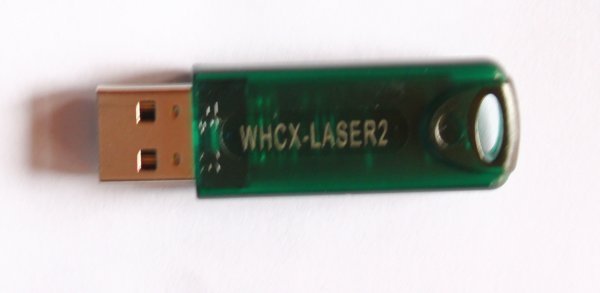
softdogusbstick
(this usb-stick could kill your business)

… aaaaaannnnnddd … the dongle has stopped working… which takes the entire machine out of commission until a replacement can be sent from China… only they won’t send one until the broken one has been sent back. Several weeks, minimum.

And for what? A fucking dongle?

If you’re thinking of buying a laser cutter DON’T buy one that uses a MPC6515 controller – which uses the DRM crippled LaserCut 5.3.

So… it’s looking like I might be looking at an open-source variant sooner than expected.

Here’s a stop-motion vid of open-source Lasersaur being put together. Far nicer looking machine than the commercial ones, and user-innovations (can) get fed back into the next iteration. I’m not sure that it does rastar-engraving mind… and that’s kindof crucial.

Lasersaur (open source laser cutter) assembly timelapse. Feb 2013 from colaborativa on Vimeo.

(NB: This sort of collaborate approach to putting-stuff-together may be great for learning, but it’s not generally how creativity happens. If you want to do any actual thinking, you’re probably better off doing it on your own. Collaboration is massively over-rated, in my most humble of opinions. Extroverts love it)

Laser Cutter : First Impressions #3

Several weeks of tinkering pass…

It’s quite an unusual tool this, in that among the first things you use it for, are to create parts to fix/improve it. It’s self-reprapping.

IMG_9688

1) The air extractor was shite. It wasn’t put together properly (a bearing was grinding) and the design simply doesn’t work very well. There’s a manifold that pulls air into a vacuum-cleaner tube.

laser_cutter_manifold1

The vacuum cleaner tube was the only thing the laser-people failed to supply… and it wound up costing $120… because the first tube I got was corrugated so made a noise like a high-pitched trumpet. The 2nd (pictured) was quieter, but that manifold design deletes about 90% of the suction.

So I made this:

IMG_9691

Basically recreating one of the removable walls of the machine, and creating a bigger manifold. The silver tube cost $12. It’s now simpler, and extracts air like a backwards hurricane.

The laser-cutter built replacements for these for itself.

manifolds

(when you’re rebuilding something from reality, photo it, then use Inkscape to trace the bitmap… or just trace it by hand)

2) The focusing element consists of 2 concentric tubes, with a locking nut. Unfortunately the inner tube was so short that if you try to focus on anything shallower than 4mm (which is most of what you want to cut), the nut doesn’t connect and the lens falls onto the workspace.

What dumb fuck designed that? Jesus.

Anyway, had to cut shapes to raise the bed. Now works fine.

Word to the wise: When you’re photographing your honeycomb… be sure to mark which way up/way round it was in the machine… because these things are built by cowboys, and none of the holes will line up if you forget which way up it was.

IMG_9693

Which brings me to the software that is used to run it. “LaserCut 5.3″. Without a doubt, the worst software I have ever seen. It’s shockingly inadequate, proprietary crap… anyone who makes software that only runs with a dongle, deserves a good, solid punch in the face. Seriously.

And being proprietary (ie: Of The Monopolist Cuntscape), I’m “not allowed” to fix what needs fixing.

It only runs on Windows (which sucks) and only on versions of windows so old, they’re not actually sold any more (which is triple-word-score suckage)… so not only do you need a dongle, you need a whole new (old) machine to go with the dongle. Not such a huge deal for me, because I prefer to have a dedicated computer permanently attached (with a dropbox drive, so I can work on a proper linux laptop), and I have old computers lying around anyway.

But it’s shockingly bad… looks like it was written in the early 1990s. Any open-source alternative that turns up that can do the same thing is going to completely delete their business, and they fucking deserve it.

Various people are doing this… The London Hackerspace look like they’re making inroads (and their “how to” guide for inkscape is pretty good too).

Not quite there yet by the looks though.

I think this should ideally start as an Inkscape plugin… simply to do the laser-configuration, and generate the (proprietary (barf)) output… or maybe we should just go with fresh hardware that supports Gcode (if I’ve got that right).

So… the next machine I get will be open-source hardware. Probably lasersaur… the thing about the open-source approach, is that all the myriad design improvements that get made, get fed back into the main body of work… so each release contains improvements made by people actually using the thing… which is not happening with these Chinese machines… who’s design is akin to Geocities websites from the 1990s.

Open-source is a fairly radical/radicalising process. With software it’s kindof taken for granted, but with hardware, you can really see how shite things really are without it.

Not that this is a bad machine… it’s just that all the improvements I (or anyone else) makes, don’t make it into the next iteration, and it uses Slumlord-Software… ie: a tatty shithole that is nevertheless very expensive, because its owner has a monopoly.

“Intellectual Property” is a state-inflicted monopoly that suffocates innovation. We need to abolish it all.

Laser-Cutter #2 : Awsome POWAH

Ok… some time passes, time to recalibrate and regroup re: impressions.

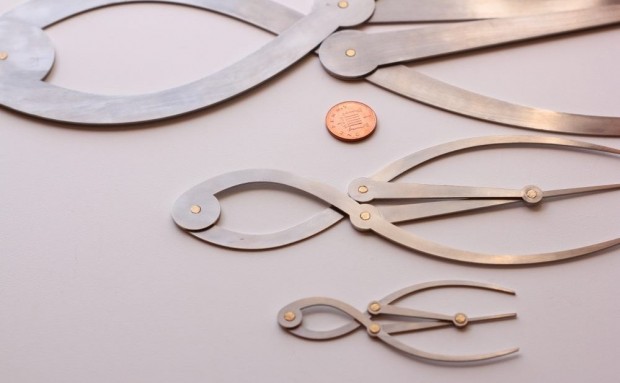
The new laser-cutter is now making $. Using it to make linings for caliper boxes:

felt_laser

And I’ve made these little things to help with calibration

laser_cross_hairs

And 1/2 did a new business card…

biz_card

…but there’s more to this stuff than meets the eye – it’s doing this annoying thing where every new cut starts with a massive spike, that leave a hole. When you work with steel, you need to make a “track-in”… but I really don’t want to have to do that with acrylic. If Ponoko don’t need to do it, then neither should I. Off to the laser-cutter forums go I then.

Still… the most major second impression I get from this bit of kit… is the (waiting) power of it… the power to make something… then click a button and make it again. And again. And send that file to someone else and they can make it. Not the right size? Scale it. Press button. Done. Different material? No problem… click a button, done.

I know this is kindof pointing out the obvious – but this is the first time I’ve really felt it… when digital fabrication hits the mainstream it’s going to be a tsunami. Entire industries are going to be knocked out of the way… and new industries created I guess. The copy-monopoly people are going to be utterly incontinent – but like, fuck them. The technologies for oppression that these people are co-creating are such that not only do they not deserve to be in business, they don’t deserve to live.

But… still… there it is… waiting in the wings…

… Download a design… click a button. Done. Want another one? Click a button… done. Want to sell it? Fine… go for it, but you’re competing with people who also have these machines… and what do they do? Click a button. Done.

Fastest way to Calibrate a Laser-Cutter

New Laser Cutter.

laser_cutter2

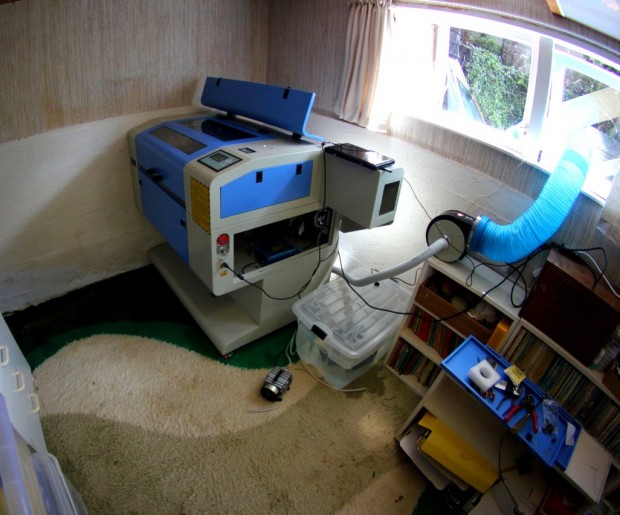
In what passes for my new laser-cutting studio, which has the grooviest 1970s carpet in the world.

laser_cutter1

Back of laser-cutter… big tube, held in place with combination of rubber bands* and gravity.

laser_cutter3

The laser-beam bounces around 3 different mirrors before hitting the lens… and these mirrors are on moving gantries, so have to be calibrated so the beam hits the middle of each mirror, dead-centre… no matter where on the table the laser-cutting head is.

I’ve watched people doing this – if you’re trialing-and-erroring it, it takes hours… days…

Unless you make one of these:

IMG_9572

laser_cutter4

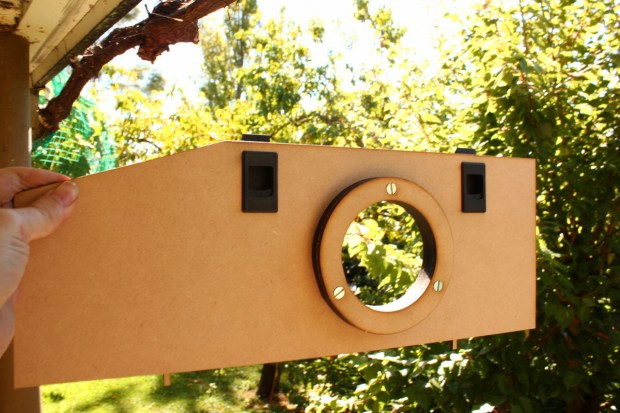
Which is a low-powered red-dot laser, centered in a couple of bits of wood, and put inside a tube the same diameter as the laser tube. It’s basically a simulated laser-tube.

You then remove the real tube, and put this one in its place. This way you can adjust the mirrors, and see where the beam goes in real-time… rather than guessing which mirror to shift based on an invisible milli-second burst of light so powerful it sets fire to everything it touches.

So you get the mirrors set up with the low-powered DIY simulation tube… swap in the high-powered tube… fine-tune… done.

Took less than 5 minutes.

* RUBBER BANDS ??!??!!

You’re holding the laser-tube in place with RUBBER FUCKING BANDS????

This laser-cutter is in much better nick than the last one I bought, but rubber-bands represents a new level of daring in the corner-cutting stakes. There are pros and cons:

Cons: ARE YOU FUCKING KIDDING ME? RUBBER BANDS???

Pros: If I need to replace them, I have more in the kitchen.

In a funny sort of way, they’re not a bad idea.

Quite an easy machine to set up all in all. Had to learn to read Chinese obviously, but that’s not a biggie. It’s a bit like cobol

The Open Source Price-Warp

It’s hard to recall exactly when it started, but ALL THE BULLSHIT IN THE WORLD seems to be justified by the notion that corporations should do everything because when they compete, the prices are better.

I think it started with Reagan – or at least it came out of the closet under Reagan… but Thatcher did the same, and here in New Zealand a Labour govt was hell-bent on selling assets owned by everyone, so people who were rich, could the rent them out to people who were poor. This ideology was used to rape and torture South America (under the aegis of the IMF, who now admit they were wrong)… and the same austerity and insanity is being inflicted on the EU, resulting in the highly predictable return of Nazism.

Corporations do not compete on price, they compete on profit. This may be achieved by driving prices down, or by innovation… but is just as likely to be achieved by lowering the value of their output, or by shifting their business into areas where they can extort monopoly rents. Or crime.

Enter Open Source.

micro_copter

Something I’ve noticed is that open-source is driving prices down far faster and steeper than corporations ever did. That little helicopter (which is smartphone controllable, and has streaming video) is mooted to be sellable for $49. I’m mildly suspicious of the company that’s selling it – because they’re not selling it… and won’t, because although they claim to be open-source, they’re only interested in licensing the their “products”… which as far as I can tell ain’t that open…

… and then there’s the Leap interface. Also not open, although it is created to be a development platform… but $70? If that was being sold as a consumer item it would be triple that at least. Again it’s something that isn’t actually available yet – which is another pattern I guess. Maybe that’s a factor – using really low price as a marketing driver – and if you’re doing it with pre-sales you’re not in the risk-aggregation business.

So item 1 and 2 – dubious openness, but far far cheaper than expected – but then there’s the Kickstarter effect on 3D printing… the price has nose-dived far faster than equivalent corporation-built machines. I think video camera accessories are seeing a similar pressure, from a similar direction. The Video DSLR blogs constantly go on about “affordable” products… by which they mean $700. Open, mail-order based variants are knocking the legs out from under them.

I think there’s a bunch of things going on here. Namely:

1) Mail-Order

Selling mail-order only, automatically halves the price. If you’re intending to wholesale, you need to double your online-price, because bricks and mortar retailers generally want to put a 100% markup on top.

2) Micro-business

Tiny businesses, often run out of residential premises do not have the red-tape and expense that businesses with employees, commercial premises, loan repayments, insurance etc etc. Upstream efficiencies multiply downstream savings.

3) Transparency

If everyone can see what your materials and labour costs are, you can’t quite so easily “just make up a price that the market will stand”… because people will just make their own.

4) Not in the risk aggregation business

Big corporations do not make products that solve problems that they themselves have. Their model is based on sinking A FUCK OF A LOT of money into development, market-research, marketing etc etc… the costs of which are all up front, with the risk the product might not sell.

Because of this, the products that do, are covering the costs of those that don’t – so need to be milked for all they’re worth. This creates a bias towards incremental innovation…

risk aggregation businesses have a bias towards incremental innovation

… open-source on the other hand has a bias towards disruptive innovation. Open source is all about changing the rules of the game, or of not playing to rules at all.

This is why big corporations so desperately need copy-monopoly laws… and why open source does not give a flying shite about them.

5) Crowd-funding to achieve economies of scale

Still can’t do economy of scale like major corporations… but pitching it to the web as a pre-sale is leveling the playing-field, and relieving innovators of the pressures that career-lenders tend to impose.

6) China

Or more accurately, Ali-Express, which radically lowers the costs of (some) components. Similarly Ebay – although what’s cheap on Ebay and what’s available on Ali-Express is often coming from the same people.

7) Rapid-fabrication techs

… primarily laser-cutting, followed by 3D printing and CNC milling. These lower the cost of prototyping, and more often than not, allow you to create parts for production without having to lay out $$$ for injection molding etc etc.

And again – upstream efficiencies multiply downstream savings.

So… in a nutshell… all roads are not leading to, but are leading away from, risk aggregation. That’s the key factor I think.

(this)

And that’s probably enough for now I think.

Photographing with a White Background

This is a story of jumping through hoops – that someone else might find useful etc.

So anyway, as part of the byzantine process required to sell Things You Make Yourself on Amazon, you need to have photos with pure white, #FFFFFF backgrounds… which I’ve found incredibly hard to do.

If you simply plonk your subject on something white, then photograph it, you wind up with something like this:

Which is a long way from white.

So I messed around for ages, with varying degrees of success… having figured out (or more accurately, having being told by the internet) that what I needed to do was have the subject in front of a white background that is separately lit… while the subject is kind of shady, so the background blasts every pixel out into over-exposure, and the subject is… well, nicely lit.

I don’t want to spend thousands on lamps though, and they’re a hassle to carry about, so I tried this:

… which kindof works, and kindof not… so I’ve finally stumbled across something that I think I might make into a “thing” out of acrylic. A folding laser-cut thing. The shambolic version looks like this:

The subject is on a glass sheet, which is floating (on glasses) above a white sheet, with the sun on it. The subject is in the shade.

One of the legs of the tripod is craftily jammed under the sofa so the camera can point straight down

In addition to this, it needs a diffuse reflector at the back, and small wall (or box) to cast shade in the front…

Which actually works pretty well:

Which can be de-shambleized to look like:

The reason I’m putting all of this here is that I spent hours and hours and hours trying to figure out how to do it. It’s still not 100% (for that you would need a bunch of lights) but it is good enough for Amazon – who will shrink it anyway.

So I think I’ll make a portable one of these – probably out of laser-cut acrylic… although to be fair, there’s not a whole lot of cutting needed… just holes for hinges. Something that looks like this:

Pardon the blessed liberties with the laws of physics… but you get the idea: Hinged bits of clear and diffuse acrylic… and it’s solar powered… which is to say you can only use it on sunny days, in the morning or evening.

Move to California. You know you want to.

Cottage Industrialist Economics : Stray Observations

About 3 weeks ago, I decided it would be good to have “Question Of The Week”… a high-level, strategic question to ponder over the coming week, each week… keep in the back of mind, and focus on when trapped into periods of inactivity… eg: driving about etc.

The first week’s question was “Why does it take me so long to get my shit together?”

No clear answers were forthcoming, and the Question Of The Week project was discontinued.

Various things however:

1) you spend a fuck of a long time looking for things like this:

Which you start out not even knowing the name of. You can spend 1/2 a day fruitless scouring google-images… invariably coming up with places like Ali Baba… who might have what you’re looking for, but who will only sell you them a million at a time.

Then you do find a supplier… order… takes over a week to arrive.

If you’re trial-and-erroring (which you are), then you’ve got about a 1/3 chance that this widget will actually work, and then you’re back to square one. If you live in New Zealand then all durations are doubled… although to be fair, I can remember looking for electronic components in London, and that was a pain in the arse as well. Can’t imagine what it must be like in Africa… impossible I guess. The Maker Movement is utterly dependent on a good postal service.

There must be a way around the massive amount of time it takes to source stuff – I’m guessing it’s being a member of an online community would help… maybe I ought to do that.

2) Projects on Indiegogo are starting to pull in similar $ to Kickstarter

They are fewer and further between… but 6-figure multiples are starting to appear. This is interesting because Indigogo doesn’t suffer from the same locational-apartheid that Amazon imposes on Kickstarter. That said, all of the first page of “most successful” projects are American anyway… so maybe that’s a moot point.

There are a couple of successful projects that are connected to viral videos/events… with the indiegogo campaign created after the fact… which is an interesting one, because until now, the chances of anyone actually benefiting from their (often fairly exploitative) 15 minutes of fame have been pretty slim… or have just been more exploitation.

3) Polish doesn’t sell

So I thought my calipers website looked like a dog’s breakfast… which it did, so I redesigned it… it all looks beautiful… new photos, fluid layout, everything lines up etc etc…

… and thence followed the worst crash in income it has ever experienced.

I think (hope) I’ve got the copy wrong… which is to say, it’s a lot less personal than the last site, and there’s a lot less… copy. I’m going to try that next (today) (screengrab of existing site here).

Failing that, I’m going to make a shite-looking version and run a split-test.

I spend an awful lot of time buying stuff off an awful lot of sites that look awful… eg … and I’d always assumed it was because they’d set up their site 10 years ago and were now running a successful business out of it, and changing it was simply too much grief. Which is true. I’d also always thought that Trademe.co.nz and Ebay.com looked fucking terrible… but I’ve been to talks by the trademe people, and they actually send UI people round to their user’s houses to see how the site is being used, how it can be improved etc… so maybe the terribility is a finely-tuned terribility.

Ebay will be the same of course – it’s a far bigger company. Etsy doesn’t look terrible though… so maybe not… but I have this feeling that “what a shop looks like” has precipitated out, and embedded itself in the minds of the internet… and a shop looks like a shop. It doesn’t look like a 5-star hotel room… and when people see something they like in a shop that does look like a 5-star hotel room, they think “that’s nice, I wonder if it’s available from a shop?”

Maybe. Might just be a lack of copy on my part though.

,

An ode to Cognitive Surplus.

A celebration of the inventive backwaters of the human spirit... a celebration of people who would appear to have far too much time on their hands...


A celebration of laterality.


If you come they will build it.


By knowledge shall the spheres be filled.


Golden Mean Calipers