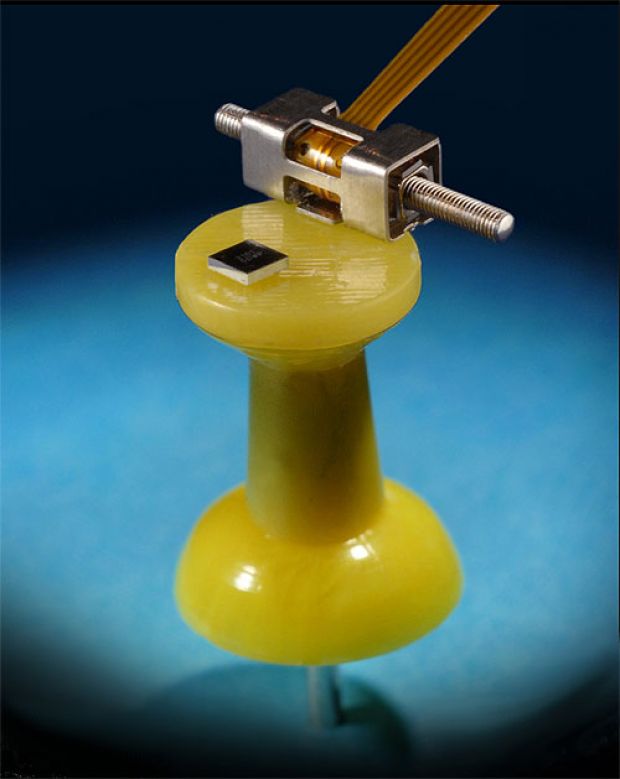
Which I find quite interesting because it uses a mechanism not a million miles away from bristlebots… basically a thread, the holder of which buzzes at a frequency that causes the thread to screw. Never underestimate somebody else’s daft idea.
– No parasitic drag – less wasted power
– Zero backlash (with a light pre-load)
– Very high stiffness
– Nanometer resolution and high force
– Smooth velocity at microscopic speeds
– Off-power hold
– Very small diameter
– Manual screw rotation for off-power positioning
– Standard linear motors feature direct linear drive – no gearbox
Which is pretty cool – unfortunately they bleat on about “patents” at every available opportunity which more or less morally obliges the rest of the world to reverse-engineer it.
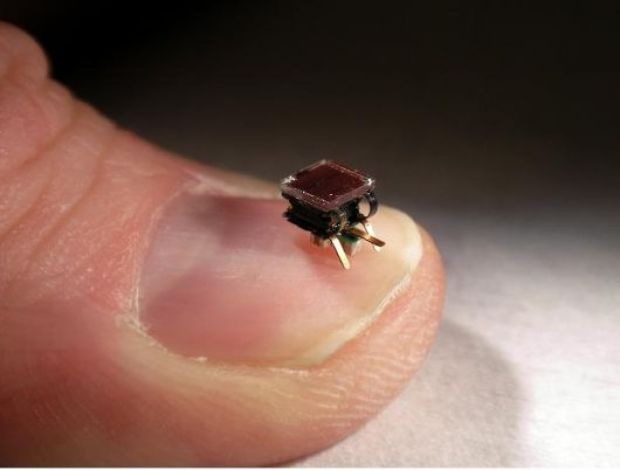
Solar-powered and self-motile… a cross between a bristlebot and a beambot… and a chocolate-teapot I suspect, but it’s a journey, not a destination afterall.
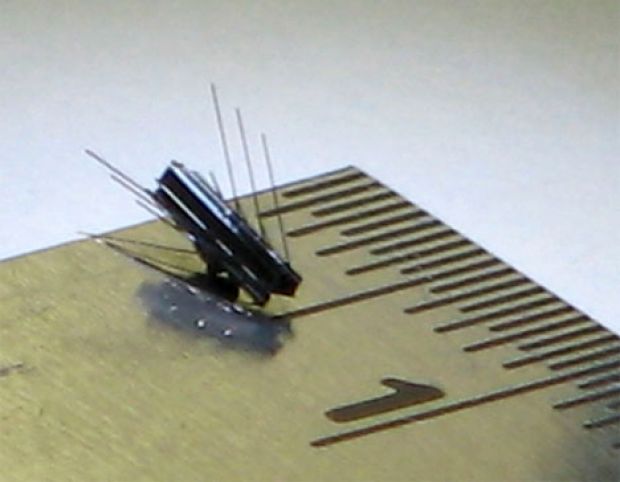
It’s about 1mm wide by 1cm long and is powered with an external vibrating magnetic field. Apparently there’s plans to mount a camera on it, which is something I went on about before, and everyone thought I was mad etc. Microbial Safari.
Of course this particular robot is a direct nick from nature – foxtails which (in NZ at least) are the bane of dog owner’s lives because they get stuck between their toes, and like these robots, can only go in one direction – deeper.
Nasty little shits they are. Quite intriguing to play with though – they’re actually covered in micro-barbs to accentuate the affect. Kindof like one-way velcro.
Ok, so let’s begin at the end… or at least the pinnacle of the art so far:
From Eno Henze – about whom more shall be said later… “I try to stress the idea of a drawing that is the result of a collaborative process between me and the machine” – the machine being a fairly big printer.
Which begs the question, what is a robot? Surely not just a printer? We’ve had those for years. Can’t robots do more than one thing?
It’s a bit of an iffy question really – my own printer (that I use about 3 times a year) can print, photocopy, scan, send faxes, do OCR… In certain respects it’s cleverer than I am, much like this computer that I share my internet connection with. Robots are already here – we expected them to look like C3PO but they’ve been sneaking in through the back door, demonically possessing our household appliances for years now – our refrigerators are now smart. Our cars are filled with computer chips. Smart This, Smart That. Video recorders have been their own bosses for years now.
But apart from video recorders… we are in control of them? Yes – for the moment – every robotic controller is a machine/human hybrid. The point of the art collected here though – is that the human is not guiding the brush.
And anyway, printers are close siblings to the robot that created this:
The distinctions are becoming harder to define.
Anyway, there are a lot of robotic artists out there – here’s a selection.
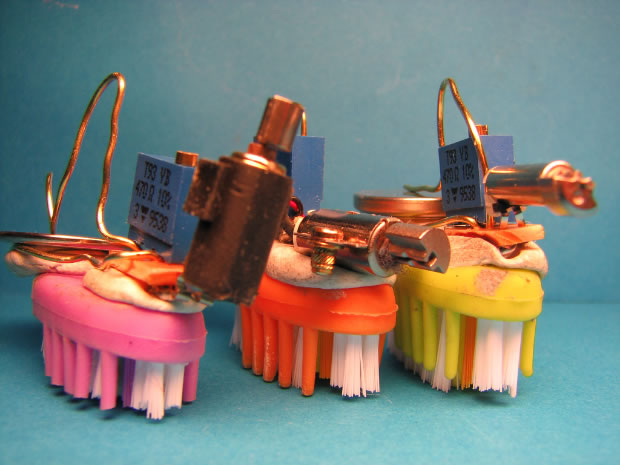
Most robotic painters are Scribblebots. A Scribblebot is only as good as its paintbrush. The ones above are made by attaching cell-phone vibrators to toothbrushes. The ones below are made by putting hamsters in micro-zorbs – so they’re not really robots either, but there are plenty of spherical robots out there that could do much the same sort of things so… anyway, here they are.
One of the things about blogs, is that as time goes by, the navigation needs change… that massive long list at the side is starting to get a bit unweildy so I need to categorise or tag etc.
Which has meant I’ve had to perform the exceedingly tedious task of tagging about 200 posts.
And the temptation of course is to try to make genealogies… family-trees of innovation, which is a kindof gene-centric way of interpreting what’s going on. It’s not what happens with Machine Generations. A new generation of a machine doesn’t have two genetic parents… it (potentially) has genotypes of the entire previous generations, and quite a few more besides. A major influence on my cardboard solar collector was (for example) Vinay’s Hexayurt things – rather than the thousands of “how to make a solar collector” instructables and videos currently available on the web.
A while back there was a load of fuss (which I thought was a bit childish TBH) because some book publisher put out a book about bristlebots without citing the original “inventors”. Hell, I’ve written a couple of things about bristlebots – and I didn’t know there WERE any original inventors. I’m guessing the publishers had the same inputs as I did – a huge mass of youtube videos, with no clear paths as to who inspired what… because really, each new generation may or may not have been inspired by any number of disparate sources.
Crowd-sourced Evolution is quite a bit more powerful than biological evolution. Machine Generations are not made up of randomly combining traits from a successful previous generation – the number of inputs can be much greater, and they’re specifically selected for rather than being randomly combined. A bit like an advanced sorting-algorithm… it homes in on the optimal solution far more quicky than the more basica algorthims.
I’ve noticed that when a new idea turns up, often it’s immediate use is as a toy… which I think is a useful creative path – “play” gives people a consequence-free medium in which to experiment with things. I went on about Bristlebots a while back, apropos of nothing… just thought they were a neat idea and that it was cool how the bristlebot meme propagated.
Now it appears they may have a useful application – in a theoretical sense at least… as a means for launching spaceships. I kid you not. There has long been talk about the use of a space-elevator for escaping earth’s gravity – basically a long cable that is held in place by the centrifugal force of the earth spinning. There was always a problem however with how to propel the car/ship.
It turns out that a guy from the EU Space Agency has demonstrated a possible method – using bristlebots… but instead of vibrating the bristlebot, you vibrate the thing it’s standing on – in this case the cable.
Someone’s discovered that if you attach a vibrator to a sawn-off toothbrush, it scurries about the place:
So they put it up on Youtube… and now there are about 150 other versions, all evolving and morphing etc.
From the sublime to the ridiculous. There are a bunch of remote controlled ones…
And for some reason, the better the bot, the worse the music.
They evolve legs, wheels, lights, become petrol driven, learn to paint
I think what’s important (or at least interesting) about this isn’t the fact that you can make toothbrushes scurry about the place, it’s that people are taking a daft little bit of technology and exploring hundreds of different angles that probably wouldn’t be considered if people were working in isolation. It’s like having a combination lock and being able to try out hundreds of combinations at the same time… it massively increases the possibility that something truly remarkable will be unlocked.
And maybe something has been at a higher level… people are doing this rather than watching television.