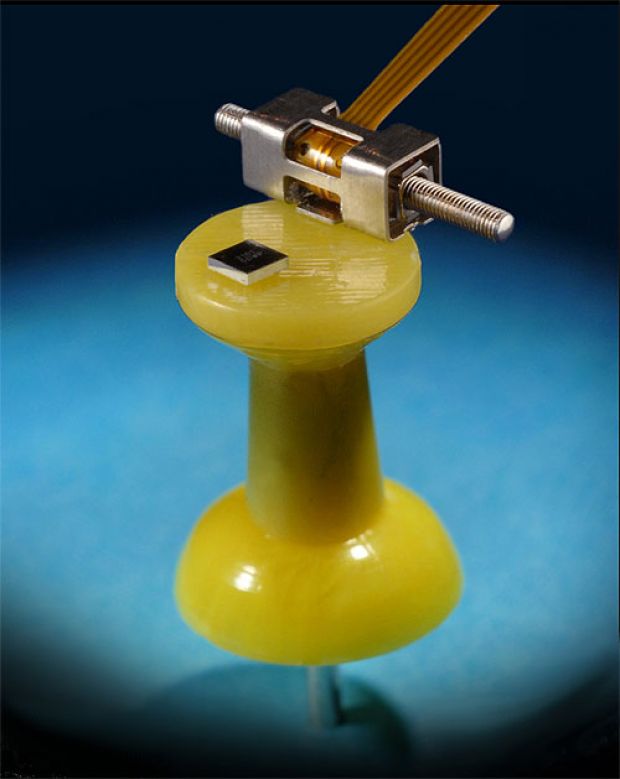
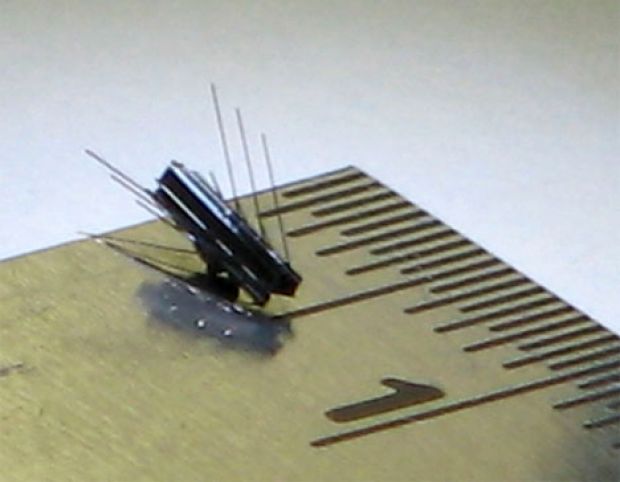
Which I find quite interesting because it uses a mechanism not a million miles away from bristlebots… basically a thread, the holder of which buzzes at a frequency that causes the thread to screw. Never underestimate somebody else’s daft idea.
– No parasitic drag – less wasted power
– Zero backlash (with a light pre-load)
– Very high stiffness
– Nanometer resolution and high force
– Smooth velocity at microscopic speeds
– Off-power hold
– Very small diameter
– Manual screw rotation for off-power positioning
– Standard linear motors feature direct linear drive – no gearbox
Which is pretty cool – unfortunately they bleat on about “patents” at every available opportunity which more or less morally obliges the rest of the world to reverse-engineer it.
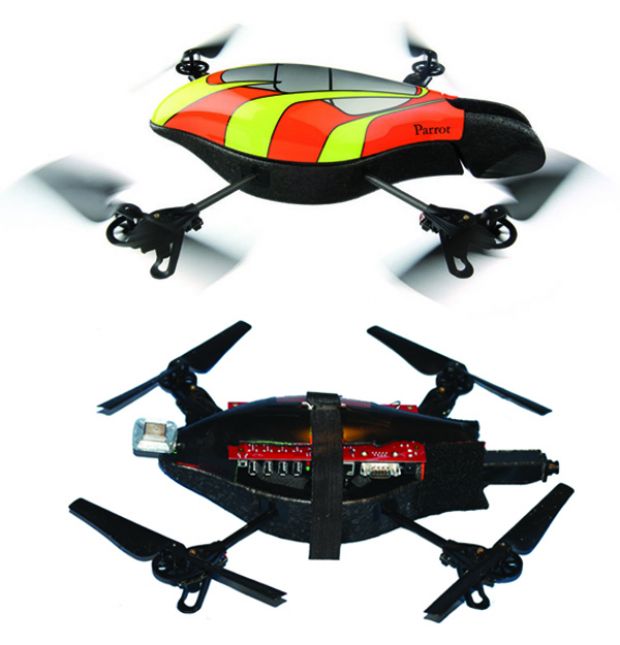
So further to the inevitable, but entirely ill-advised drift into small weaponsied robots, is this
Which is a linux-based wifi finding and hacking machine grafted onto a “toy” parrot AR-Drone. About $600 all up.
I’ve been planning these for ages – won’t ever get it together mind, but this is how you fuck up institutions you want to fuck up – fly a wifi-hacker up onto the roof and transmit their dirty secrets to the world. It’s not the first time I’ve seen an aerial-hacking machine like this, but this is definitely the prettiest – and the Parrot drone is a pretty cool machine, because you can see through its eyes.
Still kindof big though – the trouble with tiny toy helicopters though, is that they’ve got about 5 mins worth of battery power. I’ve gone on about this before… anti-nuke though I am, I think we need some sort of pocket-nuke device to persue Moore’s law in various directions. The main reason I’m anti-nuke is because I’ve seen what a bunch of fucking corrupt old cunts holding the world over a barrel because they’ve cornered the energy supply did to the 20th C. What humans do when their lives are dependent on systems that are optimised for scarcity is worse than the inherent dangers of nuclear power itself. By a long way. This is the reason not to have a nuke industry… not because nuke power is dangerous (but sorry, it fucking is) but because the nuke industry is dangerous. Any industry is dangerous.
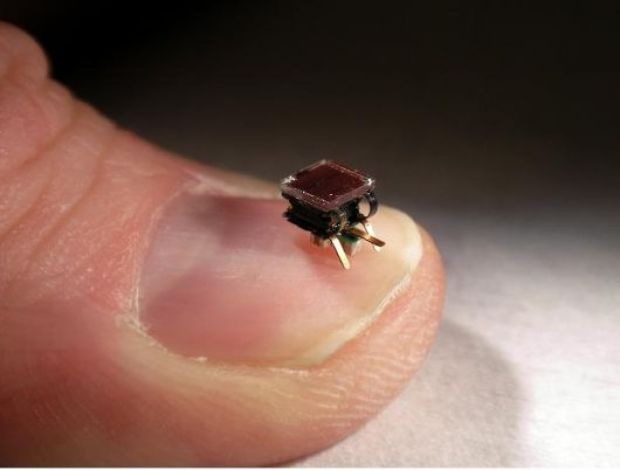
However – decentralised is cool, and this is that:
It’s a little nuke battery – from University of Missouri – not sure what the environmental impact of a couple of billion of these being thrown into landfills would be… but it does offer a way past the flying microbot power-supply bottleneck.
Not saying this is a good thing mind – it just is… (but I’m a technophile, so I’d say “yes”)
Of course if you want to shrink microcopters to the size of wasps, it might be simplest just to use… wasps. I have a feeling that nano-tech as-imagined-by-sci-fi will actually be a bio-mech hybrid. There’s just so much bio-systems can do without even thinking about it. Self replication for example.
as in An individual bacterium’s motion appears random. However, at a concentration of about 10 billion bacterial cells per cubic centimeter, the organisms begin to swim together in what the researchers described as “self-organized, large-scale vortices.” It’s that collective motion that powers the gears’ movement. In their experiments, the motion petered out if the concentration was increased to anything beyond 40 billion bacteria per cubic centimeter, as the organisms appear to shift their behavior toward creating biofilms.
Which is fairly incredible really.
It reminds me a bit of the (very ) early computers though – they were originally set up to create logarithmic/mathematical tables – which had some sort of military application if memory serves. It was only later that it was realised that the computers could perform the calculations themselves… and that they could cut out the middle-man – ie: the logarithmic tables.
Similarly with nanotech I suspect. Microbes already are tiny little machines that can do all sorts of incredibly useful stuff – so using them to create bigger little machines is a bit daft. If you want to use nanotech to build something – a chemical, or a body part or whatever – it might be easiest to cut out the middle-man and just getting microbes to do it directly by tinkering with their genes.
I think the nanotech thing might be a bit misunderstood actually – there seems to be this expectation that we’re going to have tiny little monsters that can eat steel and replace cut-off arms from materials stolen from the side of a passing train etc… but have you seen robots trying to walk recently? Not bad. Not good. We’ve got a looooooong way to go before we can get a machine to self-power, let alone self-replicate.
And bugs can already do it. I’d be putting my money on the biotech revolution really kicking in big-time well before the anticipated nanotech revolution… and the nanotech revolution is actually part of a materials revolution that’s already well underway.
That green one at the end was particularly scary. These people don’t really get androidal xenophobia. Making something look a bit human is worse than leaving it as a machine. If you want people to relate to it as though it’s a… “being” then give it eyes that blink, and follow things about, eg:
It’s really not that hard I don’t think… if you’re smart enough to make a robot to pick someone up – which of course I’m not, so what do I know etc.
Human powers of anthropomorphism are unstoppably powerful. As Bruce Stirling said about some laser-projected smart-seeming tadpole creatures… no one looked up. Even when it was pointed out that these things were being projected from the ceiling people went “oh yea”, then went back to looking at them as though they were real creatures.
And we like them. We just can’t deal with them looking like weird mask-wearing psycho-clowns.
Solar-powered and self-motile… a cross between a bristlebot and a beambot… and a chocolate-teapot I suspect, but it’s a journey, not a destination afterall.
I believe virtually everything I read, and I think that is what makes me more of a selective human than someone who doesn’t believe anything… but until I’ve seen a video of this thing flying…
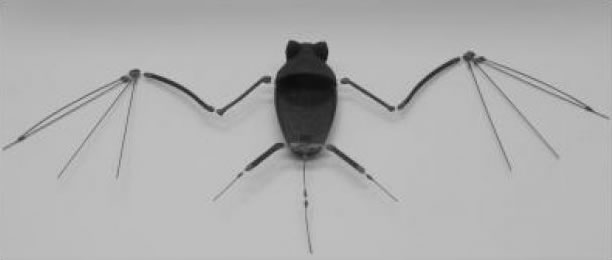
The point though is though, that it’s using memory-metal for the muscles – pass a current through it and it moves. I can remember reading about this stuff in OMNI magazine in the 70s… and thought the future had finally arrived (actually, it was only just being invented), but nothing much seems to have happened with it since. I think that finding robot muscles other than magnetic-induction type motors is fairly fundamental in moving things forward into proper sci-fi land though.
I’m not entirely convinced about this fluttery business. I think the reasons moths and bats and whatnot have wings rather than propellers is more a case of evolution designing around a physical weakness in multi-cell systems than one being more efficient than the other… I mean, which looks more stable to you, this:
Ok – about the same, but the flapping to me looks like a it’s basically two propellers doing two back and forth semi-circles rather than a full rotation… and I suspect very strongly that the reason it’s filmed in slo-mo is that at normal speeds, they only managed to get seconds of stable flight at a time. There are a lot of flutterbots on youtube, and they look as erratic as hell.
I suspect that stability basically comes down to smarts… as you’ll know if you’ve ever watched wasps raiding bee-hives… bees bumble about and crash all over the place* while wasps can zoom straight through really narrow gaps – and they’re basically the same hardware.
Still… tiny muscles are to robots what light-gates are to computers. Maybe.
–
* Christ on a bike, how much time must people have on their hands to dub a scream over a bee crash?
Here’s some insane person’s fantasy about using robotic bugs to spy on and kill people. The voice-over is flirting with that whole hollywood macho tone – an indication that they’re living in movie-land rather than the real world. Just like Ronald Reagan – who had an alarming habit of telling anecdotes about his life which were actually from movies, and they named a battleship after him. I’m talking about The US Air Force.
1) they’re all little flying robots that look a bit like bugs
2) they all employ first-personism
3) they’re all evil. Either for spying or killing people – apart from the last one maybe. Or any of the other ones.
4) they’re all a bit rubbish.
I mean no offence etc, they’re a lot better than I could do – I can barely tie my shoelaces, but if you compare them to an actual insect… they’re crap. Take a proper hornet for example. It can :
fly : really accurately. Straight through holes the same size that it is without hesitation.
walk : like the clappers, up walls, upside down on the ceiling, all limbs individually sensored and controlled.
3D print using locally sourced materials (their nests are 3d printed)
self-fuel using locally sourced materials.
reproduce itself from locally sourced materials, with sexual selection and variation so evolution happens.
work/live/fight/build communally.
Now that, my friends is quite a feat of engineering. Think of the best flying machine we have today… a stealth bomber? It doesn’t come close to what a simple wasp can achieve.
So I’m guessing that we’re going to learn to make “brains” that learn how to use alien systems faster than we’re going to learn how to build robots that actually manage to do what mad-scientists want them to. I’m guessing that the biotech revolution is going to merge with and eclipse all the others – robotics, nanotech etc… they’re not going to be like they are in sci-fi movies because it’s easier (and a lot more potent) to program/adapt existing creatures than it is to make them from scratch.
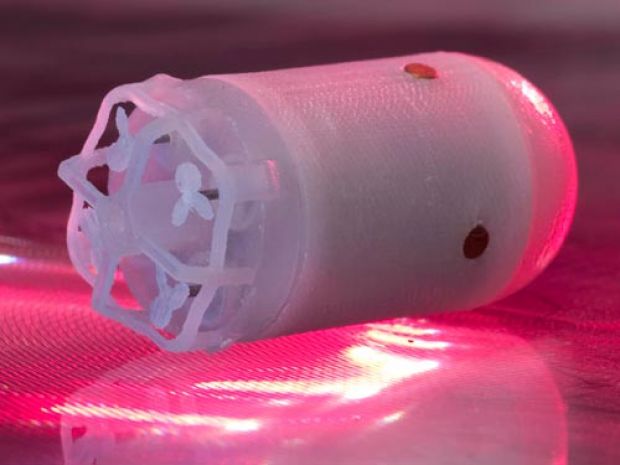
It’s about 1mm wide by 1cm long and is powered with an external vibrating magnetic field. Apparently there’s plans to mount a camera on it, which is something I went on about before, and everyone thought I was mad etc. Microbial Safari.
Of course this particular robot is a direct nick from nature – foxtails which (in NZ at least) are the bane of dog owner’s lives because they get stuck between their toes, and like these robots, can only go in one direction – deeper.
Nasty little shits they are. Quite intriguing to play with though – they’re actually covered in micro-barbs to accentuate the affect. Kindof like one-way velcro.
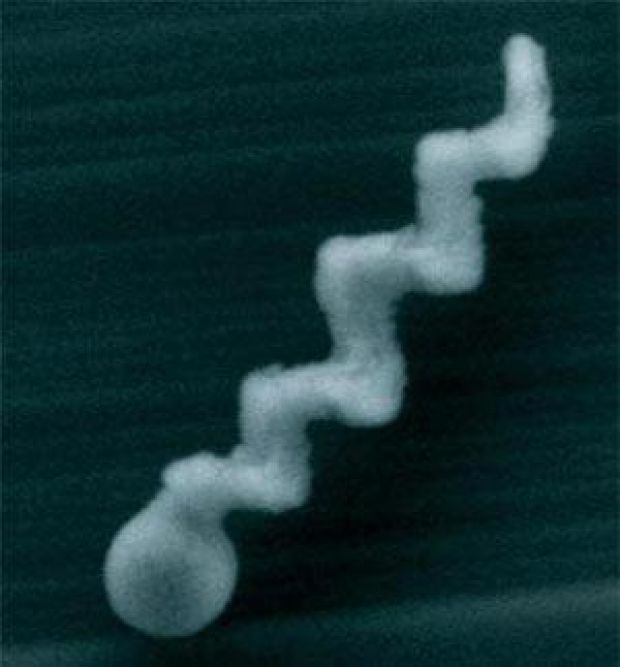
“Made of glass, each has a spherical head 200 to 300 nanometres across and a corkscrew-shaped tail 1 to 2 micrometres long – less than one-tenth the length of a human sperm. To make their propellers, Ghosh and Fischer covered a silicon wafer with glass beads, before depositing a vapour of silicon dioxide onto them.” - New Scientist
I think one of the things that’s quite interesting about this is that they’re propelled (to a fairly fine degree of accuracy) using magnetic-fields… force-fields in other words. Just like the ones off The Death Star.
That’s one of the things that wasn’t immediately apparent from watching Star-Wars – Darth Vader was only a couple of nanometers high, and The Death Star was the size of a pea. It was a serious business though.
It’ll be interesting when we manage to shrink ICs/Optics down to microscopic level – and incorporate first-personism into nano-bots. We’ll be able to go on bacterial safaris. I think that’s one of the most interesting things about first-personism: the ability to shed size-constraints – and detach ourselves from the otherwise serious consequences of getting into a fight with an amoeba 100x our size.