GENOMICONrss

rss

The Crowd-Sourcing of Intelligent-Design

arduino

How to rule the world with a single Arduino

Ok, the hell with bambies and butterflies and such. Let’s get into something really dangerous… and not in a “Top Gear Blowing Up a Car” dangerous, but really serious 3rd-Reich level fucking-up-reality dangerous.

First you need to watch this, to learn who Edgar Cayce was.

YoungEdgarCayce

Edgar Cayce was the most powerful psychic in recorded history. He out-Nostradamused Nostradamus. He could predict the future, heal people over the telephone, tell people lottery numbers, go back in time and describe the life of Jesus… all that sort of thing.

What he’d do, is have a lie down… go into a bit of a mid-sleep state, then people would ask him questions and he’d talk out loud etc… with answers.

He reckoned he had access to some sort of Universal “pool” of knowledge, which pretty much anyone could access once they’d got the knack – he didn’t think he was special. There’ seemed to be vague rules attached – like he’d get headaches and such if the knowledge was used for selfish purposes, but Paracetamols have been invented since then, so fuck it.

I’m not entirely averse to this idea to be honest – we live in an 11-dimension universe… and there are lots of instances (eg: here in NZ, The Maori knowing the shape of NZ from driving a canoe round the outside)… people in “primitive” cultures having access to knowledge that they really ought not to have known… given the science of the day etc. The notion of “Information being non-local in space/time”, and space/time (as we know it) being a byproduct of the n-dimensional information rather than vice-versa.

I’m not big on mumbo jumbo from anything other than an artistic perspective (mumbo jumbo art is great)… but… you are, and you’re ambitious and irresponsible, so I’ll continue.

So what you do is you get this here arduino-hacked EEG sensor


(via)

and you hook it up to your laptop when you’re sleeping.

This way you can measure your theta/alpha/beta/schmeta levels – and use them to trigger sound files on your computer… and record the response (if any) with a voice-activated recordy thing.

What you do then is home in on the Edgar-Cayce zone by asking yourself progressively more difficult… and then impossible questions in your sleep.

So

1) record the vocal “what is 1 + 1?” and trigger it at various brain-states during the night – eg: one for coming into Theta, one for 10 minutes in, one on leaving etc etc.

If you don’t get a response, the whole thing’s a failure. Go and stare disconsolately at the tumbling breakers for a bit. That what I normally do when I fail to take over the world.

2) If you do get a response…. try it again the next night, concentrating on the working brain-states. “What’s 5+7?”

3) If that works, try one which will involve extra-normal intelligence. eg: “what’s the square root of 12345?”

4) If you get that right, try something that’s accessing information that you can’t possibly know about, eg: “What is the first word on the 35th page of the biggest book in the cooking section in the local library?”

5) Then something from the future: “what’s the first word in the first article in the newspaper tomorrow?”

You get the idea. You win the lottery repeatedly then invent nuclear fusion. Or whatever. You live in a tower, and grow a beard and go among the people only in disguise.

Before taking over the world though, there are two other questions you should ask

1) If there are reasons why I shouldn’t be doing this, what are they?

and

b) Where is this information coming from?

Because you don’t want to go painting yourself into any Faustian corners… although… you know… maybe it’s too late. Knowledge is not enough. It never was. Never was.

If none of that works, here’s an invocation for Asmodeus, King of the 9 Hells, and Arc-Demonic Prince of Lust etc.

Go on, you know you want to. What could possibly go wrong? LOL

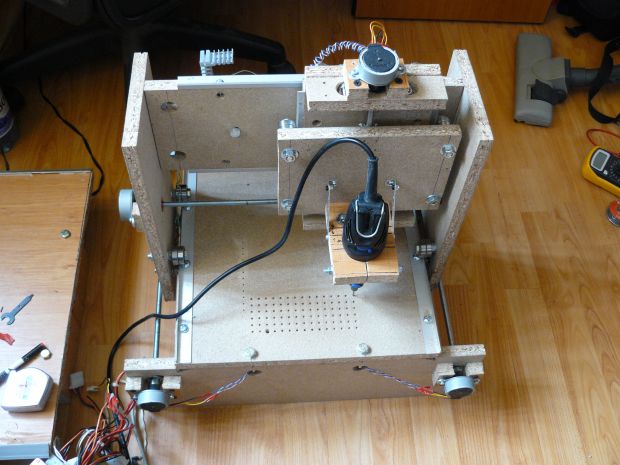
$100 CNC Machine

CNC1

from : via

Controlled by Arduino, with tutorial etc on the site.

A slightly more together looking variant here:

CNC2

Machine generations.

Something I’m noticing myself now that I’m getting away (hah) from programming and more into physical stuff… the prototype is generally corrugated cardboard, wood, hacked-acrylic… what the likes of Ponoko do is reduce the gulf between “hacked proof-of-concept” to “work of art” to…

…, an evening in front of a graphics program.

What Ponoko do is reduce massively reduce the energy that is required for the Second Machine Generation.

What I’d really love for them to be able to do (do you hear this Ponoko folk?) is a same-day turnaround.

I can remember when mail-order had a standard 28 day delivery time, then Amazon was invented and destroyed that model… in the UK I’ve ordered a book from Amazon and had it in my mailbox the next morning. Ebay took up this approach, and now we kindof expect more or less instant delivery. This would be really useful for Ponoko to be able to do, because there’s an experiment-cycle. Try->fail, try->fail, try->fail, try->succeed. This can take months.

So um… the core-value that I’m getting from Ponoko is the massive attenuation of the Concept->Art process. If they want to improve their service (to Me me me) then a big thing they could do is figure a way to radically lower the turnaround time.

But I don’t know their business, or what’s involved, or if this is a reasonable thing to suggest etc… If I were to buy my own laser-cutter though, that’s the reason I’d do it. To reduce the Concept->Art process. That’s what this stuff is for. De-Sublimation.

Anyway, back to the CNC…

These are starting to show up around the place quite a bit… eg: buildyourcnc.com, but nothing quite as cheap as the one above.

R2D2′s Dirty Little Secret

From the wrong side of the tracks : Rare footage of his Grandmother, a cleaner:

from Ladyada Arduino controlled Roomba

Detachable Brains

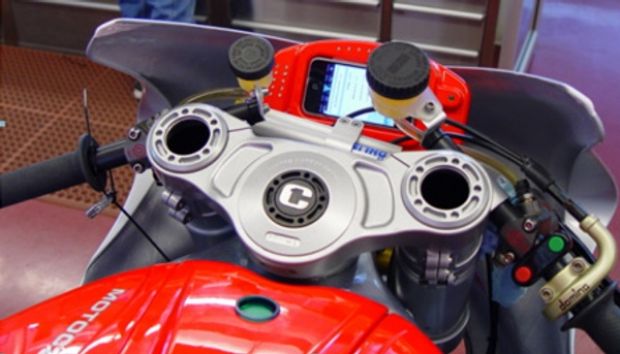
Something that’s turned up a couple of times recently, is using an iPhone as a brain for some sort of other, slightly bigger thing, that’s got absolutely nothing to do with telephones.

eg: this electric superbike… which uses one as a dashboard.

iphone1

(from : via)

I can see this happening more and more – rather than having a computer with lots of “plug and play” devices, you have a lot of devices and one computer/smart-stick etc that plugs into them.

iPhones are a bit different though – because they have eyes, ears, a sense of balance, a sense of location… a screen, an input device, web-enabled, sms-capable etc etc etc. It’s not just an extension of a brain, it’s an extension of a load of different human senses as well… though not as good as the real ones. Yet.

I can see this coming from the other end, and being a competitor for arduino actually. The potential of it is massive. Seriously… but iPhones are tethered, and they’re not open-source… and the future is open-sourced. So um… Android it is.

LittleBits : Electronic Lego

I think this is an amazingly good idea.

“littleBits is an opensource library of discrete electronic components pre-assembled in tiny circuit boards. Just as Legos allow you to create complex structures with very little engineering knowledge, littleBits are simple, intuitive, space-sensitive blocks that make prototyping with sophisticated electronics a matter of snapping small magnets together. With a growing number of available modules, littleBits aims to move electronics from late stages of the design process to its earliest ones, and from the hands of experts, to those of artists, makers and designers.”


(via)

I’ve spent ages wracking my brains trying to figure out how to plug components together without soldering or breadboards… Magnets! – and the polarity is set up so you can’t get the wires round the wrong way.

Laser-cut Jansen Arduino Walky Thing

Probably difficult to believe, but I do deliberately try not to be too robot-orientated.

This however I can’t resist because it combines so many of my favourite threads – Theo Jansen Machines, Arduinos, Rapid-Fabbing AND the designs etc are open-source, and up on Thingverse, inviting people to adapt/evolve.

(via)

Instructions / Materials / photos etc here

jansenwalker

The bits are for sale or you can make them yourself etc… this seems to be an emerging trend with open-source hardware. Varying levels of kitset completion, priced accordingly… so if you don’t want to solder, you buy a slightly more expensive, slightly more complete one. In this case the only choices are, 1) do it all yourself, 2) buy the parts and assemble yourself.

jansenwalker2

But is it useful for anything?

Indirectly maybe – we’re learning how to do open-source hardware.

What we need I think is some sort of template – some macro-format that allows a standardised way of presenting/storing designs/part-lists/instructions/photos/videos/change-logs etc etc. We can probably apply what we’ve learned from software – but hardware is different.

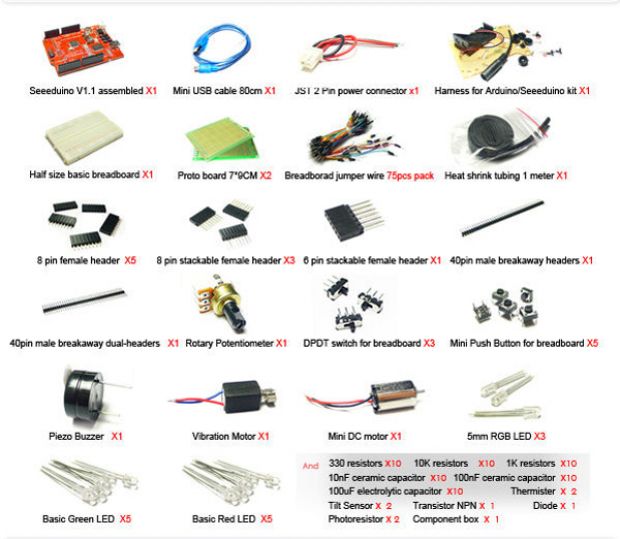
Seeeduino Catalyst Pack

If any of you are thinking of having a play with an Arduino etc – I’d highly recommend this:

seeduino1

Seeduino Catalyst Pack from Make… because in my experience, you’ll want most of the things there, and $79 is a bit of a bargain methinks… for the time that you’ll save finding out what you need by trial and error.

The Wifiification of Everything

That’s what I want. Everything wifiified.

I want gadgets that can sit on my network when my laptop is away, keeping an eye on things.

For a while I’ve been tinkering (in my mind, always in my mind) with Arduino-hooked-up XBees… these:

xbee
(from www.faludi.com)

Which are as cheap as chips (expensive chips) and LadyAda goes on about them in tutorials etc over here.

Trouble is though (if I’ve got this right) they only talk to each other, so setting one up as a network device involves some other bit of kit that I don’t know about – which is probably dead simple, but I still don’t know about it.

Then I saw these…

eyefi (from Eye-Fi)

Which are appear to be about $100 – which is way too expensive, but which appear to be smaller… and which maybe behave as a network device… so it’s closer.

Why? Don’t know. But if everything is going to have a computer in it, then it needs to talk to something… and it can’t be my laptop, because it isn’t there 1/2 the time… for example, it would be quite cool to have one of these little cards in every single wall-point / light fitting to micro-manage electricity usage. Seriously – it would be so much easier to manage your myriad stand-bys, chargers, thermostats etc etc off from a single piece of web-enabled software than by going around trying to do it by hand.

In addition to that, if it was a bit of web-enabled software, then there are probably all sorts of crowd-sourcing ramifications etc. I’m sure that simply by knowing where the electricity is going, would go a long way towards stopping it going there.

Arduino Lego… another step forward.

arduinolego

This is from Tinkerkit – an “Arduino-compatible physical computing prototyping toolkit aimed at design professionals.”

arduinolego1

Which looks like a step in the direction of lowering the learning curve required for people to build their own gadgets. Not commercially available yet, but looks pretty interesting.

Sanguino, Son of Arduino

There you go:

Sanguino: Arduino’s Big Brother from Zach ‘Iowa’ Hoeken on Vimeo.

These guys have taken the Arduino thing which is an open source way of linking a computer to home-made electronic gadgets… and replicated/morphed it so it’s got more capacity than the original. It’s like memetic software making it’s own hardware – but (for the moment) humans are part of the loop.

I love the excitement of this – hauled out of bed at 4.30 in the morning… I can just imagine those old printing-press guys back in the day going “Dude, that’s awesome… check it out” and “this must be like 200 in Swatch Time” and so on.

Now this may seem like a hobbyist thing, but remember that the computer that you’re using to read this has this as it’s ancestor:

The machine that inspired Bill Gates to write Basic. This is how it starts.

You can buy your own from Sanguino for 25$

,

An ode to Cognitive Surplus.

A celebration of the inventive backwaters of the human spirit... a celebration of people who would appear to have far too much time on their hands...


A celebration of laterality.


If you come they will build it.


By knowledge shall the spheres be filled.


Weirdsky Industries