GENOMICONrss

rss

The Crowd-Sourcing of Intelligent-Design

reprap

Accelerating RepRappery

(from)

“The experimental four-dimensional GCode interpreter is now five-dimensional. Four dimensions are so three weeks ago… It has an extra DDA variable that is the feedrate. ” – blog.reprap.org

Cool. I have no idea what that means*.

I think it’s incredibly interesting how this is being developed COMPLETELY in public. I first came across repraps on the 23rd of March 2008 – just over a year ago – and I remember it well (ish) because I’m one of a massive segment of humanity, who now keeps public diaries (although mine was at least semi-fictional)

Has it come a long way since then?

Yes and no. The original video (from 2007) talked about it as an academic research project with a 3% chance of “success”… I think progress towards being able to create all its own parts has been fairly slow – but as an idea, it has exploded – it’s famous, and it’s gone from being an academic project to something that now probably can’t (or at least won’t) be stopped. It’s taken on a life of its own – and not always in the ways that the core team had planned – but that is the nature of the beast. It’s a success. Arrrgggh.

So that’s the benefit of its development being entirely public I suppose – although the physical replicator is still finding its feet (and it will be years before it does I think), a higher-order replicator: the reprap meme, is growing and dynamic, and providing the energy that is needed to create the physical object.

I think there’s possibly some natty little formula (which probably doesn’t work) in there somewhere: “In the Attention Economy the interest generated by the ongoing Making-Of story, can sometimes provide the energy needed for the creation of the final object”.

Transparency of Process can be a powerful creative catalyst – even though it’s a diametric opposite of 20thC business intuition.

When I worked in the City in London in the 90s, much was made of the notion of “management of expectations” – and secrecy was the norm. The power of Transparency of Process on the other hand (if it’s well done), is to do with “management of surprises” – and openness is the norm. I’m not sure that one’s any easier than the other to be honest… it’s just that you get more energy from the latter.

* actually, I do know what that means. Kindof. I think.

Reprap Map

A couple of things I find interesting about this – one the proliferation… they’ve really gone from 1 to hundreds very quickly, even though most of them are bootstrapped… the other is that there seems to be a European locus around the UK and Holland – makes me think of wool smuggling or the East India companies (or that era at least) for some reason.

And the other one of course is that this is a community. All of these people are talking to each other… they wouldn’t be on the map otherwise.

Self-Assembling Reprap

reprap123

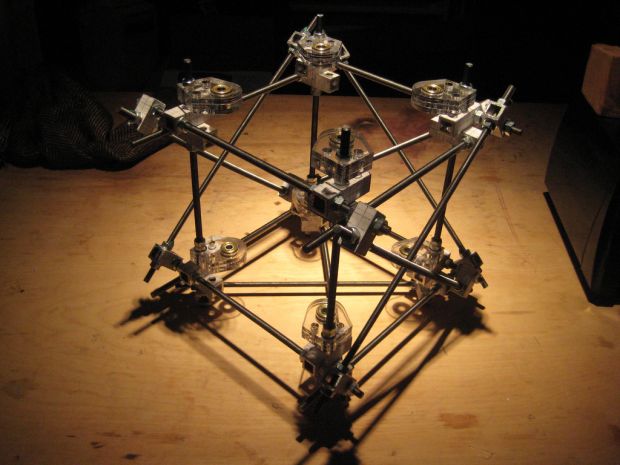
This rather glam looking variant is (it would appear) a bit of a leap forward in that the corner bits are a) massively simplified and genericised and b) when combined with a stepper motor and the right bit of software, allow for the construction to be done semi-automatically, obviating the need for fiddly measuring and so on.

It’s looking like the threaded rods might be a vitamin-part for the foreseeable future mind. I wonder if you could make them by wrapping a bit of string round a dowel or something.

Don’t mind me. Chatter from the cheap seats etc

The Lego Reprap Convergeance

Recently, Forrest Higgs over on the Clanking Replicator Blog was bewailing/bemoaning the fact that the exponential rise in the number of reprappers in the world is not due to them going forth and multiplying, but because they’ve essentially become more-or-less out-of-the-box, consumer items composed entirely of vitamin parts.

lasercutreprap

And obviously he’s quite right… but then that will happen, because the entire planet and the entire internet are together operating as one giant reprap machine… and if the parts can be more easily sourced from outside the experimental confines of a single machine, then chances are they will be. Everything is memetics… and whatever allows the virus to spread fastest will win. For a time.

So here’s what I think he/they/we should do:

Use repraps to make lego.

Ok, obviously you can’t do that, because the engineering tolerances for lego are about .0001 of a mm, but lego has kindof become a defacto rapid-prototyping tool in its own right. I’ve mentioned it often enough on this blog – everything from art to rubiks cube robots… and there’s a blog post over here, entitled 2008: The Year Lego Took Over the Internet – The Super Meme… which, in most humble of opinions doesn’t really do it justice – it’s not a super-meme, it’s simply one of the oldest and best memospheres that operates on the physical plane. Meccano was another one, but that appears for the moment to be somewhat off-radar.

One of the troubles I have with Reprap at the moment, is that it doesn’t seem to be much good for making anything other than reprap machines. I think the direction it needs to go in is to be able to create the building blocks for ANY sort of machine… similar to what Lego Mindstorms does… in fact combined with Arduinos, I think Reprap should be a direct competitor (or maybe symbiote) to lego mindstorms.

I know that the theory is that it can make anything… including itself (a rapid prototyper) but maybe it should make rapid prototypers that really are rapid… and for that, you kindof need a reduced-instruction-set style set of building blocks that massively lower the learning curve for participation.

So that’s my 2c.

And as a total non sequitur, here’s a video of another modular constructor thing made out of magnets.

or

and something else altogether.

Neologism of the day : Vitamin Parts

hampster
om nom nom

Is this basically just an excuse to post this picture of a hamster? No. Rubbish etc.

Ok. Vitamin Parts… lets say you were trying to make a completely self-contained self-replicating system that was capable of reproducing itself (ok, it gets energy, materials and initial programming from its environment, but what do you want? A caveat to the laws of thermodynamics?)… like a reprap machine for example. If you managed to get it to a point where it could 100% self-reproduce, with no outisde help, then it would be said to have “closure”.

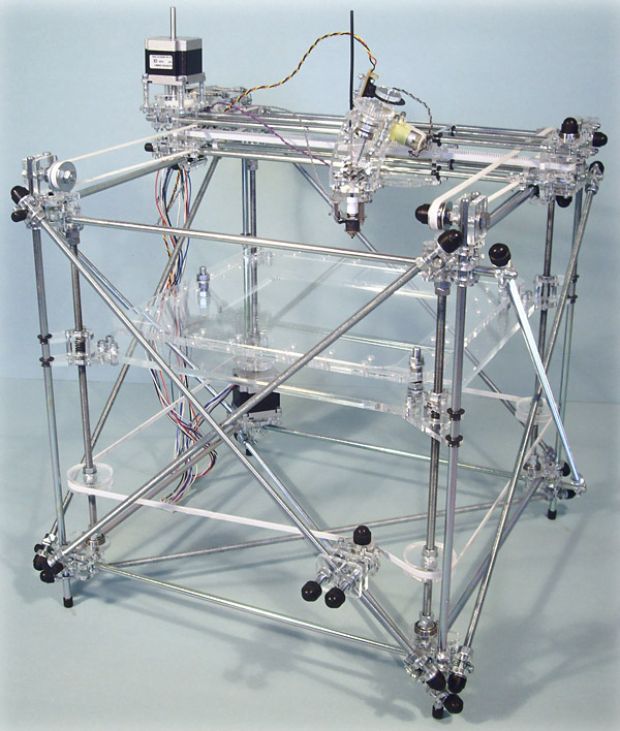
At the moment the reprap machines are currently at about 60%? 80%? I don’t know. Here’s a picture of an earlyish one

reprap

and you can see there are various bits like wires and motors etc that it can’t make itself, and which have to be supplied by helpful humans.

These are know as vitamin parts.

So if say (and I mean this hypothetically), you wanted to make a self-sustaining hamster biosphere, like this one where it can shred its own paper…

hamstershredder1

… then the hamster weel would be a vitamin part. Actually the hamster itself is a vitamin part as well, unless you have a suitably large gene-pool etc…

Ok, it’s not really a terribly good example, and perhaps the whole thing was just an excuse to post that first picture, but still. You’ve learned something etc. Stop your moaning.

Starting in the middle

For me it started here : http://www.csse.monash.edu.au/~damian/papers/HTML/Perligata.html.

How many years ago now? Seven? Ten? I can’t remember how long ago it was… but I can remember being utterly gobsmacked… The Diamond Bullet Moment… when I first came across the website where someone had created a version of the programming language PERL in Latin.

The immediate question is Why (FFS)? But being a geek, I know the answer before I’ve even asked the question. If you’re a geek, when a puzzle is let loose in your brain, you have to solve it. You have to. You can’t help it. The reason Damian Conway did this probably wasn’t a million miles away from the reason I created a 70km wide web page here, although his was a far far bigger job… and it’s is brilliant for what it represents… someone doing something massive and massively random, just for the sake of it.

So anyway, somwhere between this, and Clay Shirky’s thing about cognitive surplus here…

…yet another revolution is underway. People are doing stuff. Lots of it.

People want to participate in their culture more than they want to sit back and be entertained (and advertised to). They’re making stuff and putting it up on the internet and they’re not doing it for money, they’re doing it for attention – which makes for far more diverse and interesting output. And because it’s all going up on the internet, these things aren’t getting lost. They’re getting to cross-pollinate with other ideas.

It’s not just that copyright cartels are being sidelined, the entire culture has changed. Copying and mutating IS the culture now. Mind you, it probably always was. The 20th century was probably an aberation.

But I digress…

(you need to watch these two videos at the same time)


This blog is a collection of projects from the fringe.

An ode to Cognitive Surplus.

A celebration of the inventive backwaters of the human spirit... a celebration of people who would appear to have far too much time on their hands...


A celebration of laterality.


If you come they will build it.


By knowledge shall the spheres be filled.


Golden Mean Calipers