GENOMICONrss

rss

The Crowd-Sourcing of Intelligent-Design

ideas from nature

Return of the Bristlebot

I’ve got this theory that every stupid idea is a great idea waiting to happen – all it takes is a different perspective.

So it is with bristlebots - I’ve touched on this before with the thing where the bristlebot turned into a possible engine for a space elevator.

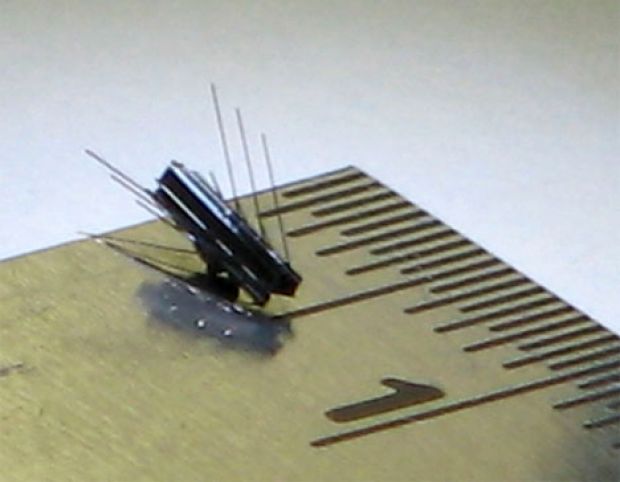
Well another one’s turned up. Making a tiny bristlebot to deliver drugs to tumours.

bristle1
(from : via)

It’s about 1mm wide by 1cm long and is powered with an external vibrating magnetic field. Apparently there’s plans to mount a camera on it, which is something I went on about before, and everyone thought I was mad etc. Microbial Safari.

Of course this particular robot is a direct nick from nature – foxtails which (in NZ at least) are the bane of dog owner’s lives because they get stuck between their toes, and like these robots, can only go in one direction – deeper.

bristle2

Nasty little shits they are. Quite intriguing to play with though – they’re actually covered in micro-barbs to accentuate the affect. Kindof like one-way velcro.

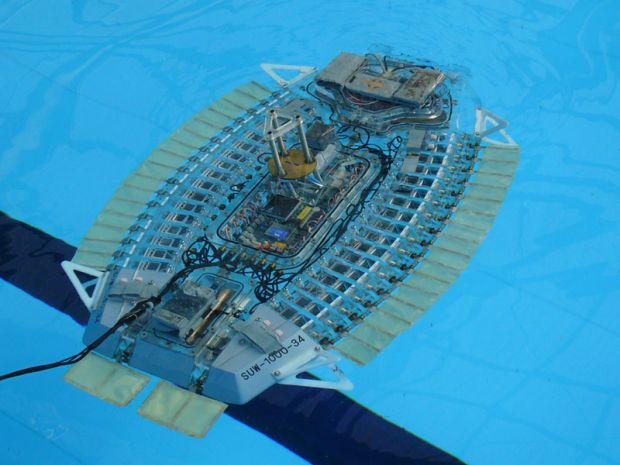
Squid Robot

squid1

(from : via)

There have been a couple of these recently – robots that do actually look quite… biomimicitous – largely because they’re starting to use soft coverings over exoskeletons I think.

This particular mechanism looks similar to some of Theo Jansen’s machines.

theo jansen

Rat Racers

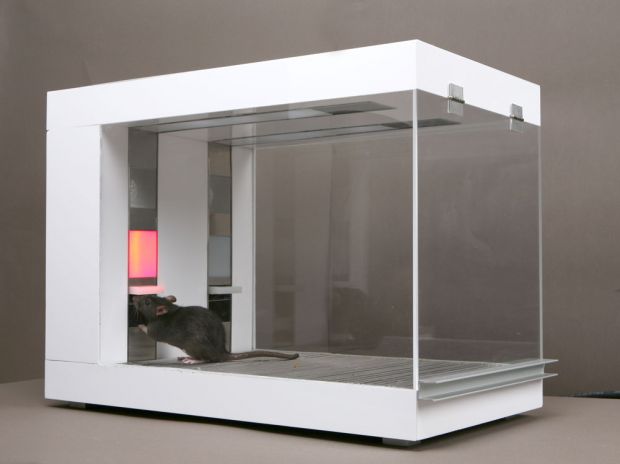
I still can’t tell if this is real or not:

rat1

Using rats to play the markets in exchange for treats etc.

Via www.notcot.org – who’s site I really like, at least partly on account of it looking just like Opera’s CSS rendition.

When high heels are not enough : Horse Leg Stilts

from www.technovelgy.com

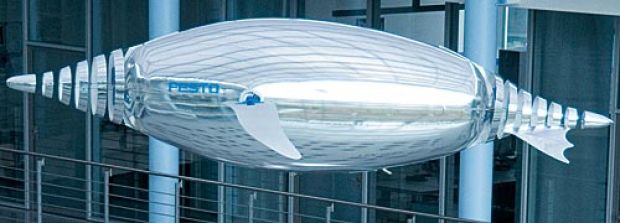
Amazing Flying / Swimming Penguinbots

Ok. Even though in the last post I said I was trying to avoid constantly going on about robots, I’m going to go on about them again, because these ones are simply too amazing, and touch upon a number of my favourite concepts – eg: ideas from nature, anthropomorphism etc.

penguin

It has a snouty nose etc. Marvellous. They use 3D sonar to avoid collisions and talk to each other.

It comes from Festo - who are a bit of a powerhouse of innovation – the same people who came up with the robotic jellyfish

and the Fluidic Muscles – robotic muscles being a bit of a missing link that I was on about earlier – these are pneumatic though, so still have the same problems at the compressor end.

The robotic fin-gripper in the first video is pretty impressive as well – looks like the claw bit might be 3D printable… one of those things that you can kindof tell is ‘right’ because it’s so simple.

via www.technovelgy.com

Beambots

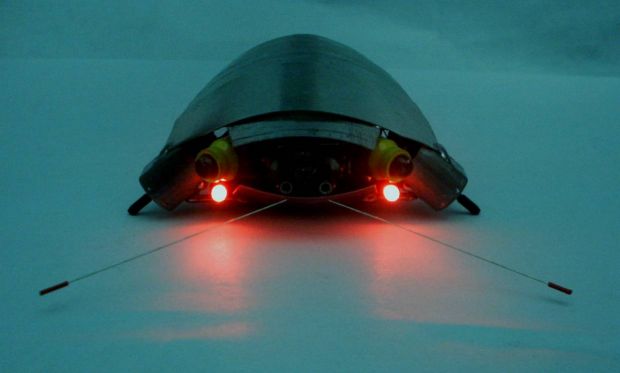
BEAM standing for Biology, Electronics, Aesthetics, and Mechanics… and meaning a strata of robotics that uses analogue circuits rather than microcontrollers to do whatever it is that they do. They also seem to mimic various biological critters (in various respects) but remind me more of really simple, single cell creatures arising out of some primordial soup… DNA learning how to walk for the first time.

mercury

mercury2

This one follows light:

from Harolds Beam Bugs and being a proper community-driven type thing, they all come with instructions etc.

vermin

One of the things I like about these is that someone’s put together a taxonomy for them:

There are various “-trope” BEAMbots, which attempt to achieve a specific goal. Of the series, the phototropes are the most prevalent, as light-seeking would be the most beneficial behaviour for a solar-powered robot.

  • Audiotropes react to sound sources.
    • Audiophiles go towards sound sources.
    • Audiophobes go away from sound sources.
  • Phototropes (“light-seekers”) react to light sources.
    • Photophiles (also Photovores) go toward light sources.
    • Photophobes go away from light sources.
  • Radiotropes react to radio frequency sources.
    • Radiophiles go toward RF sources.
    • Radiophobes go away from RF sources.
  • Thermotropes react to heat sources.
    • Thermophiles go toward heat sources.
    • Thermophobes go away from heat sources.

BEAMbots have a variety of movements and positioning mechanisms. These include:

  • Sitters: Unmoving robots that have a physically passive purpose.
    • Beacons: Transmit a signal (usually a navigational blip) for other BEAMbots to use.
    • Pummers: Display a “light show”.
    • Ornaments: A catch-all name for sitters that are not beacons or pummers.
  • Squirmers: Stationary robots that perform an interesting action (usually by moving some sort of limbs or appendages).
    • Magbots: Utilize magnetic fields for their mode of animation.
    • Flagwavers: Move a display (or “flag”) around at a certain frequency.
    • Heads: Pivot and follow some detectable phenomena, such as a light (These are popular in the BEAM community. They can be stand-alone robots, but are more often incorporated into a larger robot.).
    • Vibrators: Use a small pager motor with an off-centre weight to shake themselves about.
  • Sliders: Robots that move by sliding body parts smoothly along a surface while remaining in contact with it.
    • Snakes: Move using a horizontal wave motion.
    • Earthworms: Move using a longitudinal wave motion.
  • Crawlers: Robots that move using tracks or by rolling the robot’s body with some sort of appendage. The body of the robot is not dragged on the ground.
    • Turbots: Roll their entire bodies using their arm(s) or flagella.
    • Inchworms: Move part of their bodies ahead, while the rest of the chassis is on the ground.
    • Tracked robots: Use tracked wheels, like a tank.
  • Jumpers: Robots which propel themselves off the ground as a means of locomotion.
    • Vibrobots: Produce an irregular shaking motion moving themselves around a surface.
    • Springbots: Move forward by bouncing in one particular direction.
  • Rollers: Robots that move by rolling all or part of their body.
    • Symets: Driven using a single motor with its shaft touching the ground, and moves in different directions depending on which of several symmetric contact points around the shaft are touching the ground.
    • Solarrollers: Solar-powered cars that use a single motor driving one or more wheels; often designed to complete a fairly short, straight and level course in the shortest amount of time.
    • Poppers: Use two motors with separate solar engines; rely on differential sensors to achieve a goal.
    • Miniballs: Shift their centre of mass, causing their spherical bodies to roll.
  • Walkers: Robots that move using legs with differential ground contact.
    • Motor Driven: Use motors to move their legs (typically 3 motors or less).
    • Muscle Wire Driven: Utilize Nitinol (nickel – titanium alloy) wires for their leg actuators.
  • Swimmers: Robots that move on or below the surface of a liquid (typically water).
    • Boatbots: Operate on the surface of a liquid.
    • Subbots: Operate under the surface of a liquid.
  • Fliers: Robots that move through the air for sustained periods.
    • Helicopters: Use a powered rotor to provide both lift and propulsion.
    • Planes: Use fixed or flapping wings to generate lift.
    • Blimps: Use a neutrally-buoyant balloon for lift.
  • Climbers: Robot that moves up or down a vertical surface, usually on a track such as a rope or wire.

I’d quite like to go cruising round youtube and find videos for each of these… but time, time…

On 360 degree lenses etc

So obviously, off the back of the small rant-ette about The Internet being The Blue Spaghetti Monster, I found these rather fab chandeliers that someone in England makes.

snaileyechandelier

icicle

The first one being called snail-eye, which is what I’m on about in this posting…

snaileye

Basically what I want (kindof) is a tiny 360 degree lens on a stick. Something that you can use to take a 360 degree shot of absolutely everything in your immediate environment…. work out the dimensions/perspective etc in software. I don’t think snails eyes do this… but they look as though they should, so that’s kindof the inspiration.

There are a bunch of companies doing parabolic mirrors eg: www.0-360.com

g6_mounted

But they ain’t quite there yet I don’t think. I think I’ve seen one that can do this with a lens as well, but what I have in mind is something really really small. LED-sized or smaller.

There would be loads of uses for these – from keyhole-surgery to remote-tourism… if you could make them small enough (and that is kindof the point) you could sprinkle a whole load of them connected to inter-communicating rfid chips (or something) and someone wearing 3d glasses could be given a simulation of walking between them. Maybe.

I wish I was back in Prague. That’s all.

This was at least partly inspired by the news that…

A miniature telescope implanted into the eye could soon help people with vision loss from end-stage macular degeneration. Last week, an advisory panel for the Food and Drug Administration unanimously recommended that the agency approve the implant. Clinical trials of the device, which is about the size of a pencil eraser, suggest it can improve vision by about three and a half lines on an eye chart.

telescope

(from : via)

Wall Climbing Robots

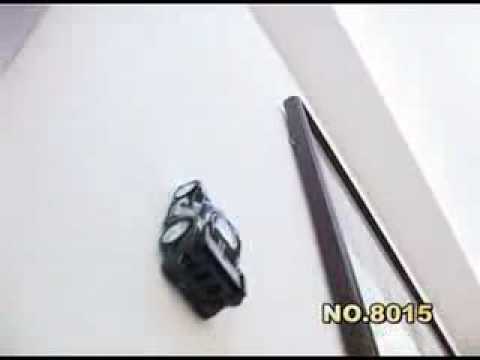
This turned up recently

I’ve had my eye on wall-climbing robots for a while, partly because people have obviously poured quite a lot of money into some of them:

And people get all inspired and build their own, using different techniques for a fraction of the price… and obviously (because this always seems to happen) the first applications seem to be toys.

Winning by a country-mile though – and purely on points for style… Stamford’s Stickybot – which is actually modelled on how gecko feet actually work.

(big talk from Robert Full on how engineers learn from evolution)

Insect controlled robots

insects1

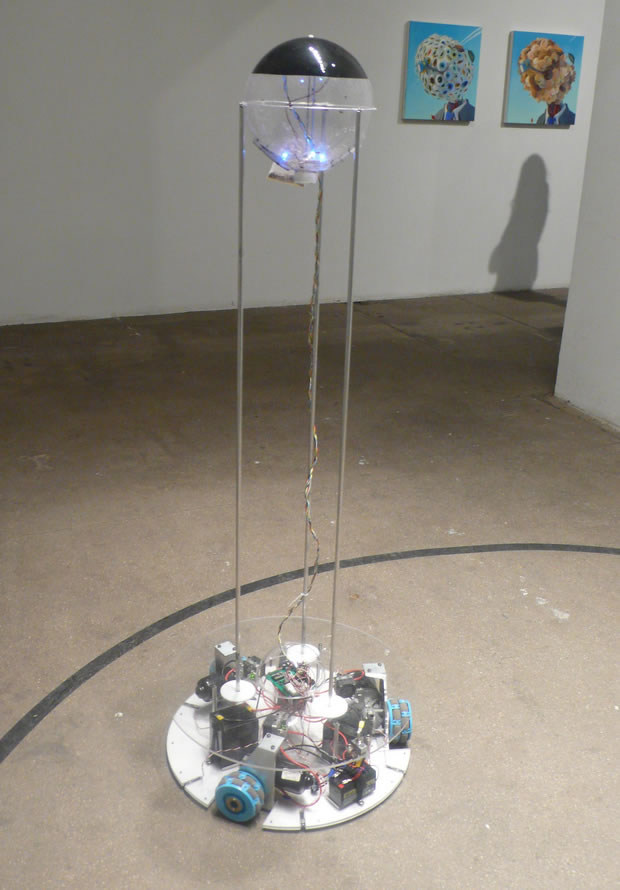
Obviously someone’s seen one of those hamster balls and decided that it would make a nice lampshade, but with flies instead of a hamster, which is fair enough… one of the lampshades at my place is constantly filling up with moths etc, so why not get them to do something useful?

insects2

I once saw this bit of art in the National Gallery in New Zealand where someone had created a glass cube about the size of a shower, put a tractor seat in it, then put an entire bee-hive on the tractor seat… with tube to the outside world so the bees could go out and do bee stuff.

The fly thing is a bit like that, but it moves around and would probably be easier to live with… but not as easy to live with than… a picture of it say.

Ok, this one isn’t so much an insect controlled robot, as an jewelled dragonfly that flutters its wings when you turn a handle. One day these things will be the future of modern warfare. They’ll flit about the place spying on people and poisoning them.

insects3

Ok, this isn’t really an insect controlled robot either – rather a robot controlled insect. You could connect it up to one of those psychic hats I was on about earlier and use it for all sorts of devious purposes.

Actually, come to think of it, I can’ think of a single non-devious purpose that this could be put to… but maybe someone else can, and maybe that’s the point. The cross-pollination of ideas. It’s a flower thing.

(edit)

Brazillian Hamster Balls.

New Zealand Hamster Balls:

Hamster ball painting :

Ok, this post should really have been about hamster balls. Whatever.

An ode to Cognitive Surplus.

A celebration of the inventive backwaters of the human spirit... a celebration of people who would appear to have far too much time on their hands...


A celebration of laterality.


If you come they will build it.


By knowledge shall the spheres be filled.


Golden Mean Calipers