Which we haven’t figured out yet. Apparently back in the 1800s a slave cost about as much as a luxury car costs today. In 2009 you can pick up a slave in Haiti for about $50. And slavery is worse today than it was in the 1800s
There’s an interesting series of talks by the guy who wrote The Wire here – about The Wire being about the end of The American Empire.
I’m in love with the idea of being able to work 2 hours a day to support ourselves – which (as far as I can gather) is one of the aims of the Open Farm Tech project… and at risk of seeming cavalier (as I already have) about one of the (if not THE) worst on-going, trans-millennia tradgedy that humanity has managed to inflict on itself… most of us are (in a diluted sort of way) still slaves. Most of us will spend most of our lives working just to survive… so someone else can get rich. It’s ok. It’s livable. We could do better.
For vast swathes of humanity, NOT being a slave is a life-threatening condition. We’ve created this system based upon scarcity where for the majority of people, if you’re not part of the system, you can’t feed yourself – even if you did have a machine that can do the work of 70 slaves – because the land is owned by someone else, and we’ve let this system evolve where you can’t own/use land without going through a (long) period of dilute slavery.
I’m rapidly coming round to the idea that the biggest problem we have isn’t corporatism, it’s the monetary system. Corporatism is just a byproduct of this.
I love this guy – he’s like an old armchair that sits in the corner and complains constantly… something I feel at liberty to say because (as I say) I love this guy and I too am an old complaining armchair sitting in the corner.
I think it’s doubly funny that he’s presenting this whole tapestry of bleak nihilism to an audience of Scandanavians, and they think it’s funny. I love these people. I wish I was there.
Anyway, Bruce is usually right and usually wrong – and I think he’s right about Favela Chic and I think he’s wrong because he makes it sound awful, and I don’t think it necessarily will be.
I’ve been trying to think about this subject for a couple of days – and it’s really too big a subject to contain in a single post, or even book… so I’ll do what I always do and throw up (favela like) a bunch of exhibits that act like windows – giving different views onto the same scene.
There was an article in The Guardian recently about the artistic vibrancy of the Berlin Squat scene… and I can well imagine. I came out of a squat-scene myself – Camden in the 90s was when music was finally wrested from the grip of “Pay to Play” and turned into something fairly happening and exciting – innovation between the cracks again – but the cracks are wider, and there’s so much time to play with.
I’ve done some research on where people’s money goes – there are various numbers, but they tend to look something like this:
Unless you’re already rich, you spend about 1/3 of your working life (what is that? 20 years?) as a slave to a bank or a landlord. British people don’t spend that much (or anything) on insurance or health… transport? Not if you live in Camden and can walk to everything that interests you. We basically reduced our cost of living to the price of chips and beer, and out of that a culture blossomed.
This is not a sustainable way to live, but if you’re young, it’s fucking great.
Does your landlord allow pets? In my Islington squat, we didn’t have rules-from-above, so the guy downstairs had sealed off his entire living room and had stingrays living in it. Freedom isn’t freedom until you can get out of all systems involving money.
The best years of my life were Favela Chic years. You’re free from the machine, and it’s great.
Exhibit #3 : Collapsanomics
I think collapse of Western Economics could look a little different from the collapse of the Soviet Union say. Our infrastructure and expectations are different – we do some things better, some things worse… but our infrastructure might just be better for setting up as micro-businesses (and Favelas are all about micro-businesses). Most of the people I know already are micro-businesses – as a matter of choice.
This is an interesting talk by Douglas Rushkoff – in fact this is more than an interesting talk, I think it’s kindof vital… as a starting point for understanding that this latest crash (in a series of crashes) may not be a bad thing, and may be inevitable in the very best of ways… and it may just provide us with some direction as well.
We need to (and will) find a way of open-sourcing money. We need to get rid of the banks.
Random thought #1 : Violence
I think the biggest, and possibly most difficult thing to handle in the encroaching arena of Favela Chic is the management and control of violence. It can’t be for hire. Violence needs to be democratically controlled, or things get really ugly. People need to be paid to carry out violence on behalf of the citizenry – to a degree of capability that it acts as a deterrent, and this needs to be acknowledged as legitimate by the citizenry – I don’t think there’s a way around this… and it probably needs to be organised at a national or regional level.
It’s taken us a long time to get away from local crime/war-lords, lynch-mobs, internecine blood-feuds. The worst thing about Favela Chic is the danger of going back to these states. We need laws because human stupidity will always be with us.
Random thought #2 : Reprap technologies are only useful in the 3rd World
I’m becoming increasingly inclined to think that Repraps don’t solve a manufacturing problem, they solve a distribution problem. In the West, we have pretty good distribution (and manufacturing) so the only thing that Repraps are going to be used for with any degree of economic viability, is making other repraps… and people are already selling them off the shelf, so maybe even that’s a bit iffy.
In places where distribution isn’t that great however, being able to print out physical things could be a real game-changer.
Random thought #3 : Meeting imposed-poverty half-way by going off-grid
And to go off-grid we need land-reform: a different relationship to the space that we live on and grow stuff on – because as things stand the parasitism of banks, and landlords perpetuates a scarcity economy. As long as you pay rent or interest at current levels (average being 33%) you’re in a state of indentured servitude.
If you were a gardener would you put up with slugs eating 1/3rd of your crop? Well if you’re a normal westerner, bankers and landlords are taking a 1/3rd of your crop – for reasons that are entirely historical. A reality based upon… “closed-source code, written long ago, by people who had agendas that had nothing to do with us… and who have long since left the building” – Douglas Rushkoff.
He’s made an appropriate technology that can be put together anywhere on the planet… he’s done the whole open-source thing – the “design” is there for anyone to use for free, and he even shows people how to make them themselves (in fact there’s a video of him making one in 3 minutes on his site), but his business is selling the actual physical product (and satellite items). He’s retired, has a massive youtube channel which he uses for chatting and customer support… offers advice on hiking and safety etc… his video channel has videos of his cat…
I really like the way there’s no delineation between life and work and play… it’s all the same thing. In addition to this, the process is the product. The whole life-cycle is there for anyone to see. No secrets. No SEO. No $30,000 site makeovers and Web-2.0 consultancy.
I’d buy one of these just because I like the guy. This is good advertising. There’s no deception or clever marketing techniques – it’s just someone being himself, doing something that he’s good at and likes doing.
So there you go. Here’s a wood-burning variant, with a little electric fan
Otherwise known as the blogosphere – that parallel universe where someone only has to draw a picture of something for it to become real, re-published across the net as a world-saving fait accompli.
Ooh. Beads. Shiney.
I don’t know why I find this so annoying. Really I should like it – it’s people being creative etc, throwing wonderful ideas into the soup. It’s an explosion of creativity and democratised publishing, it generally starts with designers (and design blogs) who are pretty inspirational…
… but somewhere in the process I can’t help but feel it turns into snake oil. The purpose of it goes from creativity to clamorous, panting attention seeking – tricking people into thinking they can actually buy this stuff somewhere. They always take pains to skirt around the fact that what they’re presenting is actually just a drawing of something.
The greeny blogs are the worst – they’ve created this whole diorama of world-saving consumerism, and none of it’s fucking real. To pick a random example (and I won’t provide a link because I’m sure they’re nice people, and I have no particular desire to piss on anyone’s chips). There are currently 10 articles on the front page – and they look wonderful. They are:
1) a drawing of a solar powered market – that doesn’t actually exist
2) a drawing of a bamboo prefab house – that doesn’t actually exist
3) a drawing of a university data centre – that doesn’t actually exist
4) some people aiming to build a solar powered bike – doesn’t actually exist
5) researchers aiming to power cars with cottonseed oil – doesn’t actually exist
6) an energy efficient computer power supply. It exists!
7) a drawing of a green office block – that doesn’t actually exist
8 ) a lovely looking design for a green vehicle – that doesn’t actually exist
9) a test flight by a 747 using 50/50 biofuel / jet fuel. It exists!
10) an energy efficient house in Australia, who’s roof has been extended, and looks a bit like an eyelid, though I personally would have called it an “eve” not dissimilar to what any other house in the entire country has. This exists too, but like, so what?
Maybe they’re not supposed to exist – maybe it’s purely about design and I’m completely wrong, and I’m a cunt and I should shut the fuck up… but the pattern here is spread across the web. It’s kindof like a liberals version of Fox News ending their headlines with a question mark. There simply isn’t enough news to report so they make stuff up – or in this case, report upon the “aspirational” flagship projects of designers and architects, treating them as though they’ve actually made it all the way to actually, actual, real, reality.
C’mon. It’s living in a bubble. We need shit that’s real. Drawing pictures of wishful thinking doesn’t cut it.
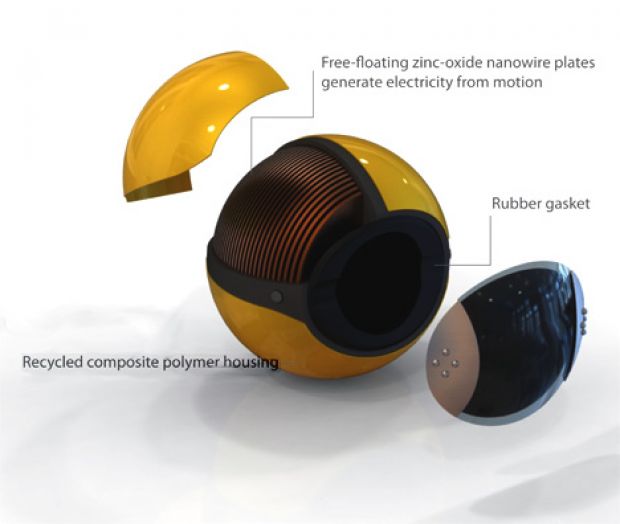
So on that note… here are a load of kinetic chargers, some of which are real, some of which aren’t… and lets face it, it’s not always easy to tell the difference… and really, I’m not complaining about these because they look quite cool as well, and I am quite conflicted about the whole thing.
Maybe it acts as a sort of – market research – designs that create a buzz are merged into tomorrow’s DNA. Who knows. Something about it doesn’t feel right though.
Laundry balls. You put them in your clothes drier and the constant motion charges the battery inside. They look cool. These would be worth having no matter what they did. The Linking site is about “form over function” as well, so no complaints there etc – other than that they publish things that other sites then assume to be reality.
Bullet shaped charger thing – you wear a bunch of them bandolera style. This one is from the site I was bitching about before, and to be fair it has apparently made it to prototype stage.
This one from Gizmag is actually real – a bit of a stretch at nine inches though.
This one’s pretty neat – for dancing apparently. I wonder if they could make one for sitting around the house in your underpants. I mean theoretically it would be more efficient to just dangle a couple of electrodes into a fermented brew of beer (which is already fermented) and pizza, and cut out the middleman. Still, I like it.
A designer security tag that replenishes your energy at the same time as you drain someone else’s with your never ending talking. This one is cool as well, and does (or doesn’t) come in a variety of fashion colours.
Here’s another one, a little less glam… any more real?
from… let me see, let me see… ah ” M2E will announce the development of an external charger later this month” – not quite real at the time of writing (last year) then… The originating site seems to have no mention of this gadget – but maybe that’s not their thing. They seem quite preoccupied with military stuff.
Eric Von Hippel having done a fair amount of research has found that around 80% of innovation is user driven – ie: people playing with actual physical things. He also says that about 3/4 of non-user-innovated products that make it to production, fail.
I hate to think of the number of products that never actually get made at all, but instead are just vapor-ware in the attention economy.
Looks like the doomed auto-makers have been reading Hugh Macleod’s Gaping Void blog, which is really rather good, and has an interesting perspective on “social objects” which are something to do with “conversation pieces” which were all the rage in the 70s.
In fact I can remember a cartoon in which a middle class suburban couple were explaining the monstrous “thing” on their coffee table: “That’s our conversation piece” they said, “We don’t like to talk about it”.
So marketing in the Attention Economy revolves around conversation pieces. God help you if you sell heamoeroid cream. It’s impossible to spell in any case. Serves you right for choosing something you can’t spell, and that hasn’t the potential to be “remarkable” enough to be talked about a great deal. The 21st century is going to be The Golden Age of Piles. I can feel it coming etc.
So speaking of piles, Nissan has released this little gem
Which has it’s own social web-site apparently, though I must confess I haven’t joined or even looked at the page because I’m beginning to find the whole social thing to be a bore… but the car? It looks like a satire – on using social-apps to sell ridiculous shite to the breathlessly gullible herds (the meaning of who’s lives is gauged primarily according to the number of pixelly 80×80 faces to the right of their “personal profile” (yea, yea, I don’t “get it”)). I mean FFS, look at the state of it. Is that really the best the auto-industry can do? after 1/2 a century of massively (and I do mean massively) funded innovation, endlessly refined in the mythically infallible crucible of the market?
Sorry, are you taking the piss?
Someone recently said to me something like “there hasn’t been any serious innovation in the car market since the Citroen DS”… and from a rank-amatuers POV, he’s kindof right. The design classics all happened at least 30 or 40 years ago – since then it’s been microscopic incremental “improvements” which are every inch an indication that the players have become too big to seriously innovate – and they’re now just milking it. Or maybe the market itself sucks?
Maybe the answer to the Car-Buying Punter’s wildest dreams is a thing that looks like, not just a teapot, but an avant-garde teapot from the 50s. I mean teapots are social objects aren’t they? Especially avante-garde ones from the 50s.
Maybe it’s just me… maybe radical innovation isn’t what people want… I mean this review of another hybrid that looks exactly like every other car on the road… ie: a compromise, is (it says) “significantly cheaper” at $18,500 to $20,000 rather than $22,000 to $26,672. Sorry? I’d describe that as being “basically the fucking same”. Business as usual in other words.
Fuck business as usual.
These on the other hand are cool.
What the world needs now is something that has that level of design aesthetic (and the safety and efficiency), but which costs about as much as this:
(from – which also has building instructions and thoughts on how to improve it)
What’s needed is an open-source chassis that allows the easy swapping in and out of engines, “looks and feels” and other bits of tech as they arise. The whole model of having to buy a $20,000 (or whatever it is) conglomeration of steel and glass, about 1% of the energy from which is actually expended on it’s given task (to transport a human), and the rest is spent on itself… and which will be kindof out of date in 5 years, is wrong.
We don’t need an exciting change in how cars are marketed, we need a radical change (ie: breaking up) of the entire business that produces them. The entire philosophy around “what they are”
And the big flashing neon sign that’s six inches from my nose, so close and familiar that I can’t see it?
“NICK YOU TEDIOUS ARSE, STOP COMPLAINING AND DO IT YOURSELF”.
That is the magic bullet. That is the catalyst that allows a transition from the industrial age to whatever’s next with a minimum of blood on the carpet. To stop waiting for our institutions to innovate, and to do it ourselves.
… I accidently took a screen grab of the entire page:
“Cool” thunk I, “looks like a water nymph or a sea-monkey… or one of the monsters off Flow“
And then it occured to me – that this is a pretty good visualisation of a creature of the New-Economy. I’m sure there are other species as well – evolving in the primordial soup of bits and bytes, but as a simple example, this is pretty good..
At the top you have The Lure. The honeypot. The Cube-Grenade. The viral bit that zings around the internet passed from peer to peer. The object that is the catylyst for conversation. The most effective device for doing this right now is video… but it can be anything that gets people to say to other people, “look at this”. Music. Pictures. Stories. It all works.
The next bit is the payload. This is the thing that is exchanged for money (or whatever). These are your products. If you are good (or lucky) this bit will allow people to participate more intensely in the conversation started by the bit above… in fact the more you can blur the first two stages the better off you are. Even thinking of it in terms of “Lure” and “Payload” is slightly counter-conversational… but I think they need to be kindof separate though… otherwise you’ve got “all conversation, no income” or “no conversation, no income”
The long tail at the bottom is the community. These are you conversationalists – the people that care enough to comment. If you’re lucky they will buy your stuff. If you’re lucky they will link/copy/embedd your stuff. If you’re lucky they will polinate your next generation with the new DNA of criticisms/suggestions.
This creature rarely if ever lives on a single machine – it’s distributed across the web… and it rarely if ever exists as a single entity – but belongs in a web of inter connecting others, which could be visualised like this:
Down a bit…
Ok, This:
So you need your competition. They are part of your conversational memosphere and part of your gene-pool.
–
The reason the entertainment industries are in trouble is because their honeypot and their payload are the same physical thing.
So they’re eating their own tail – their fanbase, who’s function it is to replicate and share The Buzz as widely as possible. The most devout of these people are (more often than not) musicans/writers etc themselves. The recent news that pirates buy more music than everyone else should only come as a suprise to people who are living in a bubble. Which of course many of the more powerful of them do deliberately, because it is their job, or to hide the fact that they haven’t been doing their job.
The purpose of the entertainment/culture industries in the 20th century… the value they created was to allow the rapid global sharing of culture (and if it’s not shared, it’s not culture) – the manufacturing, the distribution, the metadata. This was the problem they solved.
The environment that gave them a problem to solve no longer exists… so they are attempting to write it into law. They have become the problem that they once solved.
–
This isn’t our problem though. Our problem is: We have allowed corporations to become too big and too powerful.
It’s a 125 mpg car that a Ford Efficiency expert made in his spare time. Looks like a cross between an Aptera and a kamikaze plane from WWII. Nice colour though.
I think several of the commenters missed various points. This isn’t about anyone designing a product for them, it’s about someone (an individual) building a product for themselves – routing around decades of industry heel-dragging in the process. We will see more of this.
A requirement for the Internet to function as a maximally huge AI experiment is that every single piece of information within it (and without it) needs to have a URI. A Unique/Universal/Uniform Resource Identifier.
A URI may be a
– URN : Unique/Universal/Uniform Resource Name
– URL : Unique/Universal/Uniform Resource Locator (or address)
eg: Romeo and Juliet:
– URN : ISBN 0486275574
– URL : http://www.example.com/example_directory/RomeoAndJuliet.html
A name and an address are the minimum requirements for information linkage.
Not supplying these to any piece of information is a crime against the internet. This is not (however) a strong morality, unless you are a blogger or developer… in which case then general reaction is generally a vague “Oh that sucks, I can’t link to it (or) I’ll have to copy it out by hand”. Information isn’t set free until it has a URN, and URL.
and although it’s a nice gesture, it sucks because you can’t cite anything. They’ve wrapped it up in some (fucking) flash wrapper so that the smallest granularity of linkage you can get is to an entire issue. Utterly useless.
Maybe it’s a lot of work transcribing all this to proper HTML?
It is, but I think that The Whole Earth Catalog is so beloved by it’s readers, that a lot of people might just help out for free… I know I would – especially if they allowed “translated by” links. The Whole Earth Catalog is the spiritual parent of all blogs – it was itself a type of paper-based blog, and there will never be another paper-based Whole Earth Catalog, because millions of its spiritual progeny are all over the web. We are all Whole Earth Catalog editors/writers now.
Maybe they want to make money from selling back-issues?
They can and they will – but we (fans) are their marketing arm now. We’re their radio station – and we evangelise by sharing their content. They can still make money selling physical stuff or services, but the days of selling information in it’s pure form (over and over again, forever) are… well, the environmental conditions are very much against it. And I don’t buy for a second that the idea of generating infinite wealth from a finite piece of work was ever a sustainable or moral concept in the first place. It’s certainly not a moral right, as the copyright cartels would have us believe.
The world has changed. The attention economy has arrived, and new patterns are emerging: Reputational-Capital is not built by locking your information behind money, but by encouraging your fans to free it.
To participate.
This means they can quote it, link to it, share it, embed it in other contexts and make derivative works. This way they become a stake-holder in your information, and will evangelise on your behalf. This is cheaper and more powerful than television advertising… and they’re not getting it for “free”, they’re working (and some of us work damned hard) to increase it’s value as an attention-economy asset.
Sure, the models for making money on the side are still emerging – but to try to legislate 20th Century Information-Transfer conditions into some sort of permanence is both trying to fight the tide, and is deeply, damaging culturally.
The age of participation is assiduously and belligerently rejecting the age of consumption. Adapt or die.
–
An interesting extension to this idea – is applying URIs to physical objects – part of Bruce Sterling’s Spime idea – and an essential part of automated manufacturing – where bills of materials can be sourced by what effectively amounts to hyperlinks. Web 3.0 will be involve (among other things) the application of URIs to physical objects.
Applying URIs to physical objects is also central to the UK governments wankingly clamorous desire to dog-tag all of its citizens (although technically, we aren’t citizens, we’re loyal subjects – we’re not owned by the government, we’re owned by The Queen). In some ways this isn’t such a stupid idea – but it needs to be completely transparent and-open sourced. We can’t trust the government to do this… because we can’t trust the government. Period. It has to be us that does it. The government needs to be taken apart and put back together anyway. It’s no longer fit for purpose.
–
The reason I think this is probably the last emergent morality is that they get more subtle by degrees… further down the track from this one is a whole raft of initiatives that well-meaning people have tried to establish as moral practices, but are turning out to be a colossal struggle… because (largely) the extra effort required in the implementation of these interfere with the “#1: Thou shalt not interfere with the flow“. So maybe things like micro-formats, and accessible-to-disabled-people HTML may be implemented at a “web-within-a-web” application level (eg: facebook), but at a Wild, Wild, Web level it’s never going to happen because speed of propagation always wins.
Probably difficult to believe, but I do deliberately try not to be too robot-orientated.
This however I can’t resist because it combines so many of my favourite threads – Theo Jansen Machines, Arduinos, Rapid-Fabbing AND the designs etc are open-source, and up on Thingverse, inviting people to adapt/evolve.
The bits are for sale or you can make them yourself etc… this seems to be an emerging trend with open-source hardware. Varying levels of kitset completion, priced accordingly… so if you don’t want to solder, you buy a slightly more expensive, slightly more complete one. In this case the only choices are, 1) do it all yourself, 2) buy the parts and assemble yourself.
But is it useful for anything?
Indirectly maybe – we’re learning how to do open-source hardware.
What we need I think is some sort of template – some macro-format that allows a standardised way of presenting/storing designs/part-lists/instructions/photos/videos/change-logs etc etc. We can probably apply what we’ve learned from software – but hardware is different.