GENOMICONrss

rss

The Crowd-Sourcing of Intelligent-Design

building blocks

Detachable Brains

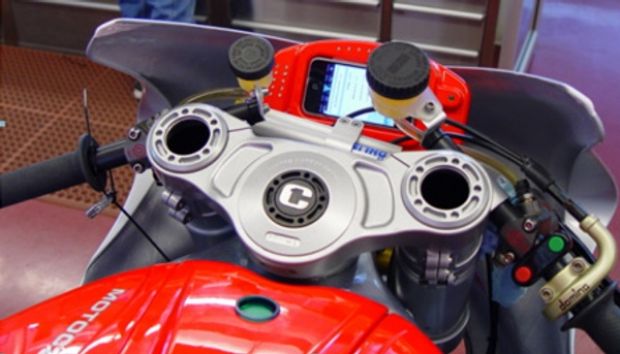
Something that’s turned up a couple of times recently, is using an iPhone as a brain for some sort of other, slightly bigger thing, that’s got absolutely nothing to do with telephones.

eg: this electric superbike… which uses one as a dashboard.

iphone1

(from : via)

I can see this happening more and more – rather than having a computer with lots of “plug and play” devices, you have a lot of devices and one computer/smart-stick etc that plugs into them.

iPhones are a bit different though – because they have eyes, ears, a sense of balance, a sense of location… a screen, an input device, web-enabled, sms-capable etc etc etc. It’s not just an extension of a brain, it’s an extension of a load of different human senses as well… though not as good as the real ones. Yet.

I can see this coming from the other end, and being a competitor for arduino actually. The potential of it is massive. Seriously… but iPhones are tethered, and they’re not open-source… and the future is open-sourced. So um… Android it is.

Smart Carpets

From www.elisastrozyk.de

wood1

Wooden carpets/rugs etc. Not dissimilar in mechanics to the little robot thing I was going on about over here.

wood2
(via)

Quite good really – that’s got to be incredibly useful for something. Other than rugs I mean. Reminds me a bit of this thing I saw the other day being developed by DARPA

wood4
(from)

Programmable matter etc. Intel had something to do with it as well.

New Slang : The Unfolding Grammar of Emergent Techs

I think maybe we just haven’t learned to walk yet.

We now have these things like laser-cutters, 3D printers (well, almost) and a rapidly advancing miscellany of tech wizardry, but we’ve been watching television for the last 40 years, and even if we hadn’t been – materials and techniques have their own traits that you don’t find out about until you play with the stuff. Materials have their own languages – and laser-cutting in a way, creates new types of materials. Acrylic that you cut with a laser is qualitatively different from acrylic you cut with a saw.

And that’s why I like these:

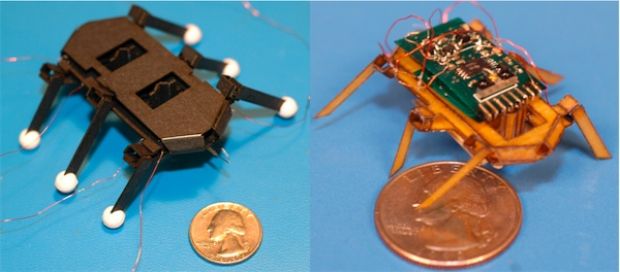
bugs1

(via)

Not because they’re another hexapod variant, not because the instructions / plans etc are posted as part of the artefact, not because as an internet inhabitant, they’re not bound to any specific address but live in a number of different places

Although I like all of these things as well – I mainly like this thing because it details a quick easy way of making hinges using a carboard-plastic lasercut composite.

A new piece of DIY grammar in other words – a new little building block that other people can use elsewhere. I used to be paranoid about accidentally being transported back in time to the 13th century, and not being any… use… because although I’ve spent my life surrounded by all this technology, I don’t know how to make any of it. Well I think we’re moving into an era where we (kindof) know how to make things again. I have a feeling we may be moving into a state where we can do things for ourselves – because it takes less time to supply our own needs than it does to work in the old-economy, and our quality of life is better. Arduinos and Gardening.

We’re still not there yet with robotic micro-muscles… but hinges? That’s a little step forward I think. One tiny step for Man, one mighty leap for Antbotkind.

There’s this thing from Lady Ada as well :

It’s still simple, but it’s more clever and complex than the bulk of the other laser-cut stuff, which is primarily ( to these jaundiced eyes) about making trendy shapes. I think there are more building blocks to come – that thing with the flying penguins for example, was an example of a set of simple techniques that could be applied elsewhere.

I think there are whole new languages that we need to learn for mass-fabrication to get underway. And when it does, it won’t be about making things we already have, it will be about making things we haven’t actually thought of yet… because we don’t learn the grammar until we play with the stuff.

To thine own materials be true, in other words.

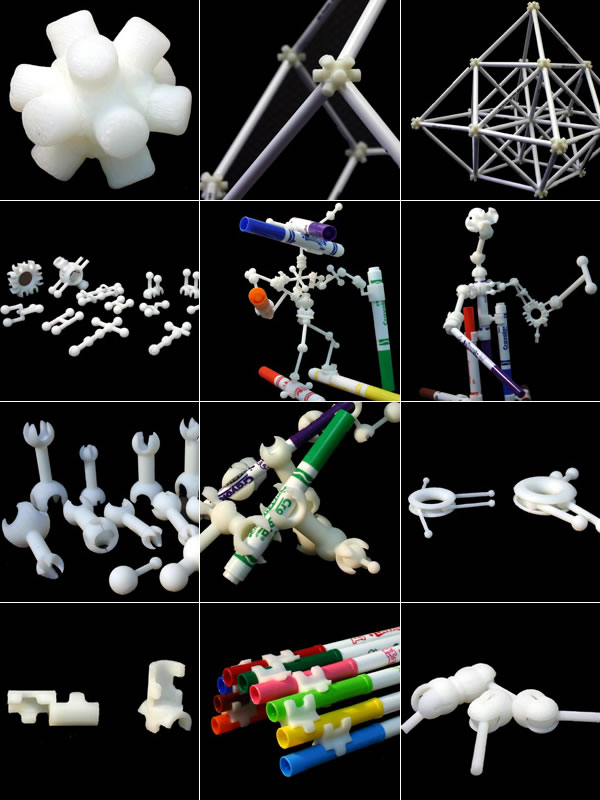
3D Pen Connectors : Consumable product life-extension

I think this is a fantastic idea

connectors

3D printed joints that turn old pens into lego-esque constructor kits… there are all sorts – from ball and socket, to side-by-side wall building to geodesic dome building.

I think eventually these would be better mass-produced via some sort of injection moulding, but as a basic concept they’re spot on – especially as old pens are tubes, which offers scope for mechanisation, wiring etc.

This is not an entirely new idea – I had a set of connectors for drinking straws a bit like this when I was a kid – and Look and Learn Magazine had “build things out of old pens” competitions back in the 70s. This particular project takes this to a whole new level though… and as so many people are now making robot, it potentially has a much wider relevance.

As an aside, the site that this comes from is also a classic case of a breach of Emergent Morality #3 – which is concerned with naming and addressing content. They’ve wrapped everything up in a flash file which means that the people who love the idea enough to evangelise about it (and work on their behalf for free) are effectively hobbled. I actually had to sit there and take screen grabs of the flash animation to create the image above. I couldn’t be bothered re-typing their text for them. This is still effectively neutered. You can’t search it, and it’s difficult to cite.

But the image above is a now a linkable resource. I’ve spent about 1/2 an hour working for them for free to increase the visibility of their project – and allow others who also think this is an inspiring project to propagate the idea.

This is illegal, and according to the old-economy morality, evil.

But the entire old-economy is itself evil, and I think this idea is brilliant, so I’m doing what I know is morally right. I’m sharing it.

This is what we do.

Two more Holy Crap moments courtesy of Google

My reptile brain holds the following pieces of information about google

  • Good search innit? You can find anything
  • Didn’t they buy a wifi station or something?
  • Their server farms use 5% of the earth’s electricity

I know they’re useful, big… and over there somewhere —->

Actually they’re everywhere. They’re the face of the internet . That old maxim “anything too big to fail is too big to exist” certainly holds true with Google. This is what the end of the world looks like:

googlegone

Google have integrated themselves far more tightly with the fabric/structure of the internet than Microsoft have done with desktop PCs – it’s become a part of our brain-architecture. The same way that cellphones mean we don’t need to remember phone numbers any more, we’ve gotten kindof used to the idea that we can find a pretty good shot at the answer to any question, pretty much all the time.

But anyway, the reptile part of my brain still thinks of Google as a text box in the middle of a page… so every once in a while I come across something that makes me go “Holy crap, they can do that?” – and there have been a couple recently

1) Similar Image Search.

google-similar-images1 (clocks)

Can this do facial recognition (which has serious social/privacy ramifications)? Maybe not, but it’s step on the way. Maybe. I’m not sure how they’re doing this… it isn’t purely image-similarity… if you look at rep-rap similar images you tend to get a lot of pictures of Charles Darwin (the name of the orginal Reprap being Darwin) so there’s something other than pattern recognition going on there. Still… it’s fairly impressive

google-similar-images1 (Jennifer Connollys)

I mean this one isn’t just returning images of Conifer Jennily – it’s getting those, but also focusing on the mood of the picture (only movies) – so there’s also Blade-Runner, Train-Spotting, Star-Wars, Phenomena (which has Jennifer Connolly, but she’s not in the photo) and Alien vs Predator (the page title being Aliens vs. Predator – Requiem: ‘Predator Arrival’)… and the first JC photo is from Reqium for a Dream (hence the Trainspotting link: Heroin)… so in addition to image-recognition smarts, there’s also word-linking smarts. And they’re smart smarts.

2) And the other thing is this O3D:

A 3D rendering plugin for browsers… which would be even more impressive if I could get the fucking thing to work, but my graphics card (on a 1 year old Toshiba Laptop) isn’t supported, so that’s that. What this is, is a memosphere. And Every Single Web 2.0 App That Ever Succeeded Was A Memosphere.

So anyway – looking at these caused me to look into what else google are doing in the app-space – there’s a hell of a lot… they seem to be able to do all this stuff by stealth. I mean the video above is on Youtube that they own – which in its 4 years of existence has become the second biggest search engine on the web… and I think it is (semi) single-handedly changing the way people watch television. That’s ~ 200,000,000,000 (us: pop~ 300,000,000) brain-hours a year, that’s now doing something slightly/profoundly different.

Google. Privately owned. Can you imagine it working if it was publicly owned? Nope. Can you imagine it working if it’s decisions came under the democratic control of its stake-holders? Nope. Is it a law unto itself, and can do whatever it wants without fear of some sort of embarrassing backlash? Nope. Not yet anyway.

Still, I can remember when Yahoo was “the only” search engine, and now they seem to be constantly under threat of being bought by Microsoft.

Nothing lasts forever but the earth and sky, man.

Wall Climbing Robots Evolve

(from : via)

wallclimbing

I’m not sure that this technique is a goer in the long-term – unless they can have some sort of self-cleaning mechanism… but I like the designs… a lot lighter and more elegant than their predecessors… interesting to see a tail becoming a regular feature as well.

(previous machine generations)

Missing Links

In some ways things are easy to predict… we’re just waiting for pieces of the jigsaw to turn up.

Robot muscles for example. I’m pretty sure that servos aren’t the way to go, although they’re dominating things at the moment. Robert Full went on about designing from nature a while back… noting that most organisms legs were basically feet on springy sticks.

“the control algorithms are embedded in the form of the animal itself.

Compare and contrast… “the world’s fastest” hexapod based on servos compared with The Stanford Sprawl machine, that uses springy legs

(from : via)

The worlds fastest hexapod is a LOT faster than the others – and pretty clever – but it’s still considerably slower than the considerably less clever model…

… and it’s all down to the muscles. A missing link in robotics is muscles. I went on about air-muscles a while back… and pneumatics is pretty interesting because it does all clip together like lego… but compressors are too big at the moment.

So anyway. There it is – missing links. Other missing links that I can think of off the top of my head – that we are creeping towards slowly:

  • fast-charging, long storing, more efficient batteries
  • pennies per watt solar electric
  • cheap and easy oil from algae extraction
  • smooth 3D printing
  • Direct to retina screens
  • a brain -> machine link

etc etc. A bit like flat screens ( the thing you’re probably looking at right now)… classic “Are We There Yet” technology that’s predicted decades in advance and takes an eternity to turn up… but when it does (as predicted) it changes everything.

Another useful cruise-missile-for-the-people component

And useful for a million other things besides I suspect

It’s got a direction cosine estimator algorithm in it. Mmmm… Marvellous. This apparently means it doesn’t need to be hooked up to a larger brain to tell which way up it is.

We’re moving into a world that’s being shaped by people doing things that the vast majority of the human population not only don’t understand, but can’t even spell.

Smart Dew : Networked Micro-Sensors

This is what I keep going on about… as though it hasn’t been invented yet:

smartdew

Networked micro-sensors which at 17p a go, is cheap enough (almost) to scatter them like confetti.

Only it’s not really cheap enough to scatter them like confetti – these need to be printable I think… and maybe shrunk even further – and the main thrust of this particular development is “security”, which is for people terrified of other people taking their stuff. Security is a state of mind… and the more you obsess about it, the less secure you feel. Security is a self-defeating prophecy. Yea, we need it to a degree, but to focus all this innovative power on it is a fucking waste.

The potential of these things is huge though I think… not for security but for environmental monitoring, farming, smart-building etc etc.

Silent Running Revisted

One of my favourite concepts: “in the end, everything comes true… but not usually in the way you expect”


(from physorg : via botjunkie)

Looks like the droids off the end of Silent Running have finally come to life, as it were… along with one of my other favourite concepts “In the future, every tree will have its own gardener“… though to be honest, from the look of it, the plants might be better off just being put outside somewhere and left alone.

As far as pollination goes… don’t scoff, when I was a kid, one of the chore-type things we used to have to do was to manually pollinate passionfruit vines… we’d get a little paintbrush and transfer pollen from on flower to another. Mai god, what a tedious job that was. Small price to pay for passionfruit though I suppose. If you can get your kids to do it.

(edit)

Looking at this again I feel kindof overwhelmed about what an incredible long way we’ve got to go… until I realise how incredibly fast this is moving.

By the way, are these things basically just Roombas with laptops stuck on the back of them?

(edit edit)

And the other thing of course is, I know damn well that somewhere down the line someone will discover that looking after plants works better than prozac… so long as you keep away from the back-breaking industrial scale stuff.

An ode to Cognitive Surplus.

A celebration of the inventive backwaters of the human spirit... a celebration of people who would appear to have far too much time on their hands...


A celebration of laterality.


If you come they will build it.


By knowledge shall the spheres be filled.


Golden Mean Calipers