GENOMICONrss

rss

The Crowd-Sourcing of Intelligent-Design

3D printing

The Makin Shit Movement: Update #n

Ok, this is a scattered collection of stuff kindof loosely involved with… DIY.

There’s a point to all this somewhere, but I don’t know what it is… so I guess it’s just a snapshot of various things I’ve tangled with recently.

1) Ironbuds.

I used to spend about $20 on earphones a month because they’re made out of the flimsiest shit in the world… then I tried the $50 because I thought they might be stronger… they weren’t but sounded so much better than my monthly earphone bill is now $50.

Why? Because the manufacturers operate as a cartel, not competing on robustness… inbuilt obsolescence. Now, we all know how these things should be designed – they should be modular so if one bit breaks, you only replace one bit, not the whole thing. But they don’t do it… because they’re about leaching maximum $ while providing minimum value, because that’s what corporations do.

Enter Kickstarter… and Ironbuds. Stupid “splash” photo, great, necessary and cartel-busting idea. Investing in this costs less than buying a new set of earbuds. Bargain.

earbuds

I’m starting to use kickstarter technology as a bit of a shopping-outlet… because I really like the idea of product design optimised for people actually using the product… rather than optimised for extracting money.

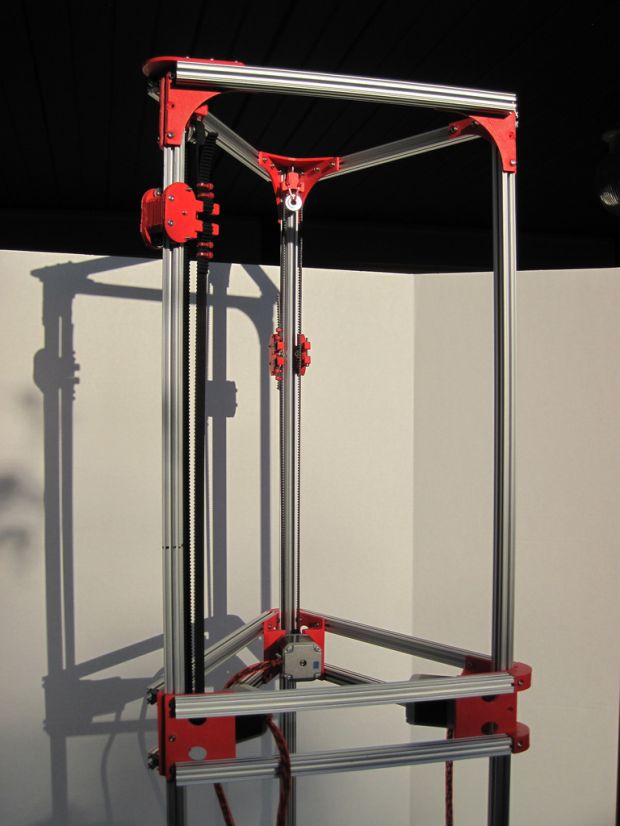
2) Reprap variant that doesn’t use threaded rod

And it’s got a Sarrus Linkage for the up/down bit… which is cool. Looks a bit like the terrible stuff they sell in $2 shops, but the vitamin parts are slowly dwindling. Incremental (decremental) innovation… but I’m a quantum kind of guy. As I keep saying, I’m still looking for real-time-sensory calibration… and something that looks a bit like this…

3) Trobot

Little desk-top 6-axis robot, that is controlled using grown-up robot software. Needs to be a bit more robust and non-wobbly than this version, but I think this is what CNC/repraps should look like.

4) There are a couple of DIY CNC devices on Kickstarter actually…

MY DIY CNC : Little machine that costs about $600… holds a dremel, does CNC with it. Can also hold a laser… there’s a video with it using a little 1kw one… etching only. I don’t need etching, I need something that will cut steel.

Cool though… getting there.

Another variant, also on kickstarter, also massively successful in terms of funding.

cnc2

Quick CNC.

5) I’ve started playing with online shops and the one I wound up with is this:

Has the easiest to use CAD software I’ve ever seen – which isn’t saying much, because they are ALL incredibly hard to use. I’ve started playing with Autodesk 123D – which is a free-download thing… which looks reasonably comprehensive (and by that I mean 1.5GB)… but like all CAD software, is really hard and unintuitive to use. You’ll spend hours just trying to select faces or objects. You want to copy and paste an object? It’ll take an hour, and in the end you’ll give up. We know how graphics software is supposed to work… it’s like photoshop or gimp or fireworks… CAD software is just wrong.

Anyway, eMachineShop is the easiest I’ve seen…. and it checks the integrity for you… you can choose the materials, and the finish… the process, and it will give you a quote directly from the download. This is the future. Make a design, choose your materials… get a quote and off it goes. What Ponoko does I guess… but a lot more comprehensive in terms of different manufacturing techniques.

And if you want to make a thumb-tack, it’ll cost you over a hundred dollars a go.

Fuck me this shit is expensive…

I tried that TinkerCad – online, in-a-browser software the other day…

… which is CAD software that has been so cut-down that getting anything done becomes a baffling intellectual exercise. After about 4 hours, I managed to make this

10 cm wide – costs about $50 on Shapeways… I guess because it’s solid… I thought that was extortionate. $50 for a piece of plastic with some holes drilled in it? I need it to be solid. I found this other 3d-print-on-demand place in Aus… and they were charging $200.

I don’t know… maybe I’m new here, but everything here seems to cost a LOT more than it should.

I think the 3D DIY design->execution thing has quite a long way to go. This stuff is still too expensive to experiment with… well, for me anyway. I guess people are doing it – but it’s not like lego where people can really play without it costing $50-$100 every time they want to try something.

I’m not sure about “The Maker Movement” actually… I have a feeling that it isn’t really to do with hardware at all… but is actually about blogging… and the fact that people need something to write about, and “people actually doing something” is more interesting that people who don’t… and the idea that “I could to that too” is inherently interesting to people.

I kindof think that that is what it might be about, rather than something that’s addressing any particular need. It’s still about “meta”. Information. Memetics.

Tiny 3D Printer

This is cool.

Some nerds from Austria have made this really small… commercial scale/cost 3D printer, and there’s some sort of prehistoric tree in the background.

Maybe they’re not nerds… looking closer at the big (really big) picture, there is “something of the hipster” about them. Am I being distracted by irrelevant details? I wonder how many things it’s possible to be distracted by at once. About 4 or 5 I would have thought.

Still… projected cost about 1200 eu – and 1/20mm resolution… using LEDs to harden the substrate… rather than lasers or extrusions or whatever. 1/20mm? that’s pretty impressive. That’s vertical resolution – I wonder what sideways resolution is. I think this is probably the way desktop machines are going to go though – if the resolution is going to be a function of light-focus and substrate granularity, then heated extrusion might be a bit of a blind-alley I think. I still think there needs to be a cutting tool though. Or a cutting machine.

Maybe a reprap isn’t a single device. Maybe it’s a nine-axis cutting tool AND a 3D printer. Symbiotes that make parts for each other.

Ok. 1200 EU. I think… that might be how much normal printers cost. I know you’re going to kick up a fuss and say no no no, mine only cost $100… but what is happening with your $100 printer is that the utterly extortionate cost of 1/2 filled printer-cartridges is subsidising the hardware. The printer-makers have slid into this model and now they need to do it to compete. So… if the substrate for 3D printers follows the same (entirely toxic) route of 2D printers… then 1200 is probably already at price-parity. We’re probably already there…. they just ain’t in the shops yet.

And the real money (and developmental potential) probably isn’t in the hardware, it’s probably in the ink.

3D Printed Flute

My

I’d kindof lost faith in this 3D stuff (the world is going to end before it can do anything useful) but I think I just had it restored again.

But don’t mind me, I can remember this when it was new

Which also had a flute in it etc.

Low Res 3D

Lovely

Endless from Dirk Vander Kooij on Vimeo.

VIA Ponoko

Plastic chairs made from ground up fridges

What I find interesting about this – is that it’s using a proper robot arm instead of a cartesian table – and I really think that this is the way forward… basically because it means that the robot can build things bigger than itself. It can build a wall around itself so no one can tell it what to do, and it can sit inside, happily humming to self, making LOL cats.

This is a second hand Chinese machine. At last, the Chinese are exporting their crap to the west. Because this is what their top imports from the US are:
imports

Speaking of which (kindof), the other thing is that it’s using chipped plastic rather than extruded plastic that comes on a massive cotton-reel thing. Chipped plastic cuts out a whole stage in raw-material preparation.

Now I’m a guy who sits on the sidelines heckling – not actually doing anything myself… so far be it from me to advise… but advise I do. There it is.

This is my back yard.

In other news,

virii

An acre of virus-infected tobacco can yield a ton of material that makes 10x better batteries than current technologies… as part of the long-time-coming, never-actually-getting-here biotech revolution that we hear so much about.

I Am The One, Kinectotron

Interactive Puppet Prototype with Xbox Kinect from Theo Watson on Vimeo.

I think Kinect is a new game or something from Microsoft – something to do with retards – I don’t really understand it – but then I didn’t understand Wii either, or guitar-hero, or those video games that tiny Japanese people dance on. I understand Space-Invaders. Space Invaders understand me. And we hate each other.

Anyway the Kinect hacks absolutely fucking rock – what it’s being used for (as far as I can tell) is 3D edge-recognition…


(from)

Engaget have started compiling a list of them

This one where they’ve fused it onto a roomba is pretty neat – reminds me of the Swedish roomba hack from earlier this year, where the roomba cruised around the room indexing your stuff so you could google it later, when you can’t fucking find stuff because someone’s taken it and I don’t know why they keep doing that. It’s not in the Roomba. I’ve checked. Jesus.

It took the open-sorcerers 3 hours to release drivers for it – and it’s into the wild.

Being a clairvoyant, I’d expect to see some sort of smart-phone, kinect hybrid at some point – probably as a phone accessory – unless the phones start getting bi-focal abilities… which is probably on the cards, assuming it’s not all tied down with future-damaging patents, which it probably is.

Speaking of which… here’s a video of a microcopter

MikroKopter – Version 0.80 from Holger Buss on Vimeo.

with a couple of fairly vital enhancements in the shape of “free-style-mode” and the camera stabilising thing… which is used here,

Hive Swimwear – Aerobot.com.au from Simon Jardine on Vimeo.

taking videos of bikini-wearing models, who are doing what bikini-wearing models do best, which is hang out at the beach.

In addition to that is a 3D printed quadracopter.

Mostly consisting of vitamin parts, granted, but there is this growing tendency for hardware problems to become software problems – and software is an vibrant and insane pscycho-ecosystem of evolution. It’s like the amazon on weird fast drugs – all the drugs that probably grow in the amazon that it deliberately takes to make it weirder and faster than it already was. Software is the only ecosystem I know of that is consciously speeding itself up.

Anyway, I was talking to Josh the other day (or at him. He didn’t reply), and had this minor vision of an internet where devices could communicate via anything that vibrations could travel through – like tapping on pipes. They could lip-read Hal-like across the room. They could flash LEDs at each other, or ping each other with radio-waves etc etc… for international speed, obviously the fastest way would still be centrally owned (and controlled by scarcity-head) pipelines… but the internet of things could well be a massive, ever-adapting mesh network that absolutely no one could censor or control – which is vital I think, the work-ethic of evil being what it is. The internet is too important for it to be controlled by anything inherently disposed towards dishonesty as governments or corporations.

And further to that… really cheap wifi-routing robots – probably microcopters, that charge up in the sun, the fly off to the point of minimum coverage, while still being part of a link… avoiding each other like electrons, or strangers sitting next to each other on the bus.

This kinect thing possibly takes that idea further – robots that can do what google-street-view does but in real-time. Would we want that? Christ no. We could do it though – that thing I was on about earlier about some Australian security firm making a real-time 3D model of a dock or something – that you could virtually fly-through, just got a whole lot closer. War and tourism. And games. War and tourism becoming even more gamelike than they already are.

It would be fantastic for autonomous bio-monitoring (which actually is a good idea). A while back someone at TED talked about doing this with cellphones – but spacially aware cheapo-copters might do it better – and if they were mesh-networked, it would be like The Universal mind acquiring a sensory organ not a million miles away from a skin – a planet-wide sense of touch.

Next Week: Robot on Robot predation. It started with the greed-heads trying to control the mesh, but wound up biting their arses all the way back to the Pleistocene.

Ponoko does 3D

materials

So that’s totally k for cool. Will definitely have to have a play with that at some point – largely for creating DSLR camera parts which are otherwise extortionately priced. It just so happens that I have a little project on the go right now, which could do with some 3D stuff.

The big stick-in-the-mud (for me, now) is turnaround time. It used to be postage-costs, but for some reason I don’t notice those anymore. Maybe they’ve changed… but in engineering circles, it seems that turnaround seems to be a minimum of 10 days… this is too slow. It’s quicker to use bits of wood and aluminum in your own basement… and the “rapid”-fabrication part of the prototyping process is used for later iterations… so it’s not quite as straightforward as “design on laptop-> get it made“. It’s more like “get the physics and geometry sorted out with stuff you have to hand->tidy design in laptop -> get it made“.

Then -> release for sale on the web -> if something sells (most things don’t) get a traditional non-web company to make it in bulk. Maybe that could be Ponoko’s next step – connecting with manufacturing geniuses in China.

Anyway – as far as laser-cutting goes, Ponoko’s pricing model works well for some things, not for others – to be specific, they charge by the time that the laser sits on the page – so fast things like plastic, wood, cardboard: good ; things like metal: NSG. It’ll be interesting to see how pricing pans out for 3D stuff.

Totally cool about model they’ve developed though – the distributed manufacturing all coming through a single-hub thing. They do seem to be several steps ahead – focusing on big-picture stuff. I can’t wait for their first DMCA takedown notice… which I guess will create a killer-niche for a dark-web of manufacturing. A shadow-web of fabbers who will make whatever you like, and people who think that “Intellectual Property” has any basis in reality, can go fuck themselves.

Ignoring that for the mo – I saw that someone recently hacked a laser into a makerbot… with a photo that… um… how come you can see the laser from the side?

laserbot

Whatever – seems to work… although the laser isn’t strong enough to do anything terribly useful. I’ve long opined that this needs to be a way for repraps to go… the ability to cut as well as build.

On the Outside

So obviously as soon as I wrote that, I get this stuck in my head

Which has absolutely nothing to do with what I’m about to write, but… I suspect it might actually be quite a good song in a funny sort of way.

Still, never mind about that. This is about printers

Being a repstrap variant – $1500 and closing…

So.

They year is 1996, email has been invented and the web is just starting to go mainstream. In those days I wore a tie…

… and one day, I had the job of installing a brand new Apple colour-printer. Nobody had ever seen one before. I took it out of its box (it was about 80cm cubed… lifted it up onto a desk, plugged it in… and it didn’t go.

It turns out that simply taking it out of the box without being a certified apple engineer voided the warranty. It had little resevoirs of ink inside it, and if the whole thing tilted, they spilled and fucked up the whole thing. It was a great big opaque box, and I broke it.

So anyway. Assuming (and I think it’s fairly safe to assume) that 3D printers are at a similar stage of evolution as colour printers 15 years ago… I think it’s quite interesting that all the tech is on the outside. There are the expensoid machines of course, and nobody knows about those… but the ones that are really catching people’s imaginations are… transparent.

And I’m not sure that this isn’t entirely down to the vision of the original reprap guy… although in some ways I guess open-source versions of everything are more or less inevitable. It’s interesting to see something that has transparency as one of its core founding principles right from the outset.

Something you really notice when you go from Windows to Ubuntu – how constrained and ugly the windows software universe is. Everything carries a veiled threat (aka a EULA)… there’s money everywhere, cramping and pinching. With linux it feels like your computer is less of a walled garden – and something that belongs out there on the web. The barriers are down. This is where the future is – it just feels better. If we manage to pull off the same thing with hardware it will be way cool. We just need to find a way of fucking off the Finance/Insurance/Real-Estate industries… and we’ll be able to look after ourselves.

Mind you – I bought some of these off the web a couple of days ago…

skatewheels

… to make a little camera dolly. $7.50 a pair… $7.50 NZ… which makes them $2.70 USD each.

It turns out that when you spin them, coloured LEDs light up inside them… so there’s no just these cool rubbery nylon wheels, with bearings, but a little generator circuit and 3 LEDs.

How the fuck do you make that for $2.70?

I mean it’s all very well going on about the potential power of 3D printers and whatnot – but… are these wheels ALL built with slave-labour? Can’t see it. It could just be that a revolution in roboticised manufacturing – at the high-to-middle end, completely eclipses the DIY thing.

Printing advances…

When I worked in IT support for E&Y in London in 1996… we received this package one day on it’s own specially built little wooden pallet. A COLOUR PRINTER!

From Apple. I unwrapped it, hefted it up onto a desk (it was about 80cm cubed, 20kg), plugged it in, and it didn’t go.

It didn’t go and it didn’t go and it didn’t go and it didn’t go.

Eventually we rang the hardware guru guy (who was so cool he wore a bow-tie (proper ties dangle in the wires etc)) and he told us that we’d voided the warranty just by taking it out of the box (only certified engineers were allowed to do this) and the reason it didn’t work was that there was a little tray of inks inside, and if they were tilted, they’d spill. He saved the day. He always did. It went.

That was my first colour printer – it cost something insane like 80 thousand quid, and the only thing it was ever used for was printing test-prints… little WWII british airplane insignias (the size of pennies) like the mods used to wear. I’ve probably still got them somewhere.

So…

Today we (humans) just printed a glass ring. A tiny step for mankind etc.

From the same source… apparently full colour 3D printing is now commercially available.

It’s creeping closer… I’ve always been a little skeptical – there is such a gulf between what is imagined and what is currently doable… but it is getting closer.

Apparently the $750 makerbots – the hobbyist level reprap style printers from… Makerbot are bringing in just under $120,000 a month which is… a lot. Is it? Seems like a lot, but then again, it’s only 5 a day and it’s not hard to imagine them going way above that… and the funny thing is, that I haven’t seen these things print anything remotely useful. The best has been salt shakers… which were kind of neat, but I’m also not sure that they aren’t way off the kitschometer as well.

Still, back to the colour printer at the beginning – that’s kindof where we’re at now I think. It took about 5 years to go from the 80,000 pound monolyth, to a flakey little box in my living room that cost less than its ink cartridges.

2015 then.

Quantum leaps in 3D printing

I have foggy memories of once saying (ie: about 3 weeks ago) that a missing-link tech-wise, was the ability to 3D-print shiny objects… to the same level of quality as injection moulding.

Looks like this lot can:

And not only that, they’ve figured out a way of making composite materials by combining two different materials at a pixel by pixel level. It may actually now be possible to print something as simple, as complex and as useful as… a toothbrush say. You couldn’t before.

There’s a variety of materials described here.

This is achieved by printing 16 micron thick (or thin, depending on your POV) layers, and can, apparently, produce fairly impressive objects

syringe1

No prices for these things seem to be mentioned anywhere… and this generally means that the prices are so extreme… that they’re actually quite dangerous to say out loud… lest the gods be offended etc. Even writing them down is risky.

And as I supposed earlier, at a large (ie: consumer) scale, 3D printing doesn’t solve a manufacturing problem, it solves a distribution problem. And that means poor people. And that means having a machine who’s pricing structure doesn’t offend the laws of thermodynamics.

Reprap state of play : mid 2009

reprap1

A nice rundown of a go-to-whoa reprap printing.

A nice overview of what’s involved, how long it takes, the cock-up ratio etc etc. Still a way to go methinks – a daunting number of vitamin parts… but I think it’s fair to say that Adrian Bower’s forebodings that “91.923% of academic research projects fail” can be laid to rest. It’s underway. It’s happening.

An ode to Cognitive Surplus.

A celebration of the inventive backwaters of the human spirit... a celebration of people who would appear to have far too much time on their hands...


A celebration of laterality.


If you come they will build it.


By knowledge shall the spheres be filled.


Golden Mean Calipers